


Collector's Guides
Andy Warhol Prints: A Collector’s Guide to the Series and What They Cost
Andy Warhol didn’t just paint pop culture; he mass-produced it, and that’s exactly what makes his print portfolios some of the most collected works in the market today.
Few artists reshaped what counts as fine art quite like Andy Warhol, who took supermarket products and tabloid faces and turned them into some of the most recognized images of the last hundred years.
Andy Warhol prints remain the entry point for many collectors stepping into the Pop Art market for the first time.
Warhol was born Andrew Warhola in Pittsburgh and studied at the Carnegie Institute of Technology before moving to New York, where he first worked as a commercial illustrator.
That early training in commercial art shaped the bold repetition that later defined his prints, and it's a big part of why the Pop Art movement still credits him as its defining American artist. Much of the print work covered here came from The Factory, his New York studio, and was produced alongside his film and video projects.
If you are considering Andy Warhol prints, the real work is choosing the right series, edition, and price for the piece you want to own. This guide walks you through Warhol's major print series, what makes each one distinct, and how to think through the details that matter before you decide.
The Lasting Appeal of Andy Warhol Prints
Andy Warhol's screenprints are some of the most collected prints in the world. He worked in series, revisiting subjects like Marilyn Monroe, Campbell's Soup cans, and Mao Zedong again and again, each time with different colors and details.
That approach lets collectors choose both a subject and a specific moment within its story, which is part of what makes building a Warhol collection so engaging.
Prices span a wide range, from a few thousand dollars for smaller or later editions to well into six figures for rare, sought-after prints. That range is good news for a new collector: there's a starting point at almost any budget, and no single "right" print to begin with.
What ties the whole market together is staying power. Warhol's prints have held collector interest for decades, largely because the images themselves, drawn from pop culture and everyday consumer life, remain instantly recognizable and endlessly relevant.
Warhol's own observation that everyone gets fifteen minutes of fame helps explain why he kept returning to faces and products the public already knew by heart. That's part of why galleries and auction houses continue to feature his work prominently, and why it's a reasonable category to start learning if you're building a collection for the first time.
The sections below cover some of the major series one at a time, so you can get a feel for what makes each one distinct before deciding where to start.
Marilyn Monroe: The Image That Set Warhol's Prices
Warhol's Marilyn Monroe portraits came from a 1953 publicity photo for the film Niagara. The image became his most recognized work within a year of Monroe's death in 1962. Five years later, in 1967, he issued Marilyn Monroe as a portfolio of ten screenprints, each rendered in a different color combination.
Prices in that portfolio vary by color, condition, and how a given sheet has traded at auction over the decades. Individual prints from the portfolio typically trade between $150,000 and $350,000, depending on colorway, signature, and condition.
A collector comparing Marilyn prints should check the color variant, whether the sheet carries a signature or an Andy Warhol Foundation stamp, and its documented exhibition or auction history.
Marilyn I (Announcement)
See it in our collection
Flowers: Warhol's Most Reproduced Image
Flowers began in 1964 as a set of paintings based on a photograph of hibiscus blossoms published in a photography magazine. Warhol issued the image across several print runs over the following decade. That history is why "Flowers" covers more ground than any other series in his catalog.
The 1964 originals sell for around $70,000. A 1970 run of Flowers screenprints trades between $40,000 and $125,000, depending on colorway and condition, and black-and-white or hand colored variants from later in the decade often sell for $18,000 to $28,000.
Newer collectors sometimes assume every Flowers print sells at a similar price, since the image looks the same across variants. The print run, the color treatment, and the edition size behind each sheet tell a different story. That story is what sets the price.
Flowers (1964)
See it in our collection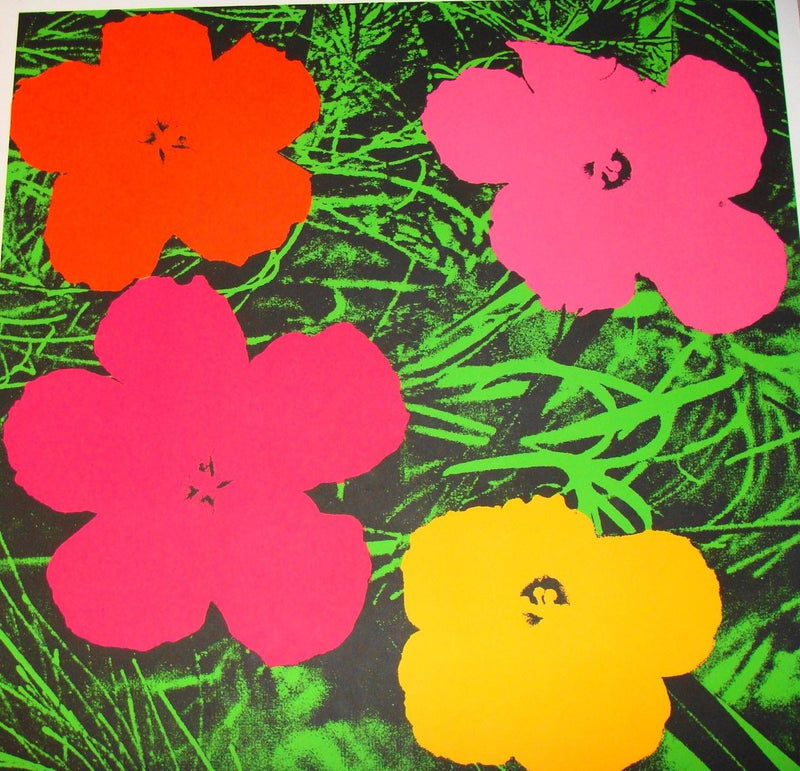
Campbell's Soup: The Image That Started It All
Warhol painted 32 individual Campbell's Soup Cans in 1962, and the piece became shorthand for Pop Art within a couple of years. Later in the decade, he returned to the image with two related portfolios: Campbell's Soup I in 1968 and Campbell's Soup II in 1969, each a set of ten screenprints showing a different flavor label in its own color palette.
Individual prints from both portfolios trade between $45,000 and $95,000, with less common flavors like Tomato-Beef Noodle O's toward the lower end. The gap comes down to how often a given flavor turns up on the secondary market and how collectors have ranked the flavors by cultural recognition over time.
Choosing a flavor here comes down to personal taste, since the image itself carries the same production quality across the set.
Campbell's Soup Cans (1969)
See it in our collection
Mao: Warhol's Most Politically Charged Series
Following President Nixon's 1972 visit to China, Warhol turned to a state portrait of Chairman Mao Zedong for a new body of paintings and prints. The Mao print series shipped as a suite of ten screenprints, each using a different color treatment on the same official portrait.
The full suite has historically sold at auction for $700,000 to $1.5 million. Individual prints from the set trade between $50,000 and $100,000 each, depending on color variant and condition. A Mao Wallpaper edition, printed in a repeating pattern rather than a single portrait, offers a lower entry point, typically well under $50,000.
Collectors chasing the full political statement behind this series tend to pursue the complete suite. Those drawn to one color treatment, or working with a smaller budget, often start with a single print from the set.
Mao (1972)
See it in our collection
Mick Jagger: Warhol's Collaboration With a Rock Icon
Warhol and Mick Jagger worked together on this 1975 portfolio, a ten-print series that mixed collage, drawing, and screenprint techniques across each sheet. The collaboration gave Jagger unusual say over his own image, which helps explain why this series reads differently from Warhol's other celebrity portraits.
Individual prints range from about $50,000 to $300,000 depending on the color combination and print condition, with a handful of sheets commanding a premium for vivid color work. A signed exhibition poster and an invitation portfolio from the same period offer lower-priced entry points into the same body of work, starting around $6,500.
Cow: The Print Warhol Designed for a Wall, Not a Frame
Cow Wallpaper began in 1966 as a literal wallpaper design, meant to cover gallery walls rather than hang as a single framed piece. Warhol printed it in a bright pink-and-yellow palette that became one of his most recognizable patterns outside his celebrity portraits.
Signed, numbered Cow prints have sold at auction anywhere from $20,000 to $70,000, while the original wallpaper roll format trades toward the lower end of that band. The format changes both the presentation and the price, so confirm which one you're buying before you commit.
Cow (1966)
See it in our collection
Endangered Species: Warhol's Environmental Statement
Released in 1983, the Endangered Species series paired Warhol's signature screenprint style with a genuine conservation message. Ten animals under threat of extinction appear across the series, including the Siberian tiger, the giant panda, and the San Francisco silverspot butterfly. The series marked one of the few times Warhol connected his work to a cause outside pop culture and celebrity.
Prices across the ten animals generally range from $100,000 to $250,000 depending on subject and condition, with a few, like the Siberian tiger, sometimes running higher. Demand for each image, shaped by color and composition, decides the price more than the animal's rarity in the wild.
Endangered Species (1983)
See it in our collection
What to Check Before You Buy Andy Warhol Prints
A few details separate a confident purchase from a costly mistake, no matter which series you're considering.
- Confirm the edition number and the total run size printed for that image and color variant.
- Ask whether the print carries a hand signature, an Andy Warhol Foundation stamp, or neither, since each status affects authenticity confidence and resale value.
- Request the provenance history, including prior sales, exhibitions, and any certificates of authenticity issued with the piece.
- Compare the asking price against recent auction results for the same catalog number, not just the series overall.
- Check whether the sheet is printed on paper or museum board, since Warhol's studio used both across different series and the material affects framing and long-term value.
At Premier Pop Art, we document each of these details for every Warhol print in our collection and help buyers with financing for larger purchases. That level of documentation is worth asking for on any piece, wherever you buy it.
Start With the Series That Speaks to You
Warhol built his print career on repetition and mass production, yet where you start depends on what draws you in. If cultural weight is the pull, Marilyn Monroe and Mao are the obvious entry points. If it's color and pattern, Flowers and Cow reward that closer look. And if you want a piece that carries a cause beyond the image itself, Endangered Species gives you that too.
Have a series in mind, or still weighing your options? Reach out to our team, and we'll help you find the right print, at the right price, to start your collection.
FAQs: Andy Warhol Prints
How much does an Andy Warhol print cost?
Prices for original Andy Warhol screenprints vary a lot, from around $6,000 for smaller invitation pieces to $350,000 or more for sought-after Marilyn Monroe or Mick Jagger portraits. Series, edition size, color variant, and signature status all factor into the final price. Many buyers find a comfortable entry point somewhere between $20,000 and $100,000, depending on the series.
What's the difference between an Andy Warhol painting and an Andy Warhol print?
Wondering why two Warhol pieces of the same image carry such different price tags? Warhol's paintings are unique, one-of-a-kind works, often the source image he later adapted into a print series. His prints are screenprint editions, produced in limited runs of signed or stamped sheets. Paintings tend to sell for far more than prints of the same image, given their singular status.
Which Andy Warhol print series is the most valuable?
The Mao suite of ten prints, which has traded for $700,000 to $1.5 million as a complete set, ranks among Warhol's highest-valued print series. Individual Marilyn Monroe and Mick Jagger prints also reach six-figure prices. Value depends a lot on the specific print, its color variant, and its condition within any given series.
How can you tell if an Andy Warhol print is authentic?
Look for a documented edition number, a signature or Andy Warhol Foundation stamp, and a clear provenance trail showing prior ownership, exhibition history, or auction records. Reputable dealers provide certificates of authenticity and can point to the print's catalog number in the Feldman and Schellmann catalog raisonné, the standard reference for Warhol's editioned prints.
Are Andy Warhol prints a good investment?
Warhol's print market showed real depth in 2024 and 2025, with a record 731 prints publicly sold in 2024 and similarly high transaction volume the following year, per Revolver Gallery and MyArtBroker data. Analysts note lower price volatility in Warhol's print market compared with artists like Banksy or Basquiat, the result of decades of steady auction activity. That gives collectors a well-documented, verifiable track record, though results naturally vary by series and edition.