




Collector's Guides
Jean-Michel Basquiat Paintings Through a Collector’s Eye
Behind the raw marks and urgent figures, each Basquiat painting carries a record of the world that shaped it and the choices that made it distinctive.
You can recognize a Basquiat in seconds. Understanding what you’re seeing takes longer. Words, crowns, figures, symbols, and text fragments collide across the canvas, creating a visual language that feels spontaneous yet carries layers of meaning.
That complexity is part of what makes Basquiat paintings so compelling to collectors. The longer you look, the more you find.
If you’re exploring Basquiat paintings, this guide looks at the influences behind his work, the details worth noticing, and the qualities that can make a particular painting stand out.
The New York Roots of Basquiat’s Art
Jean-Michel Basquiat was born in Brooklyn to a Haitian father and a Puerto Rican mother. He came of age as a Black American artist in New York City, where art, music, poetry, and street culture collided. The city became a cultural hotbed that shaped his development as a painter.
Several experiences became especially important to his artistic practice.
- Brooklyn and New York: Basquiat absorbed the energy of a city where downtown galleries existed alongside street art, clubs, music, and a rapidly changing cultural scene. The Lower East Side of Manhattan exposed him to visual references and cultural ideas that later appeared throughout his paintings.
- SAMO and Al Diaz: In the late 1970s, Basquiat and Al Diaz formed a graffiti duo known as SAMO. Working under the pseudonym SAMO, they covered Lower Manhattan with cryptic, poetic phrases. Their enigmatic epigrams combined wordplay, irony, and social commentary, establishing text as an important part of Basquiat’s creative vocabulary.
- The move into galleries: By the early 1980s, Basquiat was exhibiting in galleries and attracting dealers, collectors, and curators. The Times Square Show introduced his work to a wider audience, while his growing notoriety strengthened his place in New York’s contemporary art scene.
- A world of influences: Jazz, early hip-hop culture, punk, New Wave, anatomy, boxing, poetry, pop culture, and the Lower East Side all fed into Basquiat’s visual language. These references could sit together within a single composition, creating striking dichotomies between words, figures, symbols, and ideas.
- A visual language of his own: Basquiat brought drawing, writing, painting, and collage together on the same surface. His artistic practice addressed identity, power, race, culture, and wealth through raw marks, handwritten text, symbols, figures, and recurring imagery. This integration of different forms became central to his work.
Basquiat’s paintings also reflect tensions surrounding the Black community, poverty, segregation, and social power. His imagery could carry personal introspection alongside a wider contemporary critique of the world around him.
His surroundings mattered, too. The streets, buildings, music, and people of New York became part of the visual vocabulary he developed in his studio.
These influences give added context to familiar Basquiat motifs. A crown, anatomical reference, repeated word, or symbol can feel different when viewed alongside the artist’s life and cultural surroundings.
That mix of urgency and depth is central to Basquiat’s legacy. His paintings remain closely connected to the New York environment that shaped him, while their imagery continues to resonate decades after his death.
A Visual Language You Can Feel Before You Read It
Basquiat’s paintings can be recognizable at a glance, but there is no single formula behind them.
He moved between drawing, painting, collage, and writing, letting the forms overlap on the same surface. His approach later became associated with the Neo-expressionism movement, although his influences were much broader.
Several elements appear again and again:
- Figures and anatomy: Skeletal bodies, exposed bones, and anatomical references give many paintings a raw physicality. Some figures appear crowned or monumental. Others are fragmented, crossed out, or partly hidden.
- Words and language: Basquiat’s handwritten text belongs to the image itself. Words can be repeated, obscured, crossed out, or scattered across the canvas. His background as a poet is visible in the importance he gave language.
- Skulls and faces: Skull-like heads and expressive faces appear throughout his paintings. They can suggest vulnerability, mortality, confrontation, or something more ambiguous. A work such as View of Base of Skull (Anatomy) by Jean-Michel Basquiat offers a direct example of the anatomical imagery that became part of his visual vocabulary.
- Symbols and diagrams: Arrows, numbers, crowns, anatomical drawings, and diagram-like marks connect different parts of a composition. They can reference established systems of knowledge while questioning those same structures.
- Layered surfaces: Paint, oil stick, words, symbols, figures, and spray marks overlap across many compositions. The resulting surfaces can feel crowded, restless, and unresolved.
- Moments of restraint: Some paintings leave generous areas of open space around a figure, phrase, or gesture. These quieter compositions give individual marks room to carry more visual weight.
Drawing, writing, and painting often appear inseparable in Basquiat’s work.
A painting can reveal one connection at first glance and another after several minutes of looking. That sense of discovery is part of its lasting appeal.
View of Base of Skull (Anatomy) by Jean-Michel Basquiat
See it in our collection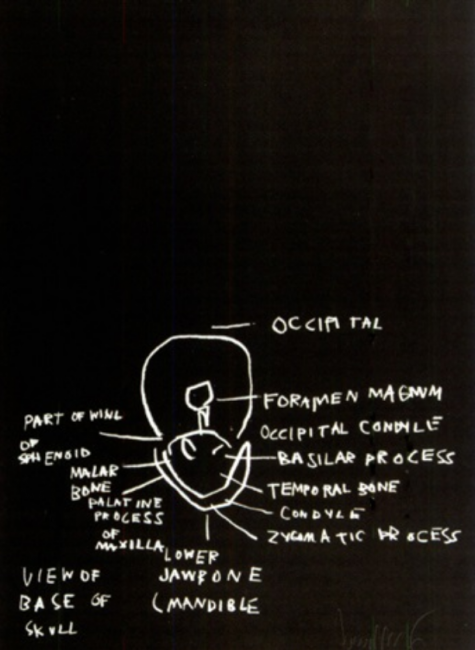
The Details That Set Basquiat Paintings Apart
For anyone searching for Basquiat paintings, the artist’s name is only the beginning. Every painting has its own physical presence, history, and visual character.
When comparing available works, pay attention to the details that distinguish one piece from another:
- Medium: Basquiat worked with acrylic, oil stick, and mixed media on canvas, as well as ink, marker, and collage on paper. Materials affect a painting's texture and presence.
- Size: Scale changes how a painting occupies a room and how closely a viewer engages with its marks. Size alone does not determine significance or value.
- Period: Basquiat’s visual language developed throughout his short career. The date of a painting provides useful context for its imagery, palette, and composition.
- Condition: Paint, oil stick, paper, and collage can respond differently to handling, light, and age. Review any available condition report before purchase.
- Provenance: A documented ownership history adds context and supports the process of evaluating an artwork.
- Documentation: Gallery records, certificates, previous ownership records, and other supporting materials can clarify a painting’s history.
- Rarity: Scarcity can contribute to collector interest. It makes more sense when considered alongside imagery, materials, history, and demand.
- Personal connection: Collectors respond to different parts of Basquiat’s language. One person may focus on poetry, another on figures and symbols, and another on his mark-making. The painting that holds your attention is worth examining closely.
For a closer look at how an individual work can be documented, Charles the First 1982 by Jean-Michel Basquiat provides an example with information about its medium, edition, Estate stamp, signature, publisher, and Certificate of Authenticity.
Charles the First 1982 by Jean-Michel Basquiat
See it in our collection
Basquiat Painting Prices and the Market Behind Them
A Basquiat painting price depends on several characteristics of the individual work.
Two paintings by the same artist can sell for very different amounts. Medium, size, career period, imagery, provenance, condition, and market interest all shape how collectors view a particular painting.
Collectors evaluating a work may consider:
- Medium and materials: Canvas, wood, paper, and mixed-media works have different physical and market characteristics.
- Scale: A monumental canvas can occupy a very different position in the market than a smaller work on paper.
- Career context: The date and circumstances surrounding a painting can affect how collectors understand its artistic importance.
- Subject matter: Figures, skulls, crowns, words, and symbols contribute to the visual and cultural character of individual paintings. No single motif guarantees a higher price.
- Provenance and records: A documented ownership history and relevant records provide important context.
- Exhibition and market history: Previous exhibitions, publications, and auction activity can contribute to a painting’s profile.
- Collector demand: Interest in Basquiat remains strong, though demand can vary significantly by work.
Prices also differ across paintings, drawings, and prints. A meaningful comparison looks at works with similar characteristics, rather than relying on a headline auction result.
A work such as Rome Pays Off 1982 by Jean-Michel Basquiat also illustrates why individual specifications matter. Its listing identifies the work as a screen print on Lenox museum board, with a stated edition of 85, a 44 × 40-inch format, a hand signature, and accompanying COA.
Rome Pays Off 1982 by Jean-Michel Basquiat
See it in our collection
Choosing a Basquiat Work for Your Collection
The distinction between an original painting and an original print matters when considering a Basquiat for a collection.
An original painting is a unique work created directly on a surface such as canvas, wood, or paper. An original print is produced through an authorized printmaking process and belongs to an edition or print production.
For collectors considering a Basquiat print, several details deserve attention:
- Printmaking medium: Identify how the work was produced and which materials were used.
- Edition size: The number of impressions provides context when considering scarcity.
- Signature: Confirm whether the specific work is signed. Not every example of a print will necessarily carry a signature.
- Printer and publisher: These details establish how and under whose direction the edition was produced.
- Year: The production date provides useful historical context.
- Documentation: Supporting records can clarify the characteristics and history of a specific print.
- Provenance: Ownership history adds another layer of information when it is available.
A signed Basquiat print is not automatically more valuable than an unsigned one. A signature alone does not establish authenticity. It is one detail within the larger picture.
Authenticity deserves careful attention. For a sought-after American artist such as Basquiat, collectors should examine the available evidence rather than rely on a single feature.
Catalog records, ownership history, supporting documentation, and, where applicable, Estate-related records can contribute to that evaluation.
For example, 50 Cent Piece by Jean-Michel Basquiat demonstrates why Estate-related documentation can be relevant when examining a posthumous edition. Its listing identifies the work as a screen print and notes signatures from Lisane Basquiat and Jeanine Heriveaux, the artist’s sisters and administrators of the Estate, along with a Certificate of Authenticity.
Collectors should also distinguish an authorized print from a reproduction or copy. The edition, production details, publisher, printer, documentation, and ownership history provide useful clues about what a particular piece represents.
50 Cent Piece by Jean-Michel Basquiat
See it in our collection
Finding the Right Basquiat Work for Your Collection
No universal formula exists for collecting Basquiat. The right choice depends on the collector, the artwork, and the space it will live in.
A few considerations can make the process easier:
- Starting small: A first-time collector may prefer a smaller work on paper that fits naturally into an existing space and provides an intimate connection to Basquiat’s hand and imagery.
- Comparing signature status: When choosing between signed and unsigned works, look at the edition, history, supporting records, and overall presentation alongside the signature.
- Choosing a statement piece: A large painting calls for attention to wall dimensions, viewing distance, composition, and the relationship between the painting and the surrounding room.
- Comparing two works: When several pieces are available, examine their imagery, scale, materials, history, and physical character. Differences often become clearer when you view the paintings side by side.
- Following personal response: Some collectors are drawn to Basquiat’s handwritten language and poetry. Others respond to figures, symbols, cultural references, or physical energy. Personal response can be a meaningful reason to keep looking at a particular piece.
A work such as Wolf Sausage by Jean-Michel Basquiat is another useful example of the details a collector can compare, including its format, dimensions, edition size, signature, condition, and documentation.
Basquiat’s name carries enormous weight, but the individual painting deserves the closest attention. Its marks, materials, history, and presence can reveal qualities that a price or auction record cannot capture.
Wolf Sausage by Jean-Michel Basquiat
See it in our collection
Take a Closer Look at a Basquiat Work
A Basquiat painting can hold your attention before you can name everything happening on the surface. A crown, phrase, anatomical reference, or layered mark may draw you in, while the medium, date, condition, provenance, and documentation reveal the work's significance. Premier Pop Art helps you assess those details when comparing a painting or beginning a Basquiat collection.
If a particular piece has stayed on your mind, share it with our team. We can help you review the information available, talk through what gives the work its character, and consider how it fits your collection, budget, and space. A closer conversation can turn an initial reaction into a confident next step.
FAQs: Basquiat Paintings
How much is a Basquiat painting worth?
Basquiat painting prices vary widely based on medium, size, date, subject matter, condition, provenance, and market history. His auction record provides useful context, but individual works differ substantially. Premier Pop Art presents available Basquiat artworks with information about each piece, helping collectors assess the qualities and market factors behind a particular work.
What should I look for when buying a Basquiat painting?
Focus on the painting’s medium, dimensions, date, condition, provenance, and documentation. Exhibition history and previous ownership add valuable context. When reviewing an available work, compare these details rather than relying on the artist’s name or a single visual feature. That approach gives you a clearer basis for deciding whether a particular piece fits your collection.
Are Basquiat prints original artworks?
Authorized Basquiat prints are original artworks produced through an established printmaking process, but they differ from unique paintings. Edition size, printer, publisher, production date, signature, provenance, and documentation all matter. The specific edition should always be identified clearly so collectors can distinguish an authorized print from a later reproduction or unrelated copy.
Are signed Basquiat works more valuable?
A signature adds important information to a Basquiat work, but it does not establish authenticity or determine value on its own. The edition, production details, provenance, condition, and market history also matter. A signed work should be considered as a complete object, with its documentation and physical characteristics examined alongside the signature.
Where can I find Basquiat paintings for sale?
Established galleries, dealers, auction houses, and specialist art platforms offer Basquiat paintings for sale. Premier Pop Art features available Basquiat artworks for collectors seeking works with clear information about their materials, history, condition, provenance, and documentation. Reviewing these details makes it easier to compare individual works and decide which one deserves a closer look.