


Prints & Editions
Picasso Prints:
Learn to See the Image Before You Collect It
Across a plate, stone, or linoleum block, Picasso could follow an image as it changed. That restless process gives you a way into his prints, and a useful starting point for building a collection of your own.
First, Picasso drew a bull as a solid, striding animal. Then, across eleven lithographic states, he pared it down until a few lines still carried the animal’s weight. The image keeps moving, and the print lets you watch the thought move with it.
Pablo Picasso, the Spanish artist who helped shape modern art, made around 2,400 prints over a career spanning the late nineteenth and twentieth centuries, continuing to work in print through 1972. He worked in etching, aquatint, lithography, and linocut, bringing the curiosity that shaped his paintings and drawings to the print studio, too. If a Picasso painting first drew you in, his prints offer another way to enter that world: through line, color, repetition, and the changing surface of an image.
As you explore Picasso prints, look at both the image and the object in front of you. The subject may catch your eye first; the medium, edition, condition, and history help you understand the artwork you are considering. You can begin with our Picasso collection and use this guide to look more closely.
What Makes Picasso Prints Original Works?
Looking at a print, you can enjoy the image first and get curious about how it came to be next. With an original print, the artist creates the image through printmaking, working on a plate, stone, or block; impressions made from that matrix form an edition.
Picasso brought his creativity and appetite for innovation into the print studio. He used etching to pursue a drawn line, lithography to revise a composition, and linocut to create bold shapes and color. Each medium gave his images a different way to develop on paper.
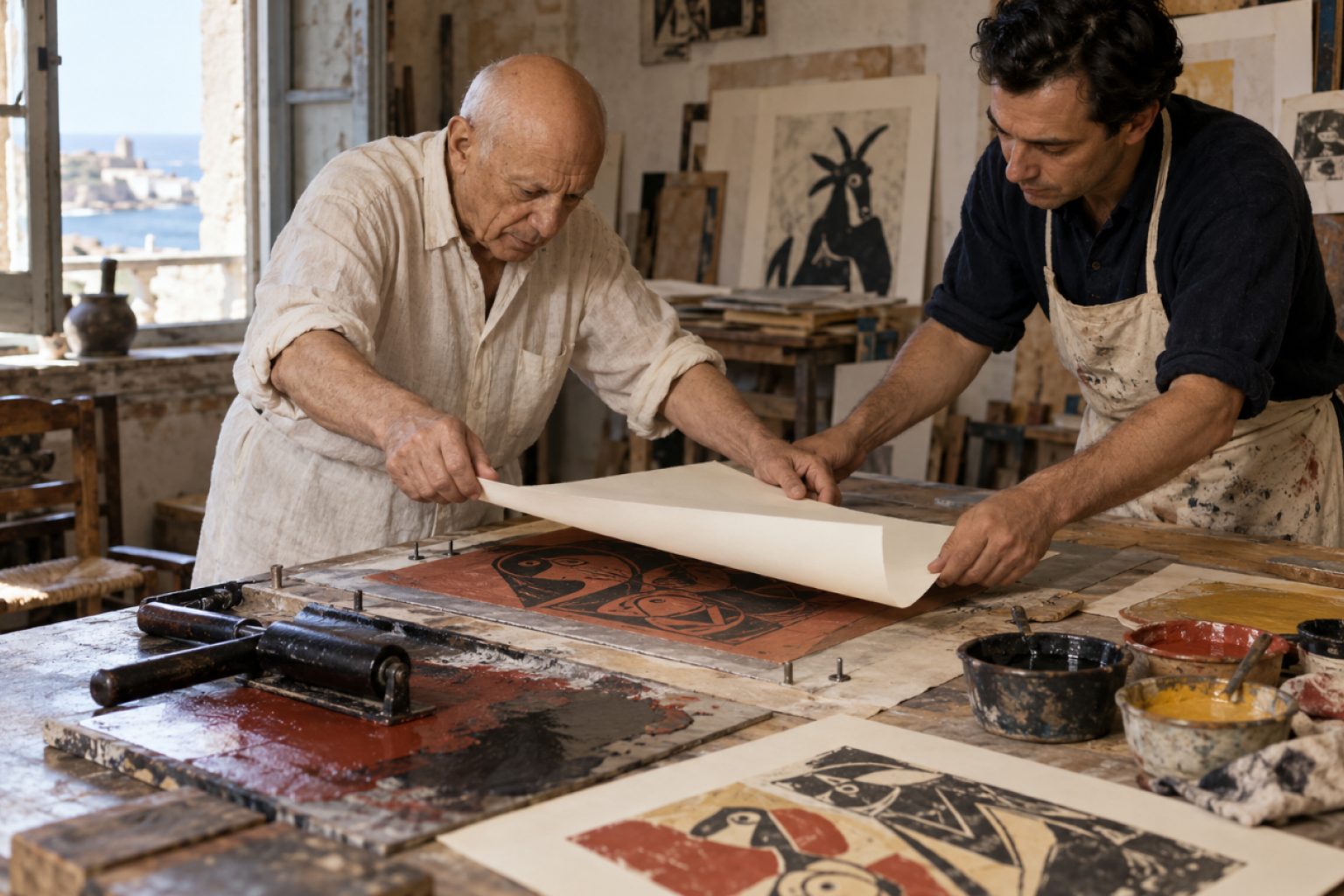
The printer often played an important part in that work. Picasso collaborated with skilled printmakers, testing possibilities together in the studio. When you read about a Picasso lithograph, for example, the name of a printer or workshop can help tell the story of how the image came to be.
A print’s title, medium, date, edition details, and documentation give you a more specific picture than the artist’s name alone. Those details help distinguish an original print from a later reproduction of an image, give you a better basis for comparing works, and trace how Picasso’s style changed across media.
Picasso’s Life, Told in Prints
Picasso’s prints follow his changing interests over more than seven decades. In 1904 and 1905, he made a suite of fourteen etchings about travelling circus performers. The Frugal Repast brings two thinly dressed figures to an almost bare table. The quiet, restrained scene carries the melancholy of his Blue Period, while other works from these years begin turning toward the warmer palette of the Rose Period.
In the 1930s, Picasso returned to etching to create the 100 works of the Vollard Suite. Mythological figures, sculptors, models, and the Minotaur move through scenes that circle around desire and the making of art. The Minotaur became one of Picasso’s recurring alter egos, joining ancient myth to the artist’s own emotional world.
After the Second World War, Picasso began working with lithographer Fernand Mourlot in Paris. He returned to images across successive states, adjusting and reworking them as he went. In The Bull, a familiar Spanish animal shifts from a forceful, recognizable body to a few economical marks, as Picasso pares down the line drawings across eleven states. The work offers an unusually clear glimpse of Picasso testing how much an image can lose while still remaining itself.
Color brought a different energy to the linocuts he made with printer Hidalgo Arnéra in the 1950s. Together, they developed a reduction method that allowed Picasso to build colors from a single linoleum block. In 1968, at age 86, he made the 347 Suite, completing 347 prints in less than seven months. The later work traces Picasso’s evolution as he continued using printmaking to explore subjects and ideas at full speed.
See one of the 347 Suite prints in our collection: 347 Series (Bloch 1715).
347 Series (1968)
See it in our collection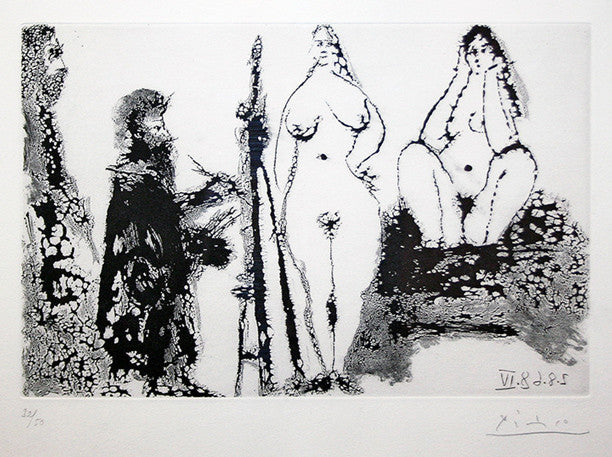
The Medium Changes the Image
The printmaking process shapes what you see. You do not need to master the mechanics to notice how an image behaves differently from one medium to another.
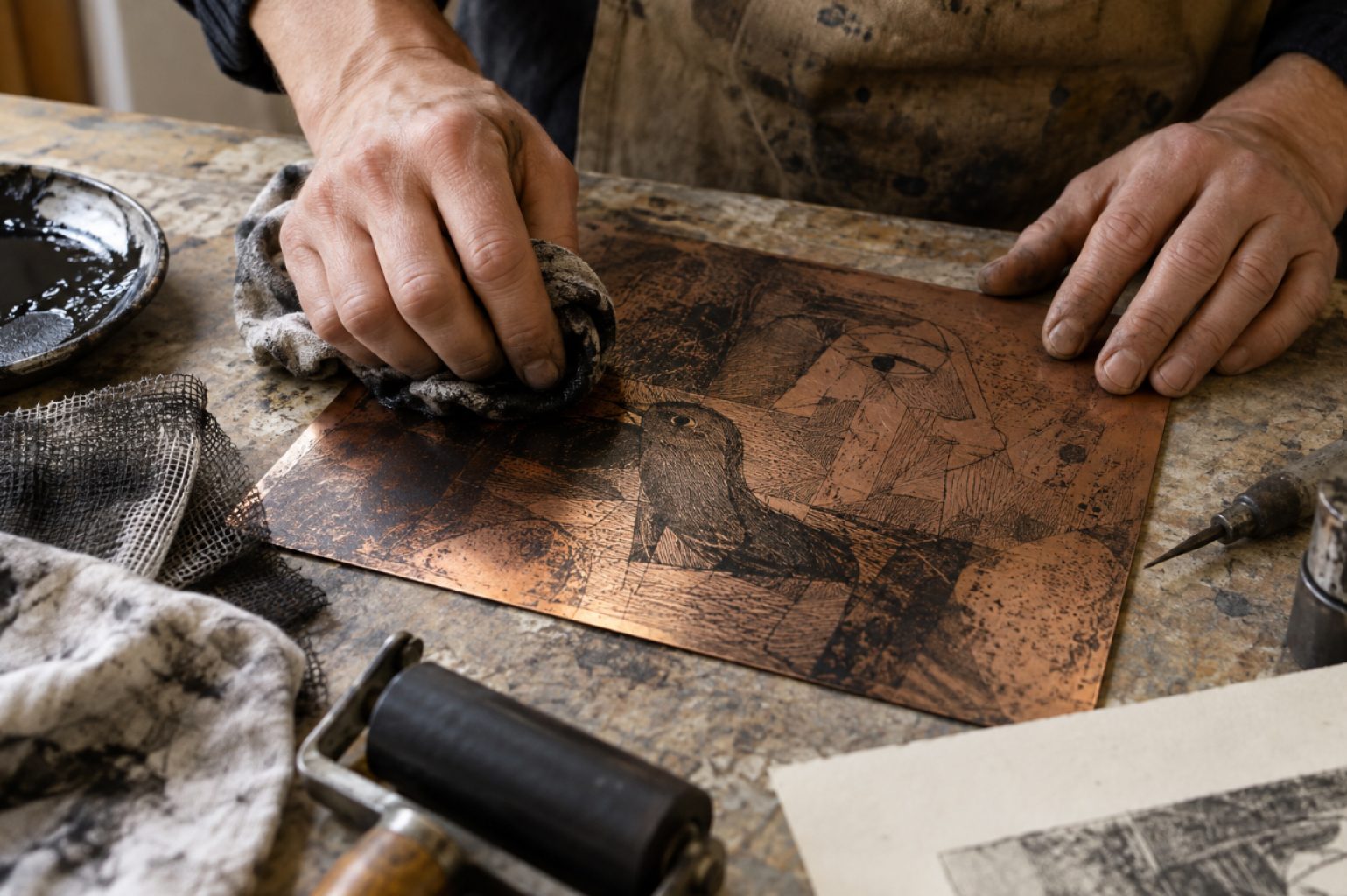
Etching and Aquatint
Etching begins with lines drawn into a metal plate, giving Picasso a way to work with detail, gesture, and crosshatching. Aquatint adds broader areas of tone. Together they can create a feeling of depth and atmosphere, as in the shaded figures and spaces of many of Picasso’s graphic works.
Lithography
Lithography starts with an image drawn on a flat surface. Picasso used the process to make changes across multiple states, allowing the paper to record the image’s development. The Bull is a striking example: over eleven states the animal shifts from a muscular body to a few confident marks.
Linocut
With linocut, Picasso carved into linoleum and printed areas of color from the block. The resulting images can feel direct and vivid, with strong shapes that hold their own, whether on a gallery wall or across a room. Working with Arnéra, Picasso turned the practical challenge of registering colors into an opportunity to experiment.
These processes help explain why two works by Picasso can have very different visual personalities. The current collection includes Bacchanale (Bloch 927), listed as a linocut, alongside aquatints from the 347 Suite. Use that difference in medium as a starting point when you browse and compare works.
Bacchanale (1959)
See it in our collection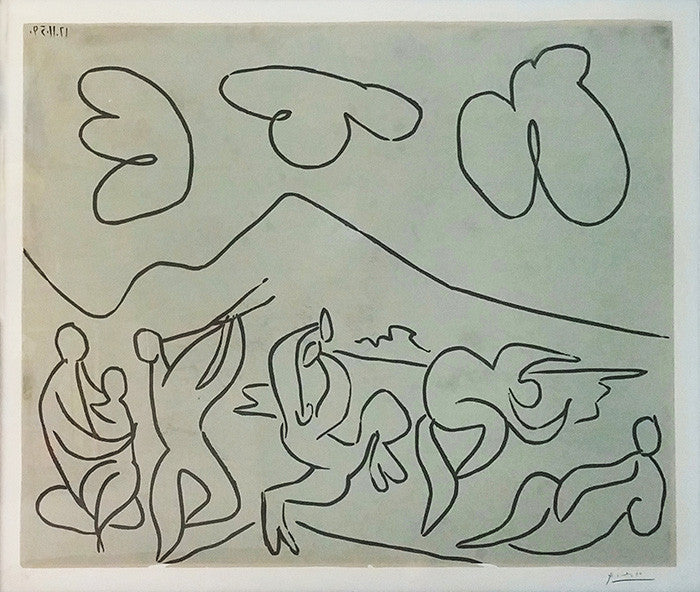
How to Read the Details of Picasso Prints
Start with the work itself. Look at its subject, composition, color, and scale, then see how the medium contributes to the effect. A portrait, a mythological scene, or a face built from a few economical lines can each reveal a different side of Picasso’s graphic imagination.
Next, find the identifying information for the specific impression. A listing may name the medium, date, catalogue reference, edition number, signature, paper, and dimensions. Read these details together. A signature or edition number is useful information, while a full account of the work’s history gives you more context for understanding it.
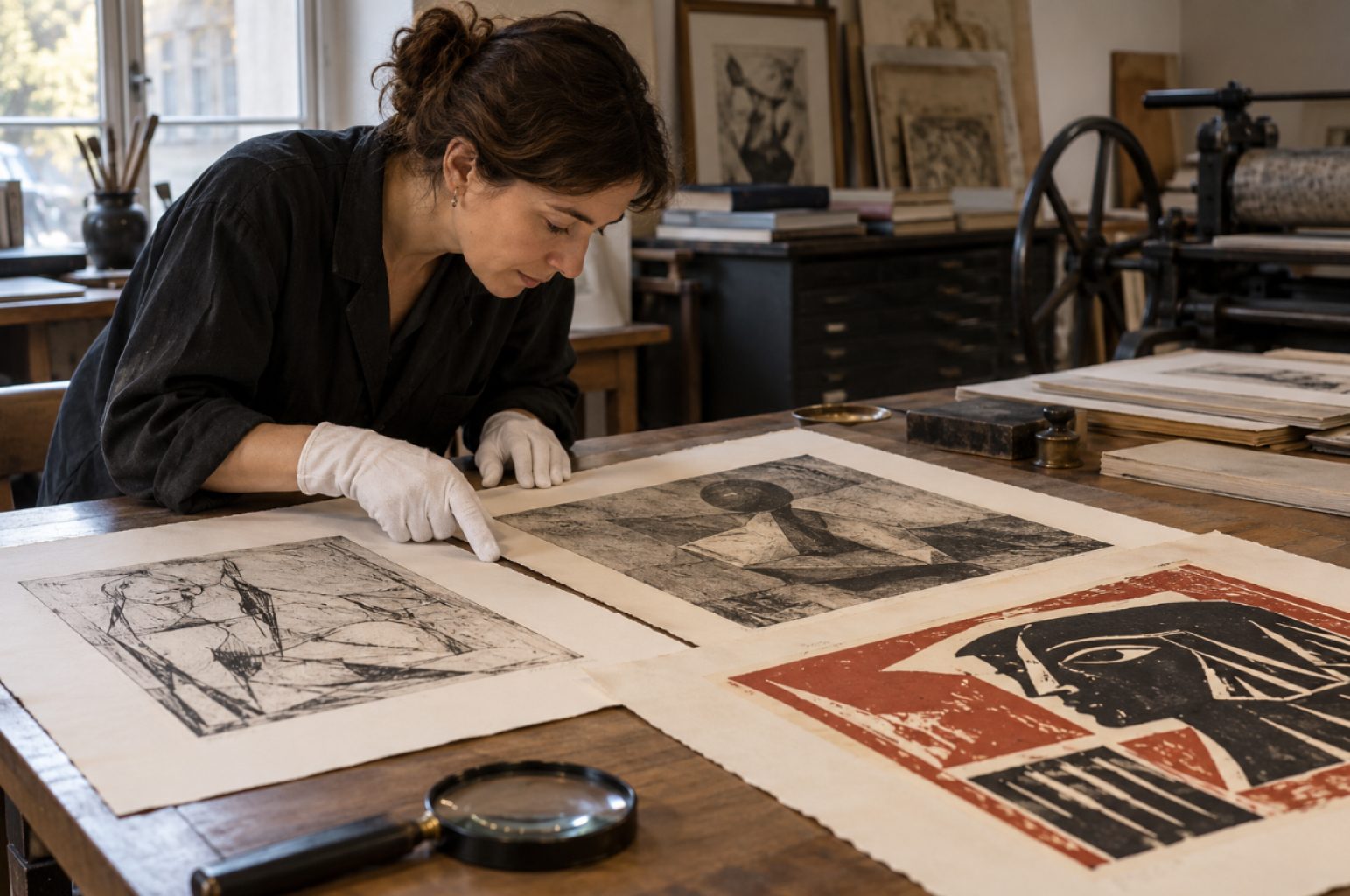
Edition numbers usually take the form of a fraction. In “32/50,” the first number identifies the impression and the second gives the edition size. The number describes where that impression sits in the edition; it does not rank the work’s quality.
Look closely at La Celestine (Bloch 1600). This 1968 aquatint is hand-signed and numbered 8/50 in pencil, and its sheet measures 2.25 by 3.25 inches. Those details bring the medium, edition, and scale of a specific work into focus. You can explore La Celestine in our collection to see the work’s details.
La Celestine (1968)
See it in our collection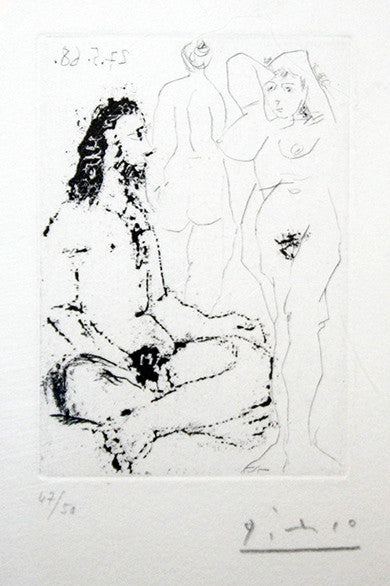
Also pay attention to dates. The date an image was created, the date an impression was printed, and the publication date of an edition may differ. Picasso’s The Frugal Repast shows why that distinction matters: its etching dates to 1904, while Vollard’s edition followed in 1913.
Edition, Impression, and Reproduction
A numbered edition gives you a useful starting point for research, but the number by itself does not tell the entire story. Ask who printed or published the work, when the impression was made, and how the piece relates to Picasso’s own printmaking activity. Documentation should describe the particular work you are considering.
Picasso prints cover a wide field. Some were made during his lifetime in collaboration with printmakers and publishers; other works or impressions have different publication histories. A later impression is not automatically a reproduction, just as a familiar image does not by itself establish that an object is an original print. The edition record and the physical work have to make sense together.
Look for a clear description of the medium, date, edition, signature, dimensions, and condition. Ask what documentation accompanies the work and whether it identifies this particular impression. If details are incomplete, a knowledgeable dealer can help explain what is known and what still needs confirmation.
Paper deserves a close look, too. A print lives through its surface: tone, texture, margins, and condition all affect how it reads. Request images that show the work clearly, along with information about any condition issues and the documents that accompany it.
What Shapes a Print’s Price?
Picasso prints span a wide range of subjects, formats, and edition histories, so there is no single number that explains the market. Price reflects the specific work and the evidence available for it.
The image itself matters. A well-known subject or an important series may attract particular interest, while an image that speaks to you personally can be a rewarding place to begin. Medium, edition, state, condition, size, and provenance also help explain why works that share the same artist can differ in price.
Compare like with like. An etching from one series and a colorful linocut from another have different histories and visual qualities, even when both are by Picasso. When you compare two examples, check the details of each rather than relying on a broad category such as “Picasso lithograph.”
For a broader view of how collectors think about an artist’s reputation and market history, the blue-chip art guide offers useful context. It is one lens for understanding the market; your own response to the image and the documentation for the specific work remain central to choosing well.
How to Begin a Collection of Picasso Prints
Choose the image you want to live with.
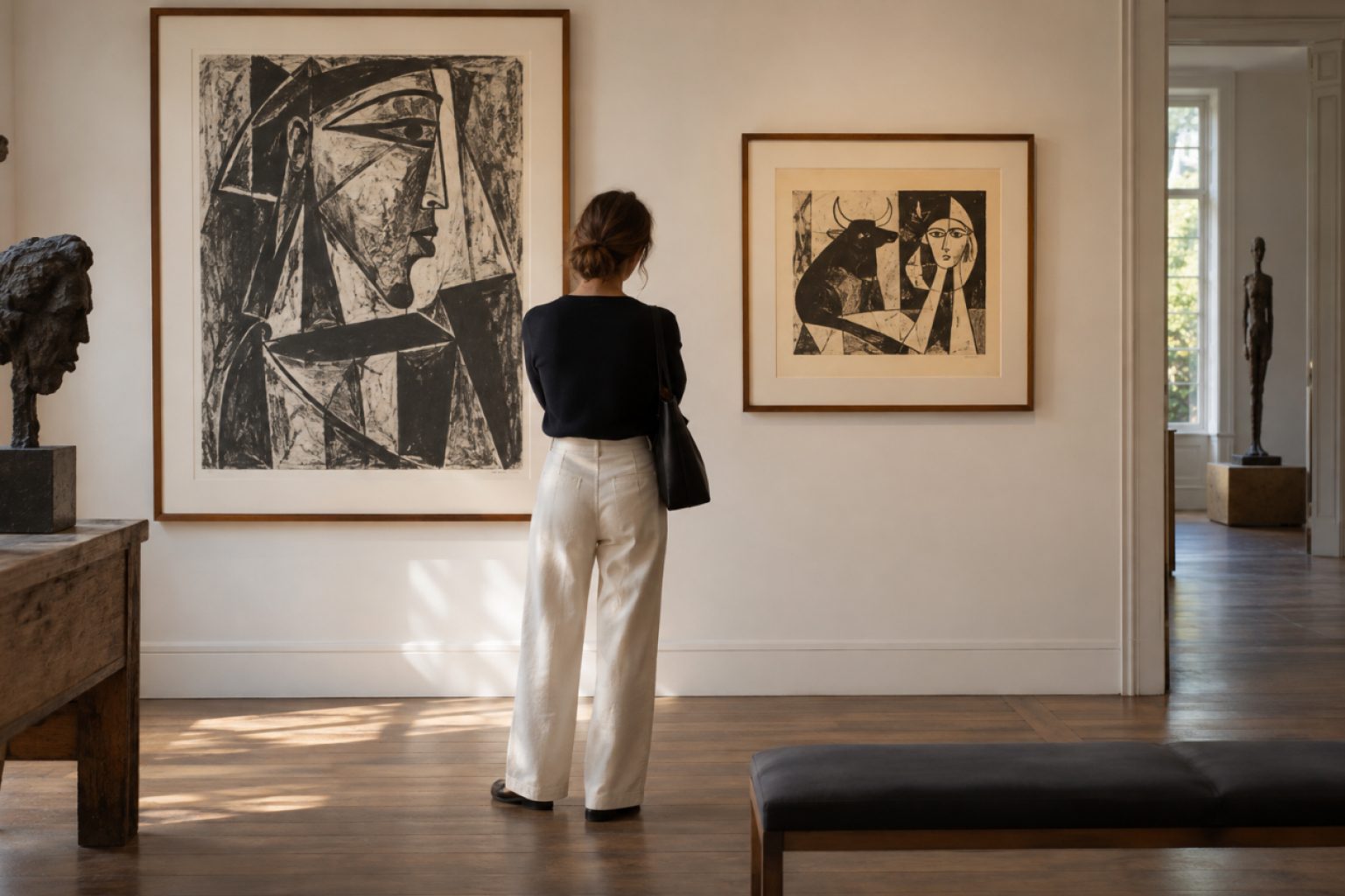
Picasso made prints across a long career, and a first piece can connect you to a period, subject, or way of working that feels personal. You might be drawn to the circus performers of his early etchings, the layered world of the Minotaur, or the direct color of his linocuts.
Then set a few practical guideposts:
- Choose a subject or period that holds your attention. Follow the image that gives you something to return to, whether it is a portrait, a mythological scene, or a particular way Picasso handles line and color.
- Decide what kind of print you want to live with. Consider the feel of an etching, lithograph, or linocut, along with the available size and display space.
- Read the listing closely. Review the medium, date, edition details, signature, condition, and documentation. Ask for clarification when an important detail is missing.
- Compare specific works. A Picasso collection can hold very different kinds of images and formats. Give yourself time to understand what distinguishes one print from another before you settle on the piece that feels right.
A thoughtful first purchase begins with curiosity and grows through looking. As you explore Picasso prints for sale, keep the image, the object, and its history in view together. That approach leaves room for the pleasure of discovering a work and the confidence that comes from understanding what you are collecting.
Let’s Talk About the Picasso Prints That Speak to You
Picasso’s art brings you into a world of restless invention, from spare lines to vivid blocks of color. The more closely you look, the more the prints reveal about the artist and the choices behind each image.
Have a question about Picasso, another artist, or a work that has stayed on your mind? Premier Pop Art can offer a knowledgeable perspective, help you understand the details, and talk through how a piece might fit with what you’re looking for.
Whether you’re shaping your first collection or adding to one, a conversation can turn a general interest into a clearer idea of what to explore next. Tell us what draws you in, and we can take it from there.
FAQs: Picasso Prints
Are Picasso prints original works of art?
Yes. Many Picasso prints are original works of art, made by Picasso through processes such as etching, aquatint, lithography, or linocut. In an original print, the image is created on a plate, stone, or block, then printed in an edition. Check the specific work’s medium, edition history, signature, and documentation to understand its status.
What does an edition number such as 32/50 mean?
An edition number such as 32/50 identifies an impression as number 32 in an edition of 50. The first number refers to that individual impression; the second states the edition size. It does not rank quality or value. Read the number alongside the work’s medium, signature, date, condition, and documentation.
Which printmaking methods did Picasso use?
Picasso worked in several printmaking methods, including etching, aquatint, lithography, and linocut. Etching let him build drawn lines on a plate, while aquatint added areas of tone. Lithography supported revisions across successive states, and linocut produced strong shapes and color. Each process gives the image a distinct character, so the medium is a useful detail to check when comparing prints.
How can I assess the authenticity of a Picasso print?
To assess a Picasso print, review the medium, date, edition, signature, condition, and documentation for the specific impression. Ask who printed or published it and whether the records identify that work, not just the image. Compare the paperwork with the physical print, and request clarification about gaps; no single number or signature establishes authenticity on its own.
How should I choose my first Picasso print?
Choose a Picasso print by starting with an image, subject, or period you want to live with. Then consider the medium, size, edition details, condition, and documentation for the specific work. Compare a few prints rather than relying on the artist’s name alone, and ask questions about anything unclear before deciding whether the work suits your collection.