


Artist Spotlights
Takashi Murakami Artwork:
Bringing the Superflat Universe Home
Smiling flowers, mutating characters, and Buddhist saints share one crowded universe in Murakami's work. His signed editions are the most direct way to bring a piece of it home.
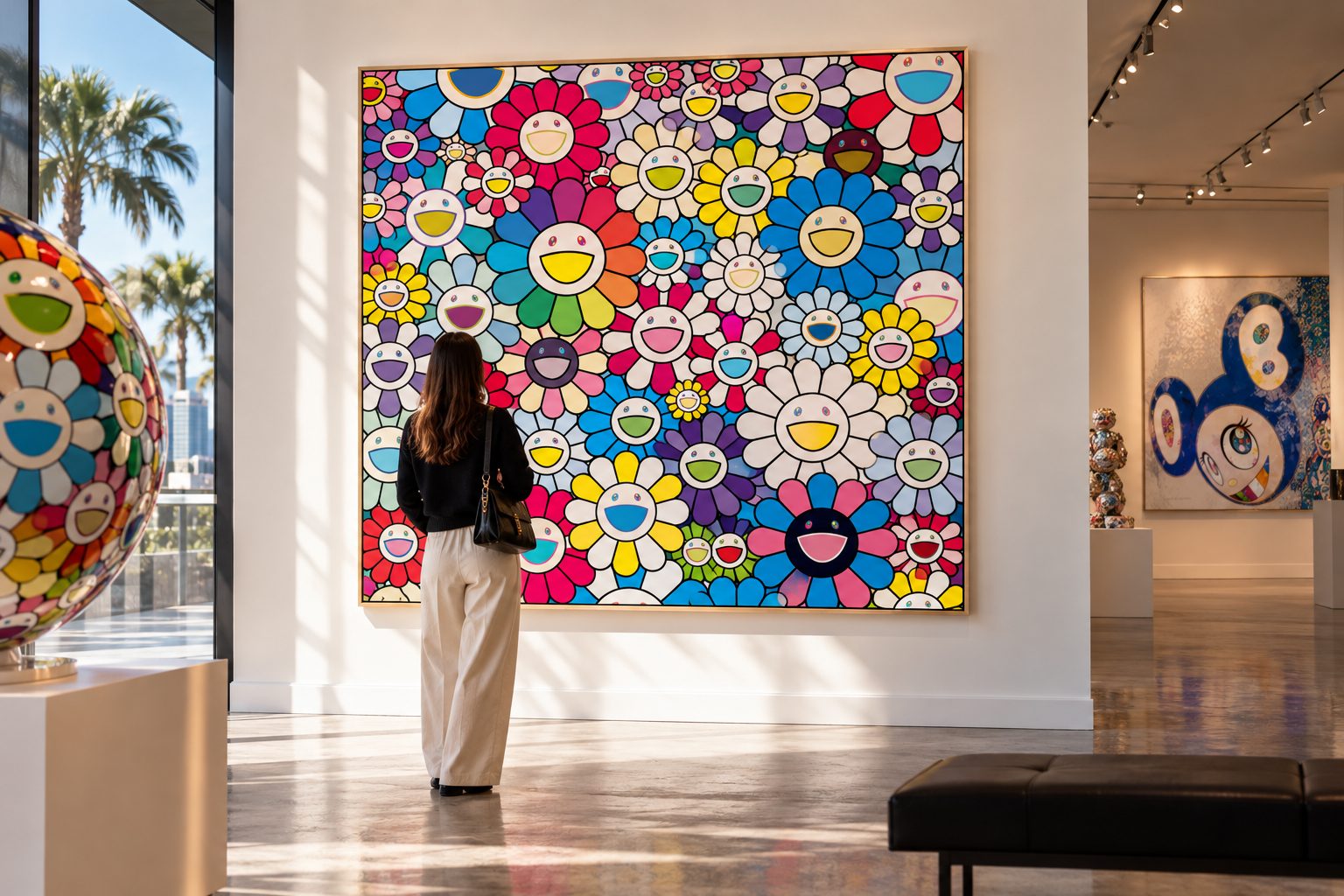
Murakami's grinning, rainbow-petaled flowers have traveled across fashion and pop culture, from Louis Vuitton handbags to the cover of Kanye West's Graduation, so you may know his work before his name. Born in Tokyo in 1962, he built that artistic style from anime, manga and centuries of Japanese art.
For collectors, most Takashi Murakami artwork comes as hand-signed, numbered prints from his own studio. His paintings and sculptures change hands in a far smaller circle of major galleries and evening sales, where the eight-foot My Lonesome Cowboy sold at Sotheby's for about $15.2 million in 2008.
This article follows the path a collector takes, from reading the imagery to weighing an edition, and our Takashi Murakami artworks give you real examples to test each step against.
Murakami's World: Where Nihonga Meets Anime
Murakami grew up on anime and comics and hoped to join the animation industry, so he enrolled at Tokyo University of the Arts to build an animator's drafting skills. He left with a 1993 PhD in Nihonga, and that grounding in Japanese artistic tradition runs through everything he makes.
Both influences meet in Superflat, the idea he launched in Tokyo in 2000 and brought to the Museum of Contemporary Art in Los Angeles in 2001. It traces aesthetic characteristics shared by Edo-period painting and anime, above all flat color and crisp outlines.
He also saw postwar Japanese culture as a place where low arts and fine arts had merged. That gave modern art a distinctly Japanese voice, and it explains why his flowers look as natural on a canvas as on a poster.
His company, Kaikai Kiki Co., Ltd., keeps that world running. It produces his work, shows younger artists at Kaikai Kiki Gallery in Tokyo, and created the biannual art fair Geisai.
That mix of studio, brand, and commercial media invites comparison with Warhol's Factory. If you collect Western art from the 1960s, his editions sit naturally beside the Pop Art prints that first brought mass-media imagery into the gallery.
How to Read a Murakami: Flowers, Mr. DOB and the Arhats
The Flowers
The flowers are Takashi Murakami's most familiar motif, and the one you'll meet most often. Murakami paints them as round, grinning faces ringed with petals, packed so tightly that the eye has nowhere to rest.
Gathered into a sphere, they become the Flower Ball, a form he has carried across paintings, prints and sculpture. Spend time with one of these vibrant works, such as the 28-inch round Flowerball Expanding Universe from 2017, and the cheer begins to feel insistent.
Flowerball Expanding Universe (2017)
See it in our collection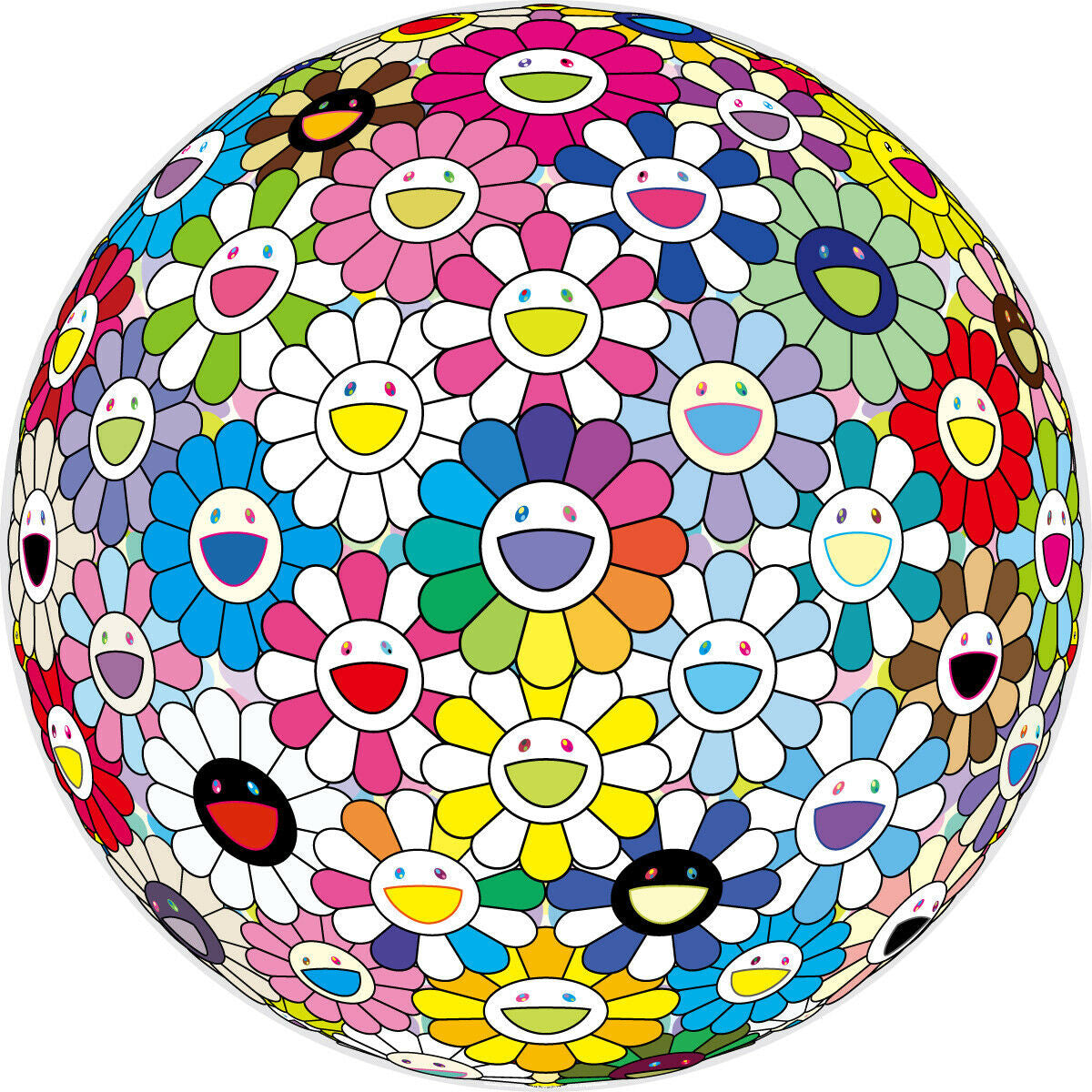
Under that cheer sits something heavier, though. Murakami made the case himself in Little Boy, his 2005 exhibition in New York, which tied the culture of cuteness in postwar Japan to the trauma of the war's end.
Mr. DOB
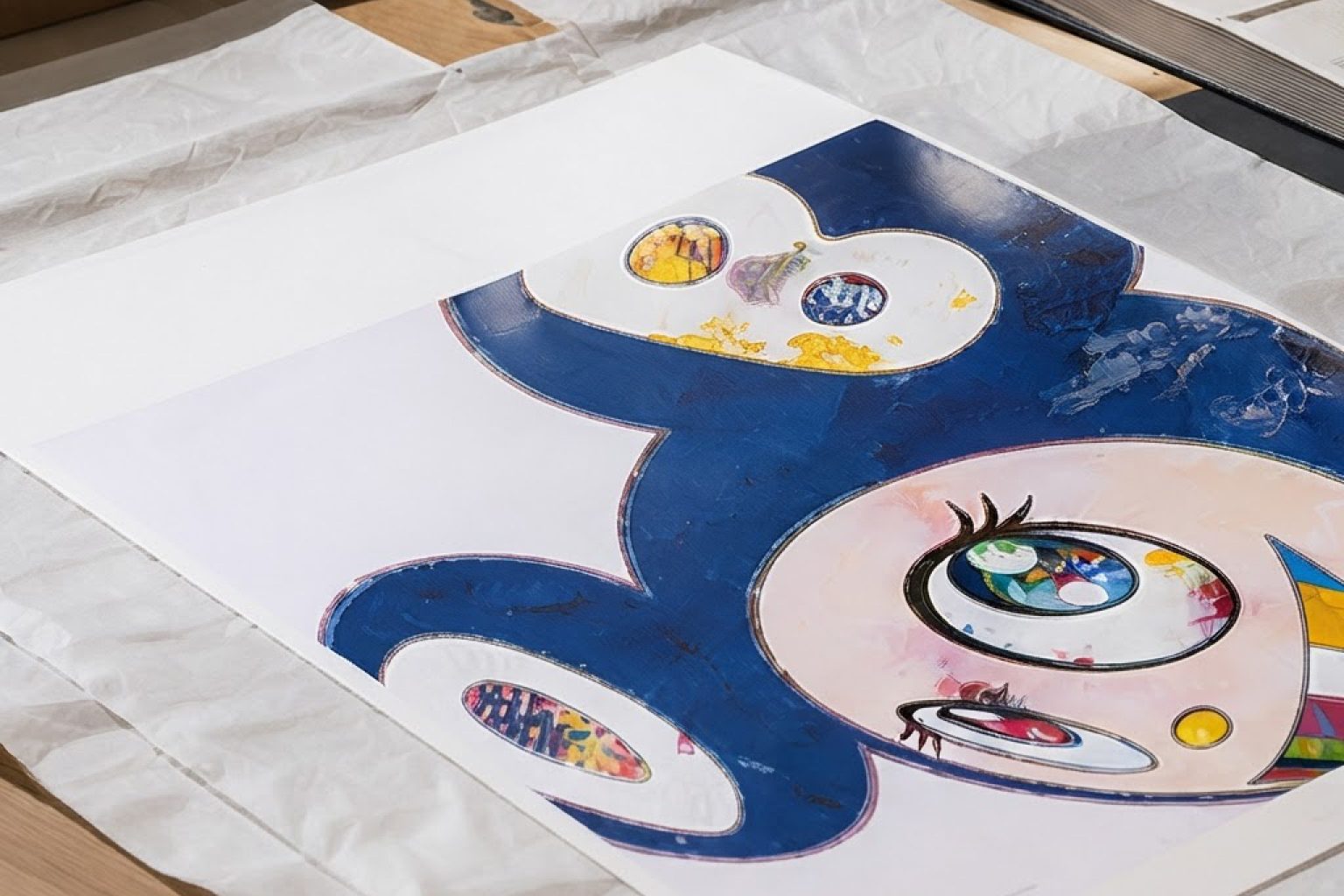
DOB came first. Murakami introduced him in 1993 as a self-portrait and alter ego, named after the nonsense phrase "dobozite dobozite oshamanbe." His ears carry a D and a B, and his round face completes the O.
Over the years DOB has mutated again and again, growing fangs and extra eyes in pieces such as Tan Tan Bo. Following those changes from Murakami's early work onward is one of the quiet pleasures of collecting him, and Melting DOB, a hand-signed 2008 lithograph, captures one of the stranger turns.
The Arhats and Kōrin
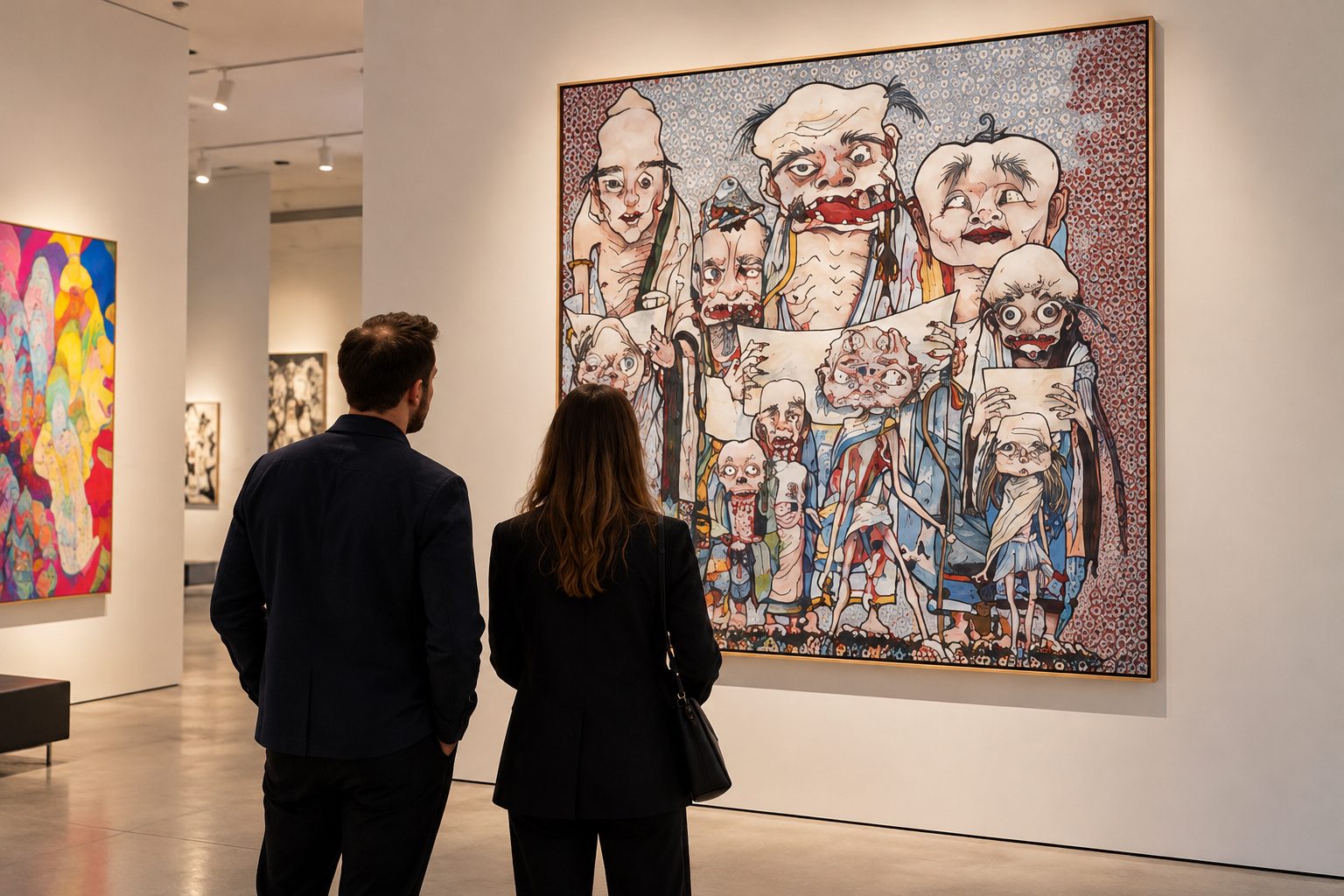
His later work reaches further into history. After the 2011 earthquake and tsunami in Japan, he painted The 500 Arhats, a cycle of Buddhist saints about 100 meters long, for Ego, his 2012 exhibition in Doha.
The prints drawn from that project keep its blend of devotion and fantasy. Gnarled, many-eyed holy men crowd the sheet in a dense, rhythmic line, and several are printed in silver on woven paper.
The same conversation with the past runs through his homages to Ogata Kōrin, the Edo-period Rinpa master whose stylized views of nature and gold-leaf screens anticipated Superflat by three centuries.
Korin: Kyoto comes from that body of work. Its cold-stamped foil and high-gloss varnish catch the light much the way gold leaf does on a folding screen.
Korin: Kyoto (2020)
See it in our collection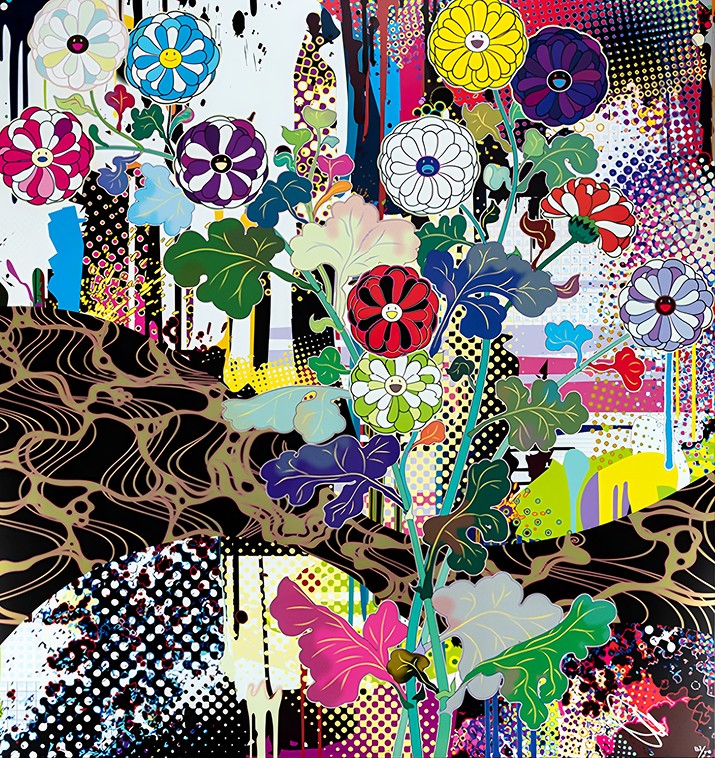
The Three Kinds of Takashi Murakami Artwork on the Market
Everything carrying Murakami's name in today's art market falls into one of three groups. Each asks something different of you as a buyer.
Unique Paintings and Sculpture
These are made in his studio and sold through galleries such as Gagosian and Perrotin, or at auction in New York, London and Hong Kong, the hub of the Asian auction market. They come to market only occasionally.
Even his sculpture editions are tiny. My Lonesome Cowboy exists in three casts plus two artist's proofs, and one of them belongs to the Pinault Collection.
Signed Editions
This is the most accessible group for a private collector. Kaikai Kiki publishes Takashi Murakami prints as offset lithographs, often finished with foil, cold stamping or high-gloss varnish, along with silkscreens and woven-paper silver editions.
Each sheet in this group is hand signed and numbered by Murakami and belongs to a stated edition. That gives you a clear record of what you own.
Merchandise and Collaborations
This group is the widest. Murakami has designed handbags with Louis Vuitton, collaborated with Virgil Abloh, and released plush toys, skateboard decks, posters and other products through his company Kaikai Kiki.
Some of this merchandise has a devoted following, and a Louis Vuitton bag is often the first door into his fine arts practice. When you're buying for the wall, two questions sort the field quickly: was the piece made and signed as an artwork, and is it numbered within an edition?
Keith Haring did the same with his Pop Shop, opened in New York City in 1986. Collectors of Keith Haring prints learn to separate the shop goods from the signed editions, and that habit serves you well with Murakami.
Murakami Paintings and the Prints Drawn From Them
Murakami's paintings are large studio productions. Working from his designs, assistants at Kaikai Kiki build up layer after layer of acrylic, often over gold or platinum leaf, until the surface looks as flawless as a printed image.
His museum record runs deep. The Fondation Cartier in Paris gave him a solo show in 2002, and his 2007 retrospective, ©MURAKAMI, traveled from the Museum of Contemporary Art in Los Angeles to Brooklyn, Frankfurt's Museum für Moderne Kunst, and the Guggenheim in Bilbao.
In 2010, Takashi Murakami paintings and sculptures were installed at the Palace of Versailles. If a Murakami painting is your goal, expect a patient search through his galleries and the major auction houses, since canvases surface far less often than editions.
Many of his editions begin with those canvases. Kaikai Kiki translates a painting into an offset lithograph, sometimes adding foil or varnish to echo the shine of metal leaf, which explains titles such as A Little Flower Painting and Acupuncture Painting.
Owning one of those editions gives you Takashi Murakami artwork with the composition, the colors and the artist's signature, in a format sized for a home.
What Shapes the Price of a Murakami
Price begins with category. Unique paintings and sculpture move in their own market, with separate auction records and gallery waiting lists, so a figure from one tells you very little about the other.
Within the editions, value comes down to the specific sheet in front of you, and four factors do most of the work.
The image. Compositions built around his best-known motifs, the flowers, DOB and his twin characters Kaikai and Kiki, often attract the widest interest. Attention to a particular image can also rise when an exhibition or new release brings it back into view.
Size. Scale changes how a piece holds a wall, and a 30-inch sheet makes a different statement than one closer to 20 inches.
Technique. Offset lithography, silkscreen, foil, cold stamping, high-gloss varnish and woven paper each change how a print looks and ages. Medium alone won't settle the question, though, since Murakami silkscreens and offset lithographs can sit in a similar range once image, size and demand are weighed together.
The individual sheet. Signature and numbering, edition size, condition and paperwork each either support a price or raise a question about it.
When you weigh a figure, a few questions keep the comparison honest:
- Are you comparing the same image, colorway and size?
- Is the number you found a dealer's asking price or a completed auction sale, and does it include the buyer's premium?
- What exactly does the documentation confirm about this sheet?
- How does the condition of this example compare with others you've seen?
Multicolor Double Face (Black), a hand-signed silkscreen from 2020, makes a good piece to test against these questions alongside one of his offset lithographs.
Multicolor Double Face (Black) (2020)
See it in our collection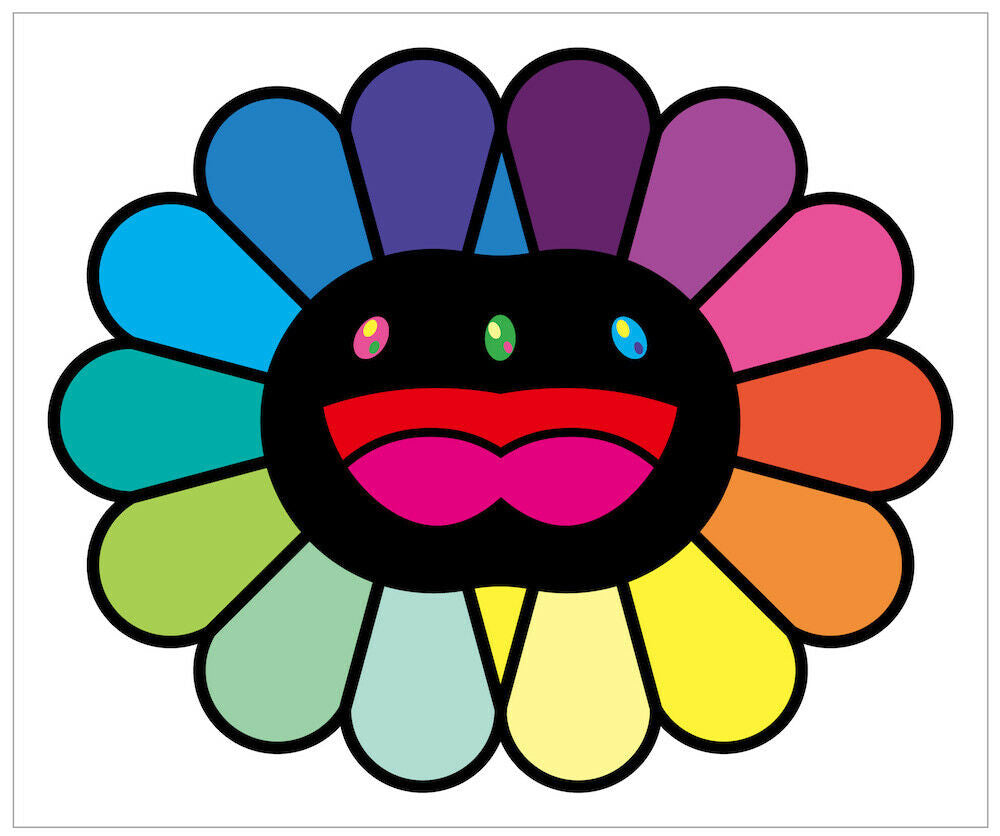
Large Editions and What Makes a Murakami Rare
Edition size deserves a direct conversation, because Murakami's editions run larger than the word "limited" suggests. A signed offset lithograph such as Korin: Kyoto comes in an edition of 300, a common size for his offset work.
Some compositions also exist in several versions. The 2010 Kansei suite, another homage to Ogata Kōrin, was released in a run of variations, each with its own edition.
Add the unsigned posters and products that share his imagery, and a single motif can circulate in thousands of copies. That scale fits Murakami's project: he has long embraced wide circulation, and editions of this size let a hand-signed work reach collectors in Paris, Hong Kong and across the USA at once.
For you as a buyer, rarity in Takashi Murakami artwork lives in the specifics: an earlier release, a less common colorway, a strong impression, or a sheet in excellent condition with complete paperwork. Treat "limited edition" as one fact in the record and weigh it with everything else.
Chaos, a 2013 offset lithograph from an edition of 300, shows that standard clearly: hand signed and numbered, with its certificate of authenticity.
Chaos (2013)
See it in our collection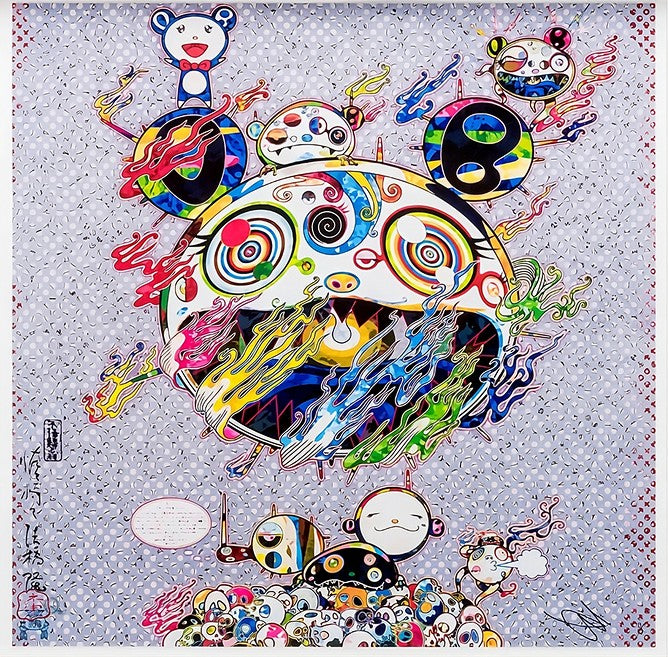
Buying Takashi Murakami Prints With Confidence
Confirming that you're buying an authentic Takashi Murakami print starts with the signature and edition number, so ask to see both up close. Murakami typically signs and numbers his offset editions by hand on the front of the sheet, so a seller should be able to send a sharp photograph of that margin.
While you're at it, check that the title, date and medium match the documentation. Kaikai Kiki editions often arrive with a certificate and in the publisher's original box, and a reputable dealer will tell you exactly what accompanies the piece and where it came from.
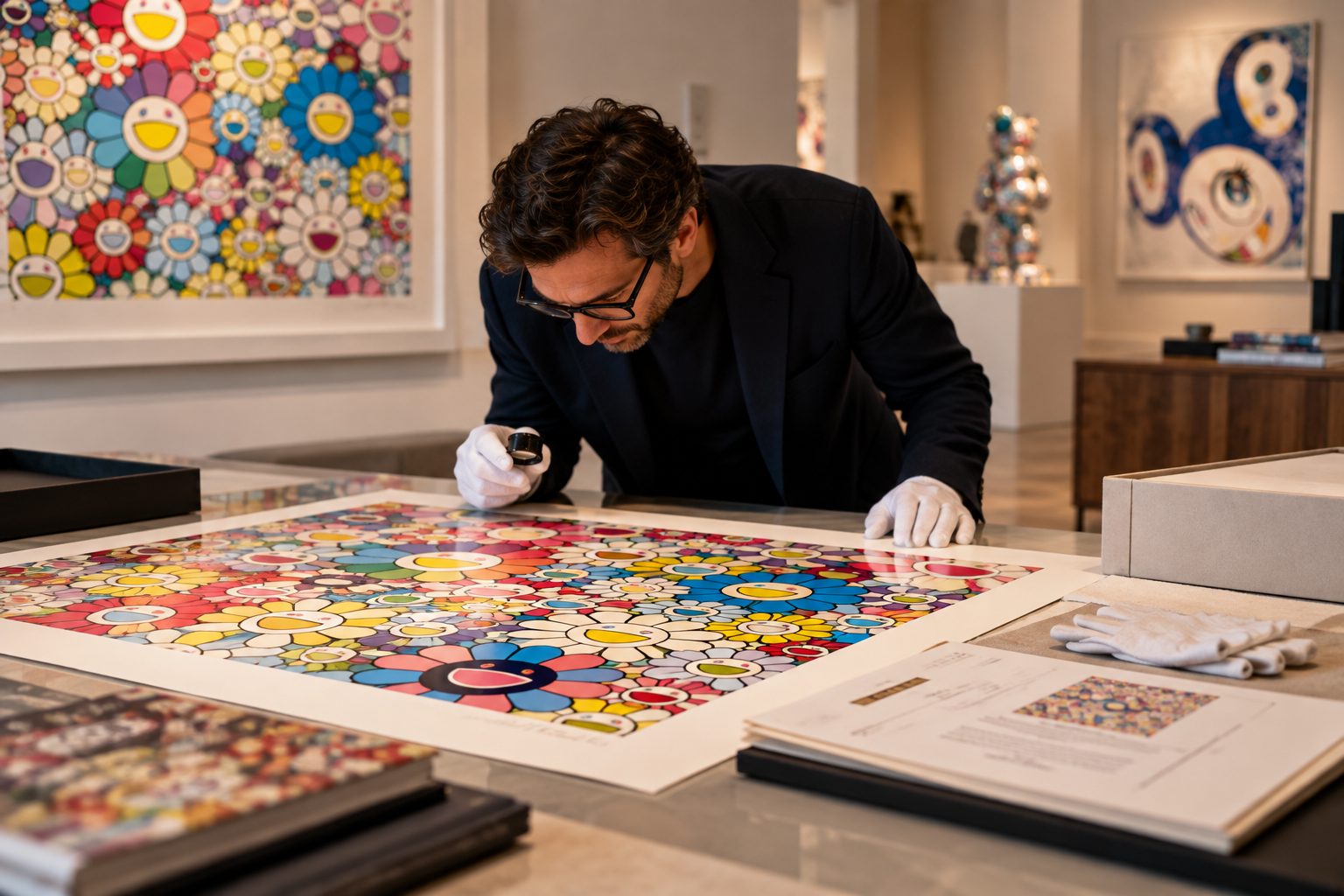
Takashi Murakami artwork calls for a closer look at condition than many prints do. Foil and high-gloss varnish pick up fingerprints, scuffs and pressure marks, and large sheets can ripple or curl after poor storage.
If you're buying from a distance, request photographs taken under raking light. It reveals surface damage that flat lighting hides.
Finally, trust your own eye. Some collectors begin with the flowers for the color they bring to a room, and some are pulled toward DOB's restless energy or the strange gravity of the Arhats.
Get Help Choosing Your Murakami
You may have one image in mind and one question left: is this the right print to start with? That's a conversation we enjoy. We'll look at the specific sheet with you, point out which details deserve the most weight, and tell you honestly how it compares with other examples we've seen.
If you're starting a collection, we can also help you plan past the first piece. We'll talk through how an early Murakami can anchor what comes next, whether that's more of his work or the Pop Art it sits beside so naturally, and suggest pieces from our collection that suit your space and budget.
Send Premier Pop Art a note and tell us which Murakami caught your eye.
FAQs: Takashi Murakami Artwork
How should you frame a Takashi Murakami print?
Frame a Takashi Murakami print with spacers or a deep mat so the glazing never touches the surface, since foil and high-gloss varnish can stick to glass over time. UV-filtering acrylic or glass and acid-free backing protect the colors. A framer experienced with works on paper can set the right depth for the sheet.
Where can you see Takashi Murakami's work in person?
Takashi Murakami's work appears regularly at Kaikai Kiki Gallery in Tokyo and at his international galleries, including Gagosian and Perrotin, whose exhibition calendars list upcoming shows. Museums hold his work too, and The Broad in Los Angeles runs a rotating installation of his pieces. Checking those calendars before you travel is the simplest way to catch his paintings on view.
Does Takashi Murakami still release new prints?
Yes. Kaikai Kiki, Takashi Murakami's company, continues to publish new signed editions, and popular releases often sell out soon after launch. Once an edition sells out, its sheets reach collectors through galleries and the secondary market. Telling a dealer which images you hope to find puts you first in line when one becomes available.
How do you sell a Takashi Murakami print?
To sell a Takashi Murakami print, start by gathering clear photographs of the front, the signature and edition number, and any certificate or original packaging. Then contact a gallery that buys Murakami editions; Premier Pop Art purchases work from collectors. Complete documentation lets a buyer assess the sheet quickly and usually leads to a faster offer.
How should you store an unframed Murakami print?
Store an unframed Murakami print flat, in its original box or an archival folder, in a dry room with a stable temperature and no direct light. Handle the sheet by its edges with clean, dry hands or nitrile gloves. Foil and varnished surfaces mark easily, so take the print out of storage only when you need to.