


Artist Spotlights
Famous Art by Andy Warhol, Explored Through His Obsessions
Warhol built his famous art from pictures the world had already seen, then kept returning to them. Follow each image to its source and the works start to talk to one another.
You probably knew Marilyn Monroe's face, printed in loud color, long before you knew who made it. That instant recognition is what Andy Warhol built his most famous art on. He took pictures the whole country had already seen, from movie-star publicity stills to newspaper front pages to the labels on grocery shelves, and gave them a second life on canvas and paper.
Follow almost any famous work back to its source and you find a photograph someone else took for a different purpose: to sell a film, report a crime, or move a can of soup. Warhol noticed what those pictures were already doing to the people who saw them, then turned the volume up. That habit gives his whole body of work its logic, and it gives you a way to read it. You can meet many of the pieces themselves in our Warhol collection.
Start where nearly all of them did, with a camera.
Famous Art by Andy Warhol Began With a Photograph
Warhol was born Andrew Warhola in Pittsburgh in 1928 and studied commercial art at the Carnegie Institute of Technology. He moved to New York in 1949 and spent the 1950s as a commercial illustrator, and illustrators work from reference photographs. He clipped pictures from magazines for ideas, a habit that followed him into fine art. From 1962 he used photographic silkscreen to carry press photographs and publicity stills straight onto canvas, then brought in color by hand.
The pictures he took himself shaped the work just as much. In the early 1970s he picked up the Polaroid Big Shot, a camera built for portraits, and made it the starting point for his commissioned portraits; he might shoot dozens of frames of one sitter before choosing the single picture that went to the silkscreen. By 1976 he carried a pocket 35mm camera nearly everywhere, and his movie camera had already turned his circle into the cast of Chelsea Girls, which ran on two screens at once in 1966.
Whatever the source, repetition did the rest. Once a photograph sat on the screen, Warhol could print it again and again in new colors, which is how single images grew into the print portfolios he published from the late 1960s onward. Two works in our collection show the camera's side of that story.
The Polaroid, Where Portraits Began
Picture a sitting at the studio: the flash fires, a print slides out of the camera, and the next frame is already lined up. Warhol's commissioned portraits began in small moments like that one. The Unique Polaroid Print in our collection belongs to that working world, a one-of-a-kind instant picture from the stage before color and repetition took over. Keep that first stage in mind and every silkscreened face that follows reads differently.
Unique Polaroid Print
See it in our collection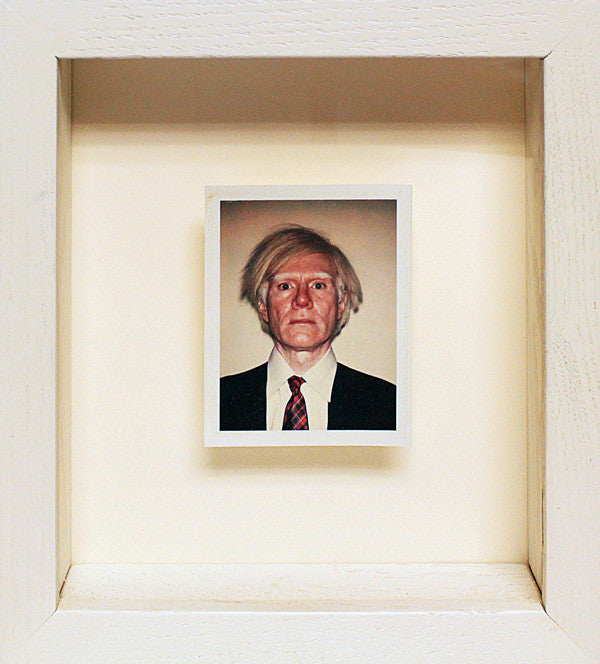
The Torso, a Photograph Carried Across
Warhol also turned his camera on the human body, and Untitled (Torso) shows what he could do with the result. The photograph travels onto acetate, meets layers of colored paper, and comes to rest mounted on a sheet, so you can read the construction with your own eyes. The work is unique, which means every layer you see is the one Warhol chose. With the camera in mind, go back to the faces that made him famous and ask where each one came from.
Untitled (Torso)
See it in our collection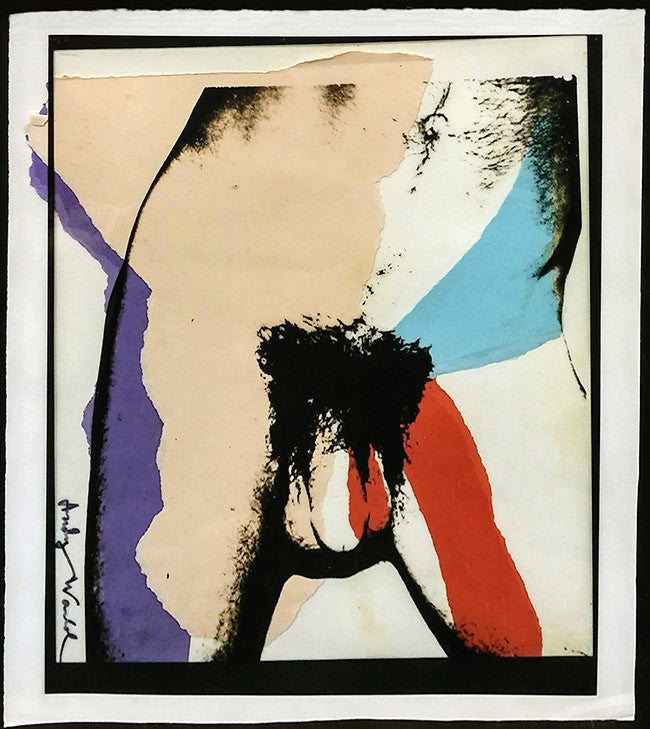
Fame and the Faces Everyone Already Knew
His fascination with fame started early. As a boy in Pittsburgh he collected photographs of movie stars, and as an adult in New York he found himself living among the people those pictures came from. By the early 1960s he was silkscreening Elvis Presley from a publicity still for the film Flaming Star and Elizabeth Taylor from a publicity photograph, and he is credited with the line that in the future everyone would be famous for fifteen minutes. Hollywood supplied the faces, and Warhol supplied the color.
Marilyn is the face most closely tied to his name, and the Marilyn Monroe prints he issued in 1967 show how far one publicity photograph could stretch. Three portraits in our collection take the idea in different directions.
Marilyn and the Face as a Mask
Marilyn Monroe died in August 1962, and Warhol began working with her image that same year. His source was a 1953 publicity photograph for the film Niagara, which he cropped tightly and printed in flat blocks of color until her face became something close to a mask. What stays with you is how little detail remains: eyes, lips, and hair turn into pure shapes, and she seems present and out of reach in the same glance. That pull shows in the 2022 Christie's sale of Shot Sage Blue Marilyn for $195 million, which set the auction record for an American artwork. You can study the same face in Marilyn FS II.30, a 1967 screenprint on paper.
Marilyn FS II.30 (1967)
See it in our collection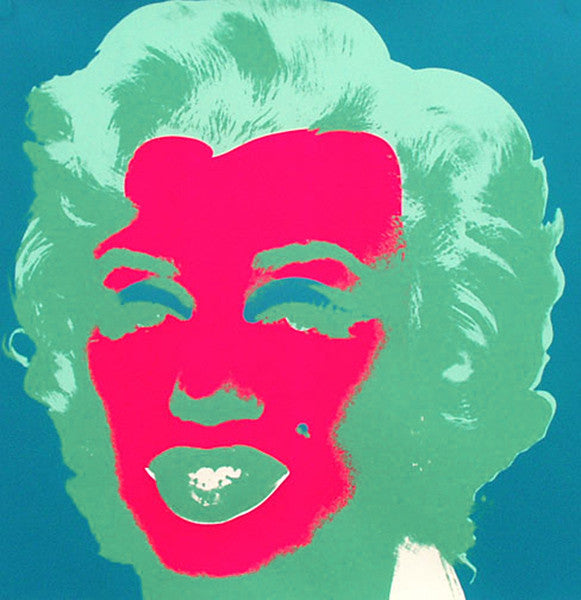
Mao, Handled Like a Movie Star
Following President Richard Nixon's 1972 visit to China, Warhol turned to one of the most reproduced portraits of the era, the official image of Chairman Mao Zedong that opened the little red book of his sayings. He printed it in bold color, laid loose, brush-like marks over the face, and gave the leader the same glamour he gave film stars. Read one way, it is satire; read another, it is an honest observation that power and celebrity borrow each other's looks. Mao FS II.93 is a 1972 screenprint from his suite of ten, and it rewards a long look.
Mao FS II.93 (1972)
See it in our collection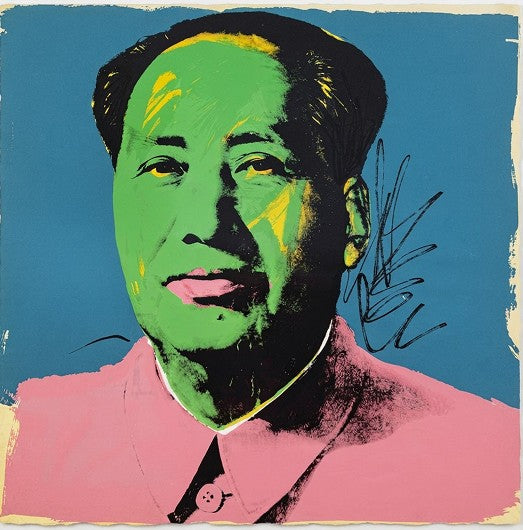
Muhammad Ali, the Fighter as Pop Star
In 1977 Warhol traveled to Muhammad Ali's training camp in Pennsylvania with his Polaroid camera to photograph the champion for a series of athlete portraits. He saw athletes as the new movie stars, and Ali, at the height of his fame, proved the point. From those Polaroids came four screenprints in 1978, where Warhol's color blocks flatten Ali's face and fist into bold shapes that still carry the intensity of his stare. Muhammad Ali FS II.182 is one of the four.
Muhammad Ali FS II.182 (1978)
See it in our collection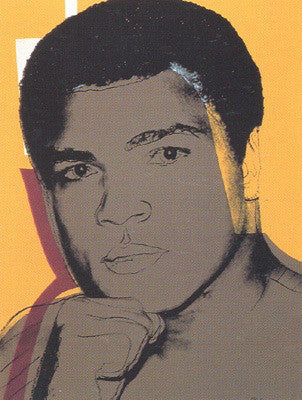
Death, as the Newspapers Printed It
The newspapers that sold Warhol his movie stars also sold him something darker. In 1962 a front page announced that 129 people had died in a plane crash, and he later said that headline started him on a long run of work about death. Car wrecks, suicides, and the electric chair followed in the group of works now called Death and Disaster, and Warhol used the photographs exactly as the press had printed them. Paintings such as Silver Car Crash repeat a single scene of violence across the canvas until the repetition itself becomes the subject.
Both of the works below date from the 1970s, when Warhol returned to the theme with fresh eyes.
Electric Chair, a Room With Nobody in It
Warhol found his picture in a 1953 press photograph of the death chamber at Sing Sing prison, circulated as Julius and Ethel Rosenberg faced execution there. The frame holds an empty room: the chair, its straps, and bare walls. He silkscreened the image on canvas in the early 1960s and came back to it in 1971 with a portfolio of ten screenprints, pairing colors that clash and cropping the scene tightly so the chair floats like a decorative shape. The emptiness hands the rest of the story to you. See it in Electric Chair FS II.76, a 1971 screenprint from that portfolio.
Electric Chair FS II.76 (1971)
See it in our collection
Skulls, an Old Reminder in New Colors
In 1976 Warhol bought a human skull at a Paris flea market, and his assistant Ronnie Cutrone photographed it in carefully arranged light. The Skulls that followed join a tradition artists have kept alive for centuries, the memento mori, a picture meant to remind you that life is short. Many critics read them against June 1968, when Valerie Solanas shot Warhol and he nearly died. Yet the colors stay playful, and the skull seems to grin back at you. Skulls FS II.157, a 1976 screenprint, keeps the shadows that lighting produced. Long before the skulls, another everyday object had already made him famous: a can of soup.
Skulls FS II.157 (1976)
See it in our collection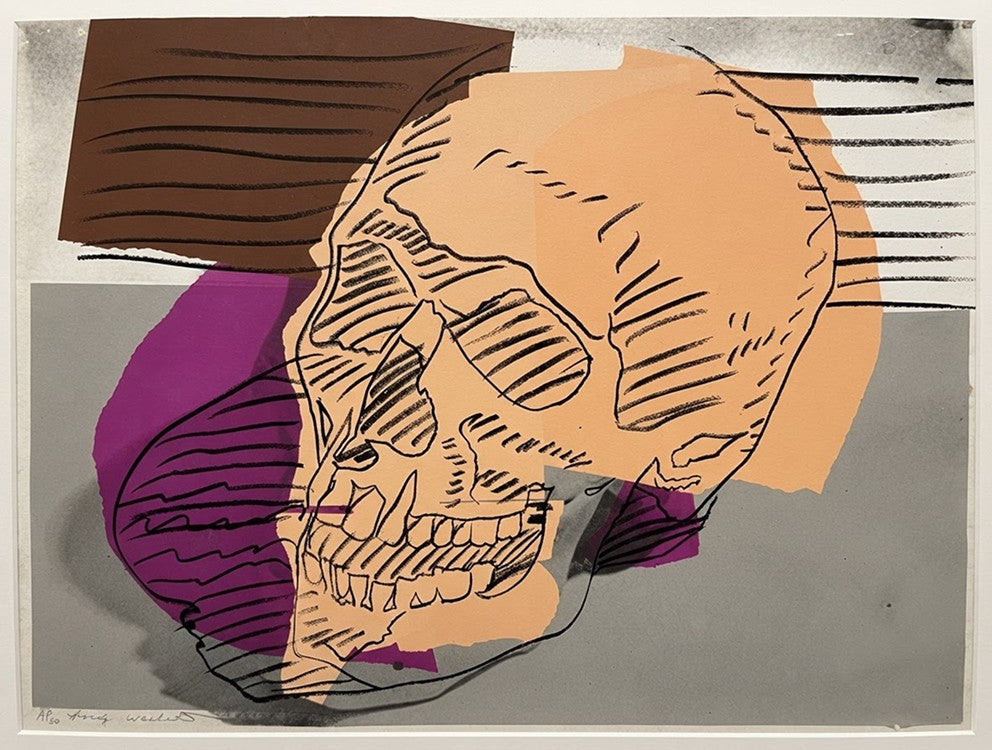
Consumer Culture Goes on the Gallery Wall
Warhol watched America turn the supermarket into its great shared space. In 1962 a Los Angeles gallery hung thirty-two soup canvases in a row, one for every flavor Campbell's sold, and in 1964 he filled a New York gallery with plywood Brillo Boxes silkscreened to look like grocery cartons. Packaging was the imagery everybody already knew, so he gave it the respect other painters gave to saints and landscapes.
Campbell's Soup and the Shelf Full of Portraits
The 1962 canvases made the can a portrait subject, every flavor lined up like a family photograph. Six years later Warhol returned to the image with Campbell's Soup I, a portfolio of ten screenprints in which every flavor gets its own palette. The cans keep their lettering and their familiar shape, and you feel the affection and the joke at once. Nothing in his work says "supermarket" as fast as the soup can does. Campbell's Soup I: Cream of Mushroom FS II.53 is a 1968 screenprint from that portfolio.
Campbell's Soup I: Cream of Mushroom FS II.53 (1968)
See it in our collection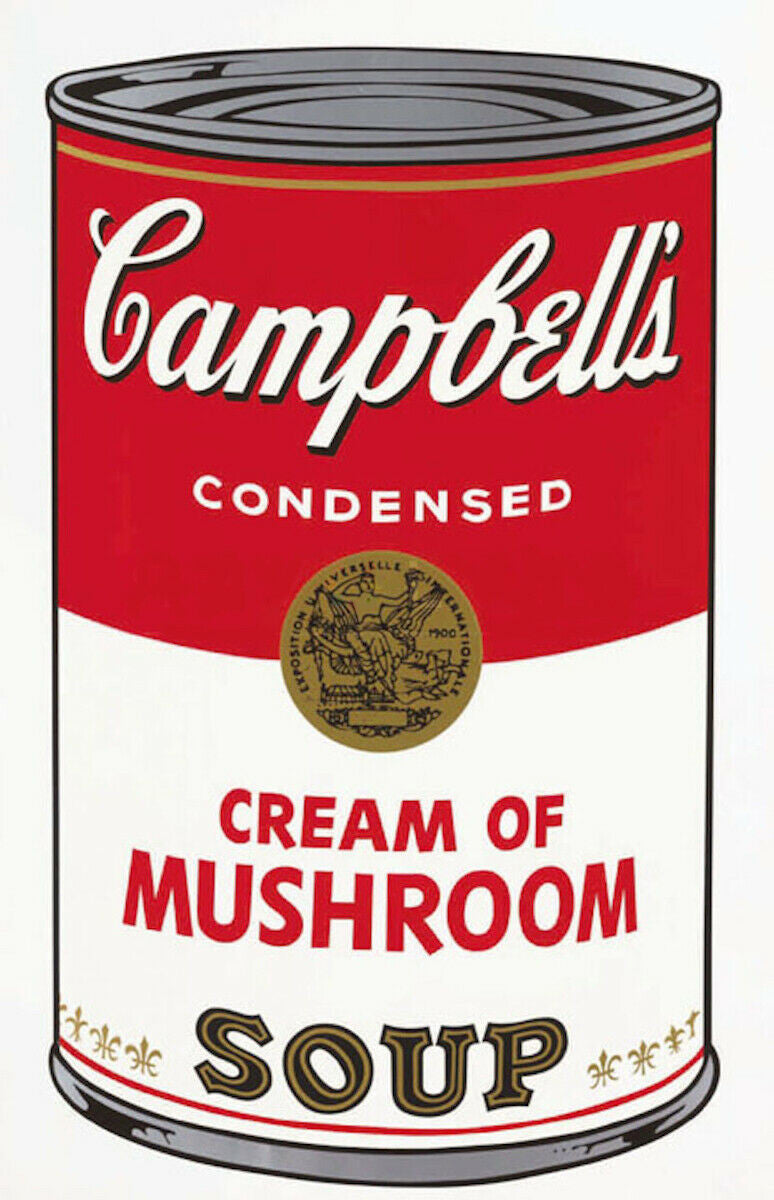
The Souper Dress, Soup You Could Wear
By the mid-1960s disposable paper dresses were a fashion craze, and Campbell's joined in: for two soup labels and a dollar, you could mail-order a dress printed with rows of the familiar can. Within a few years of the first soup canvases, Warhol's subject had left the gallery and reached the wardrobe. The Souper Dress in our collection is not by Warhol himself but an unsigned paper dress after his soup cans, printed in color on cotton paper.
Souper Dress (1965)
See it in our collection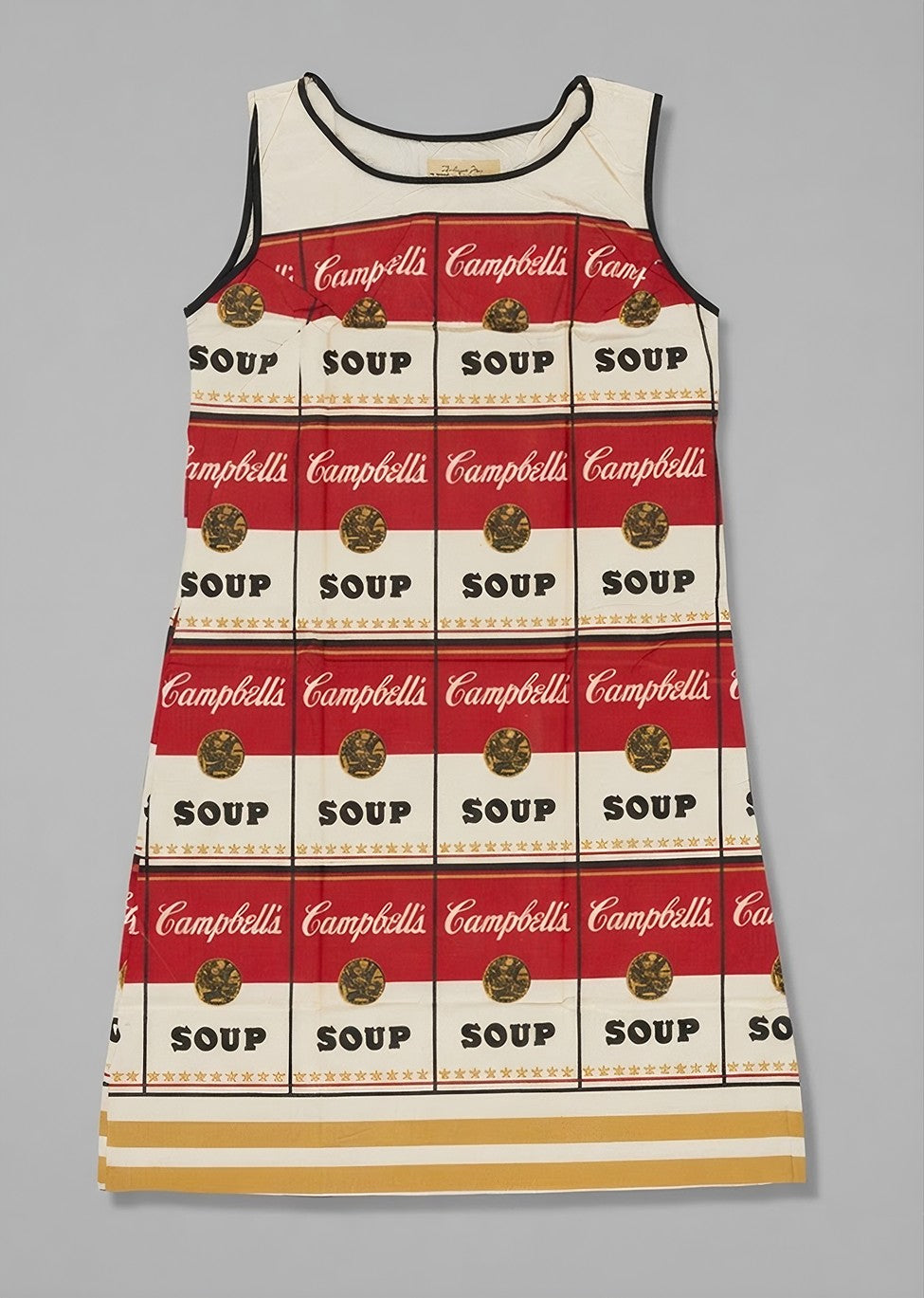
The Dollar Sign, Money Reduced to a Symbol
Money turned up in Warhol's art early; he painted dollar bills in 1962. By 1982 he had distilled the idea to the symbol alone. He once called good business the most fascinating kind of art, and the dollar sign looks like that remark rendered in color, a bold, glossy mark that makes wealth look like decoration. $ Dollar Sign FS II.276 is a 1982 screenprint on museum board from his Dollar Sign portfolio.
$ Dollar Sign FS II.276 (1982)
See it in our collection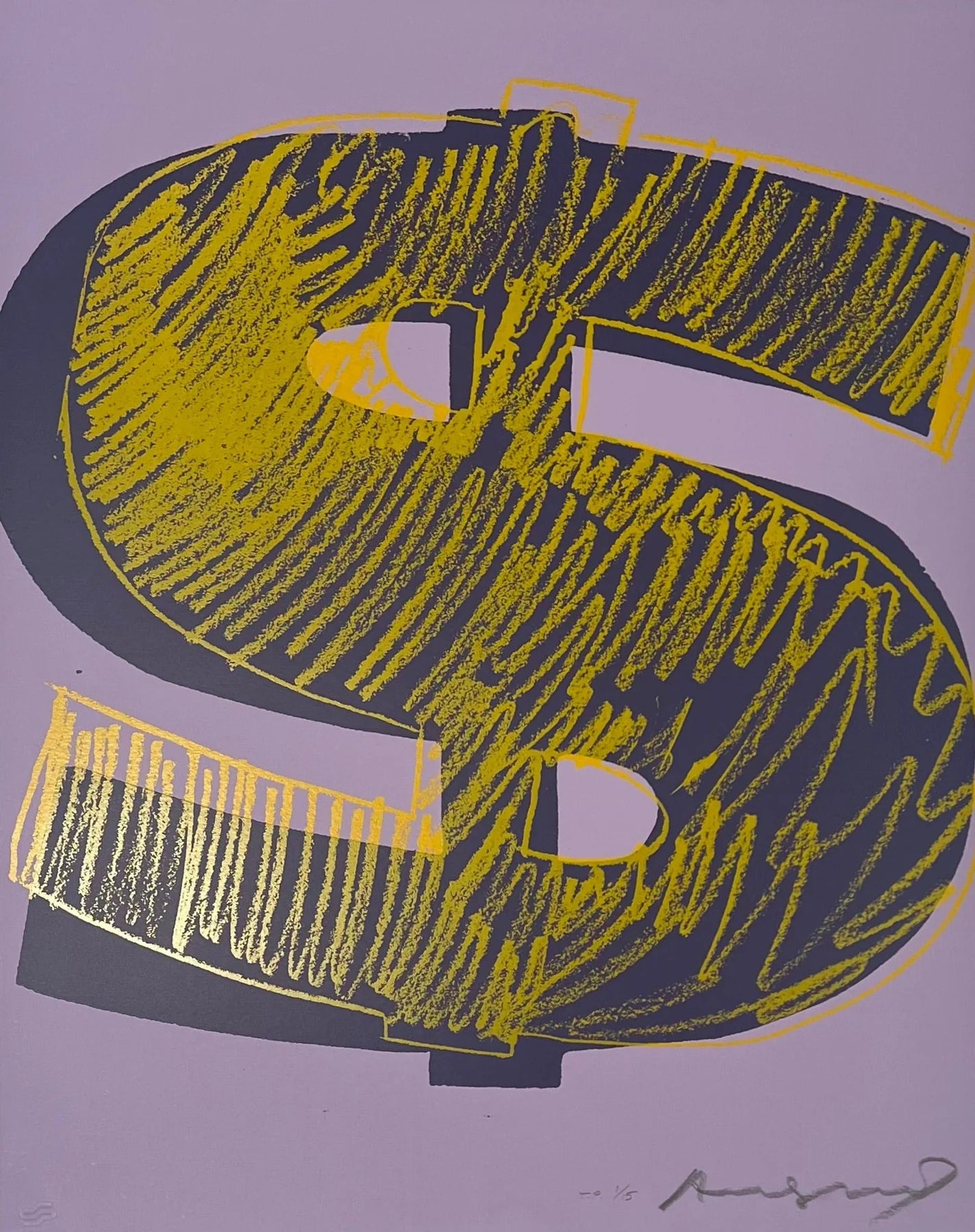
Volkswagen and a Return to the Ad Pages
Warhol began his career drawing advertisements, and in 1985 he went back to them. His Ads portfolio takes well-known brands such as Volkswagen and Blackglama and gives each the full silkscreen treatment. The illustrator who earned his living from commercial work in the 1950s now treats an ad as a subject worthy of a gallery wall, and the friendly shape of the Beetle holds up well as a portrait. Ads: Volkswagen FS II.358 is a 1985 screenprint on museum board.
Ads: Volkswagen FS II.358 (1985)
See it in our collection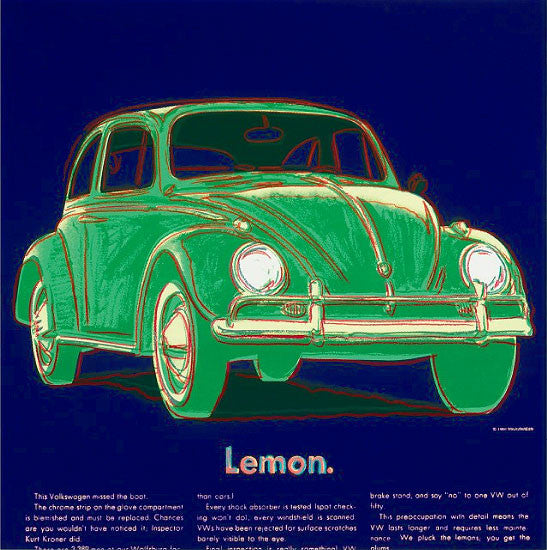
Onion Soup and the Return to the Can
In 1986, the year before his death, Warhol painted soup again. Onion Soup is acrylic and silkscreen on canvas, the materials of his early triumphs, and the can that made him famous in 1962 returns with the assurance of an artist who knows exactly what it means. Look closely at the canvas and you can feel how long he lived with this subject. That same year he turned his camera on himself.
Onion Soup (1986)
See it in our collection
Warhol Turns the Camera on Himself
In 1986 Warhol photographed himself in a towering fright wig, his face floating out of a dark background, and turned the pictures into Self-Portrait paintings and prints. He died in February 1987, so those images stand near the end of a career spent studying how pictures make people famous. By then the pattern you have followed through these pages had held for more than two decades: find a picture the world already knows, add color and repetition, and let people see it freshly. Even his own face became one more image in circulation.
The next time you meet famous art by Andy Warhol, ask where the photograph came from. The answer opens a conversation between his images: the faces fame made, the headlines that frightened and fascinated him, the products that filled America's shelves, and the camera that stood behind them all.
Let's Talk About Starting Your Warhol Collection
If one of these images stayed with you, that is a fine place to begin. Warhol worked in many forms, from silkscreened portraits to Polaroids to the soup-can dress his work inspired, and each one feels different once it hangs in your home. At Premier Pop Art, we can talk through the work that caught your eye, share what we know about it, and help you picture it in your own space.
Collecting Warhol begins with a picture you want to keep looking at, and our team will fill in the rest of the vocabulary with you as you go. Tell us which of his obsessions pulls you in, and we will suggest pieces from our collection that suit your taste and your budget, with every detail laid out clearly so you feel confident at each step.
Tell us which Warhol caught your eye
FAQs: Famous Art by Andy Warhol
What is Andy Warhol's most famous work?
Andy Warhol's most famous works are the Campbell's Soup Cans, first shown in 1962, and the Marilyn Monroe portraits he began later that year. Both treat a mass-market image as a portrait subject, and both helped define Pop Art. Shot Sage Blue Marilyn sold for $195 million at Christie's in 2022, an auction record for an American artwork.
Why did Warhol repeat the same image so many times?
Warhol repeated images because repetition mirrored how the mass media worked in his time: the same face or headline appeared everywhere, over and over. Silkscreen made repeating easy, since a single screen could print again in new colors. Many critics also read the repetition in his disaster pictures as a comment on how constant exposure dulls our reaction.
Where did Warhol find the images he used?
Warhol took most of his images from existing sources: publicity stills for Marilyn Monroe and Elvis Presley, press photographs for the Electric Chair and other Death and Disaster works, and product labels for the soup cans. From the early 1970s he also shot his own Polaroids and used them as the basis for commissioned portraits.
Where can you see Andy Warhol's work in person?
The Andy Warhol Museum in his hometown of Pittsburgh holds one of the largest collections of his work, covering paintings, drawings, prints, photographs, and films. Major modern art museums in New York, London, and other cities also show his work, though what hangs changes with each exhibition. Check a museum's current schedule before you travel.
How do you choose a first Warhol artwork to live with?
Choose your first Warhol by starting with the image you most want to keep looking at, whether that is a face, a product, or a photograph. Next, review the medium, size, edition details, and documentation for the specific work, and ask the gallery about anything unclear. Comparing a few pieces side by side helps you find the right fit.