


Artist Spotlights
Peter Max’s Umbrella Man:
A Figure to Remember Him By
An umbrella held up in a sky that is not raining, and a man who will not turn around. What is he looking at?
Look at the picture long enough and you notice what is missing: his face. The Umbrella Man has his back to you, a coat on his shoulders, a hat on his head, and a small umbrella held high. He is looking out at something you cannot see yet, and the painting offers one way to find out. You have to stand where he stands.
Peter Max painted that man for decades, and when Max died this September, at 88, the Umbrella Man was the picture we thought of first. The obituaries reached for the words you would expect: psychedelic, flower power, the Sixties, and every one of them fits.
The Umbrella Man shows another side of Max: an artist who kept returning to a figure who simply stops and looks out.
That is how we would like to remember him: by joining his Umbrella Man and looking out for a while. We will start right behind his shoulder, back away one picture at a time, and finish with the one painting where someone finally turns around and looks at us.
On the way, you will find out where the Peter Max Umbrella Man came from, how to read any version you meet, and what to ask before you bring one home. If you would rather begin with the whole sweep of his career, our online Peter Max exhibition is a good place to do it.
Right Behind His Shoulder
Start as close as the picture allows. In Umbrella Man (Original), a 2010 acrylic on paper, the figure fills most of the frame. His coat is a patchwork of bright blue, red, and gold that deepens to purple at the hem, his round hat sits low, and a red umbrella with yellow-green ribs rides above him. Beyond his shoulder, the sky is pulled into long horizontal streaks of red, cream, and pink.
Umbrella Man (Original), 2010
See it in our collection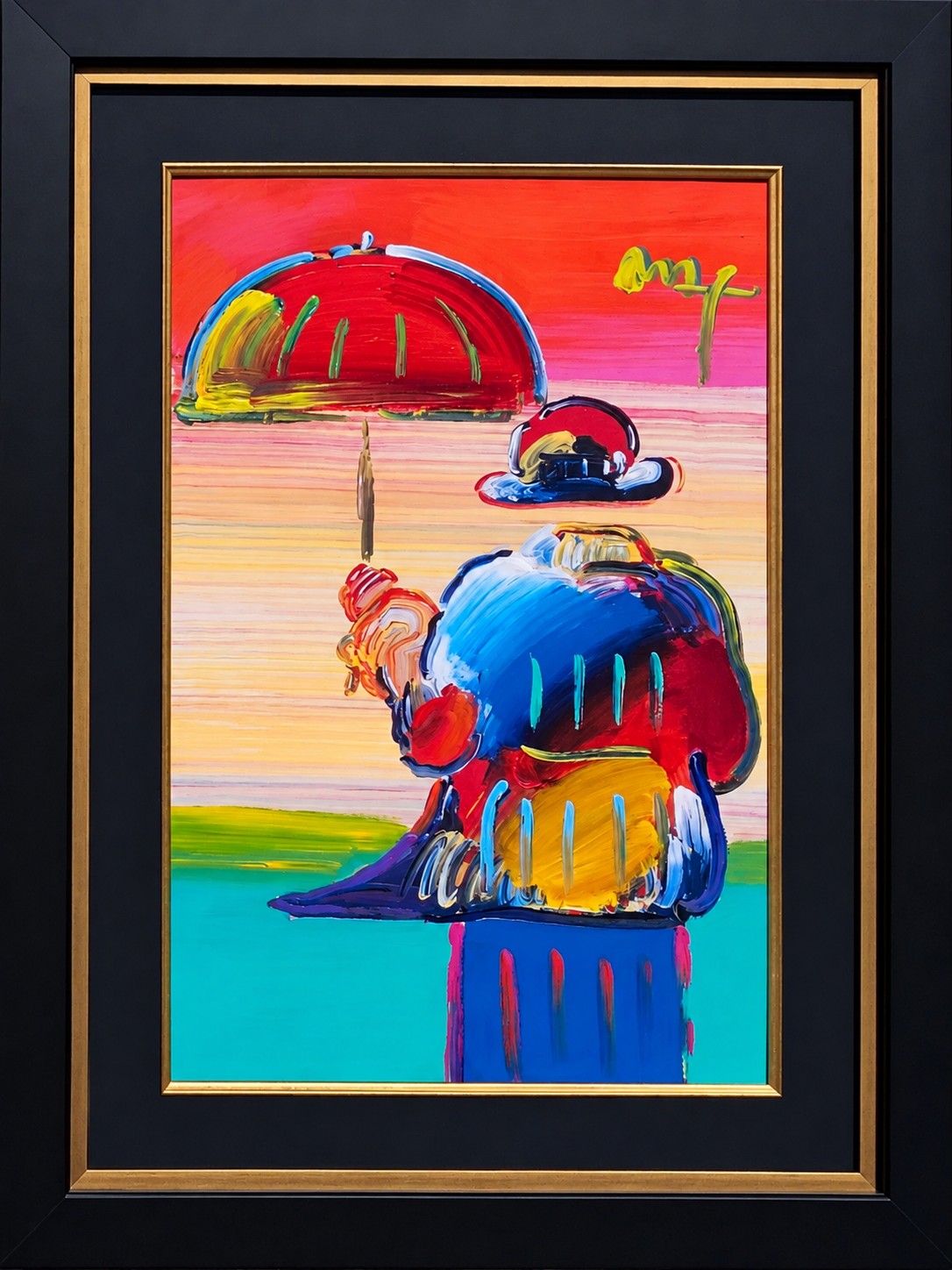
Stand this close and you almost forget to ask who he is. People do ask, though. According to the Peter Max Studio, the figure first appeared in the 1980s, during what it calls Max’s Neo-Fauve period, inspired by a famous photograph of the cellist Pablo Casals playing his cello on a beach. The studio calls him Felliniesque: a man in a coat and hat, seen from behind, looking toward the horizon.
Look at what Max kept from that photograph and what he dropped. The cello is gone, and the horizon stayed. We read that as a change of job, from the man who plays to the man who watches, and Max’s own words lean the same way. He wrote that his meditating figures stand or sit to observe the changing phenomena of nature, and he called such a figure “a projection of myself.”
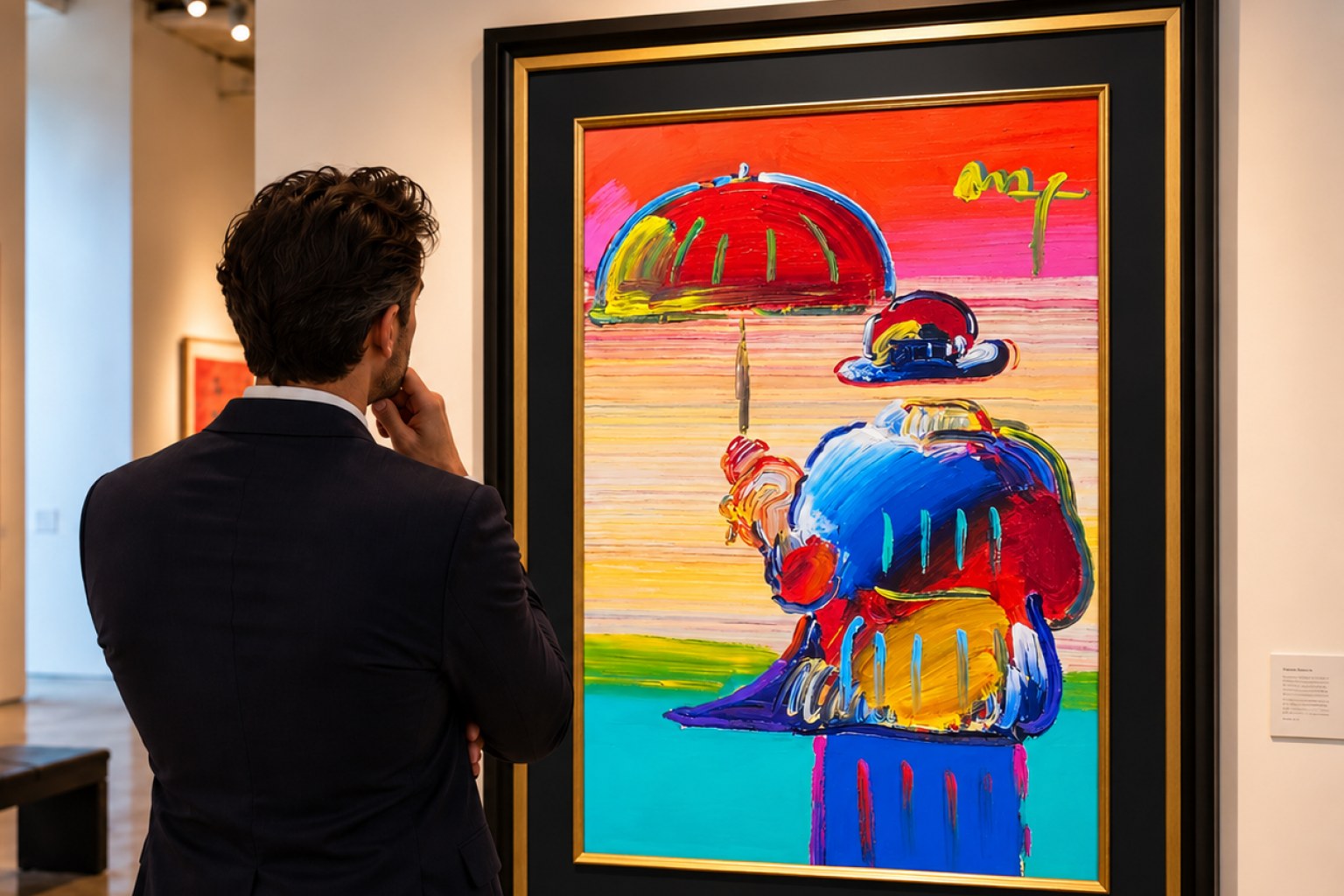
From this close, nothing stands between you and the picture but his shoulder. Follow the long streaks of the sky and the loose strokes of the coat, and you begin to see it the way Max might have, from just behind the man, looking out. Of all the places to stand in a Peter Max painting, this is the most intimate one.
Three Steps Back, After Dark
Step back and the man gets smaller while the world around him gets bigger. New Moon Umbrella Man, a 2007 acrylic and mixed media on paper, drops him into the night.
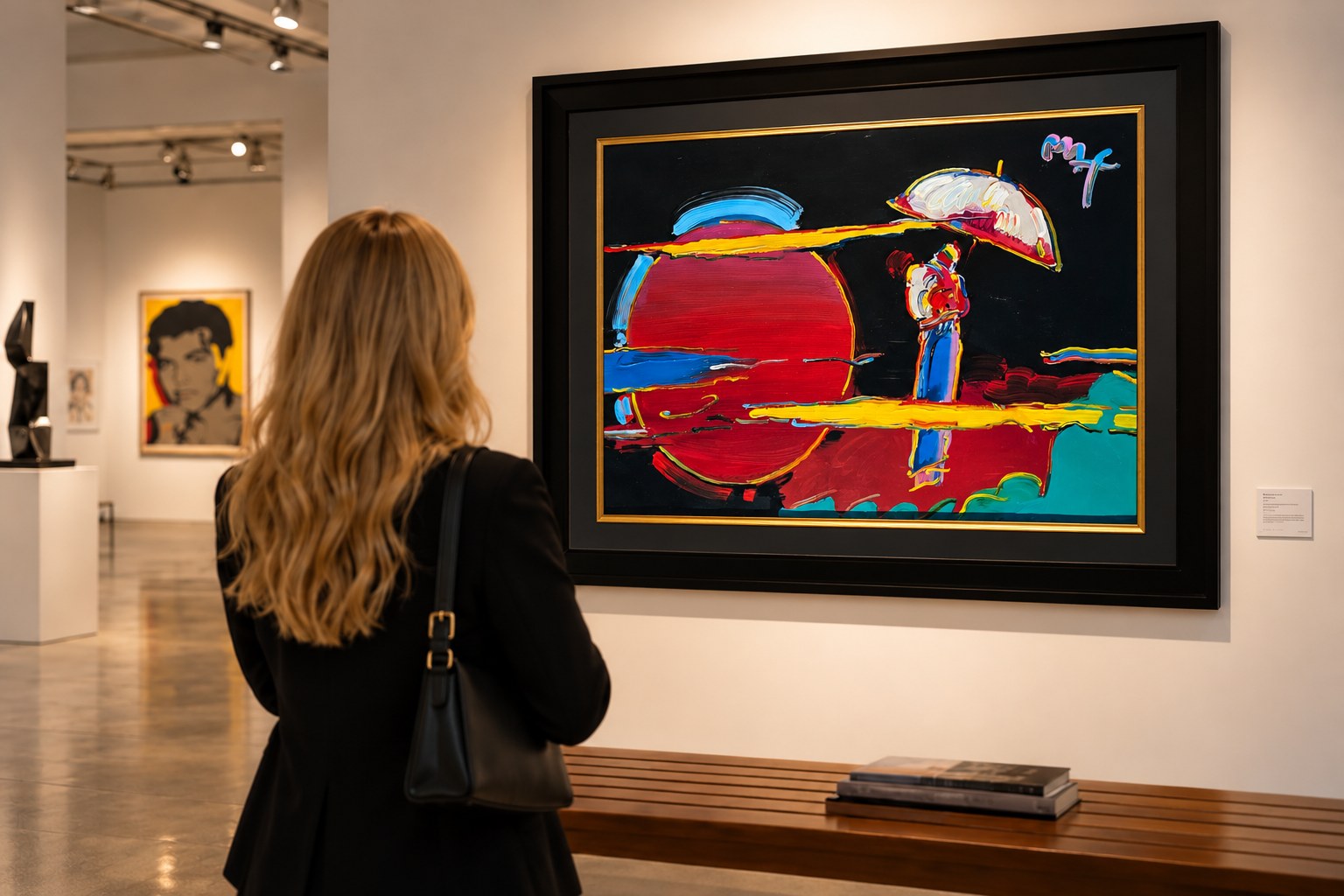
The background is black. A large crimson disc capped with a bright blue arc fills the left side, and bands of yellow and blue slide across the dark like streaks of light.
The figure stands right of center in a white and red jacket and blue trousers, holding a silver-white umbrella rimmed in red. One of the yellow bands drifts across his legs like a low cloud, and the rest of him continues below it, while teal hills lift at the bottom right.
New Moon Umbrella Man, 2007
See it in our collection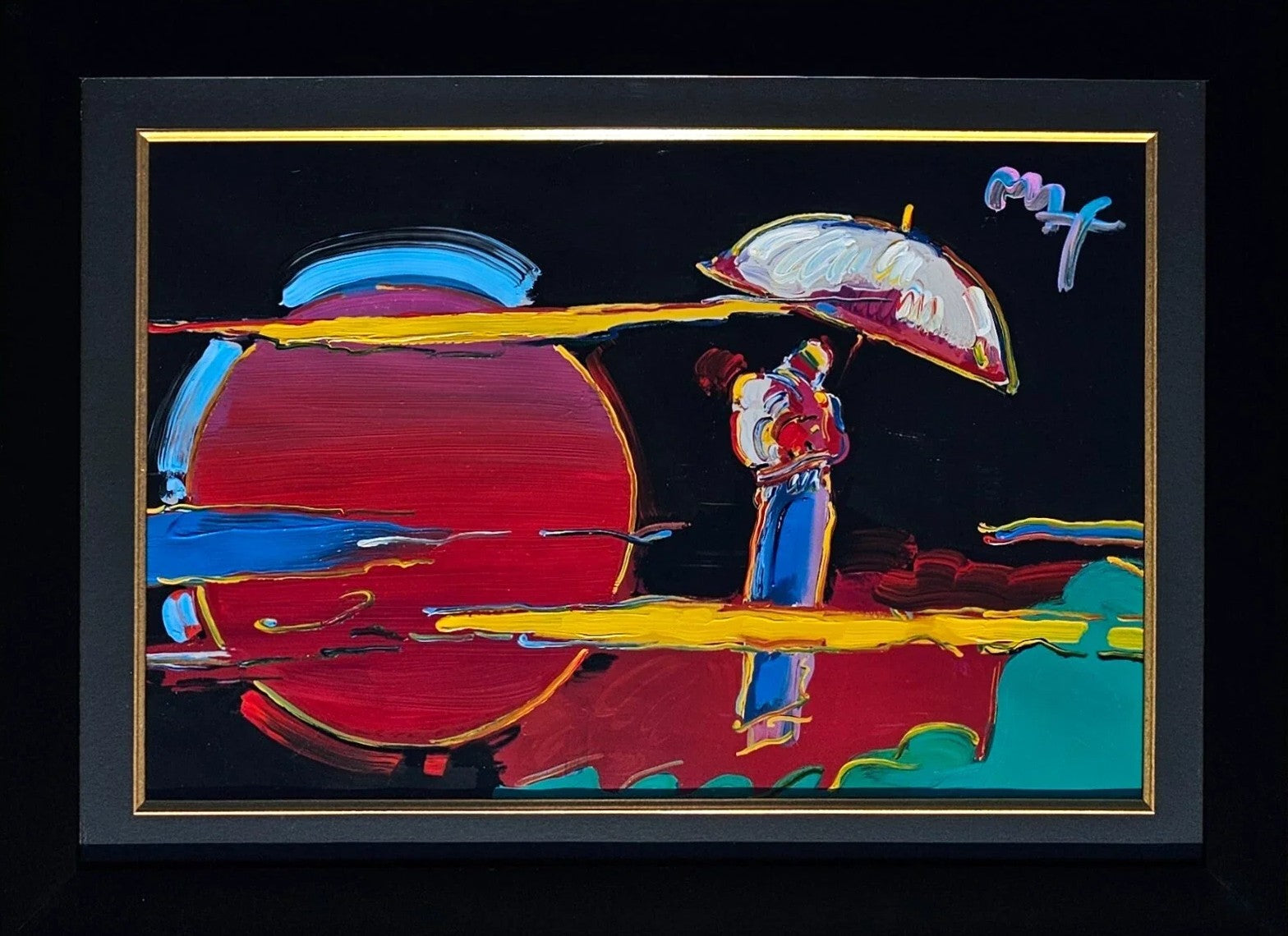
Max was looking at the sky long before he painted it, since his fascination with astronomy goes back to his youth. A title like New Moon fits a painter who kept a sky in so many pictures. Here the umbrella takes on a new scale: a small pale canopy under a very large night.
Dark backgrounds change how a color behaves. The red and yellow seem to lift out of the black, and the picture holds a wall you pass in the evening. Like the first, this is a unique work, signed by hand. When you choose one, ask where in your home a night scene would live best, and at what hour you will look at it most.
Far Enough to See the Whole Sky
Keep walking backward and the figure shrinks to almost nothing. In Umbrella Man I With Rainbow Sky, a 1990 serigraph, he is a small pink and red shape at the lower right, with a long shadow on a flat teal expanse. Above him floats a cloud built from rainbow arcs, pink, yellow, orange, cream, and gray-blue, stacked like scales against a dark teal sky.
Umbrella Man I With Rainbow Sky, 1990
See it in our collection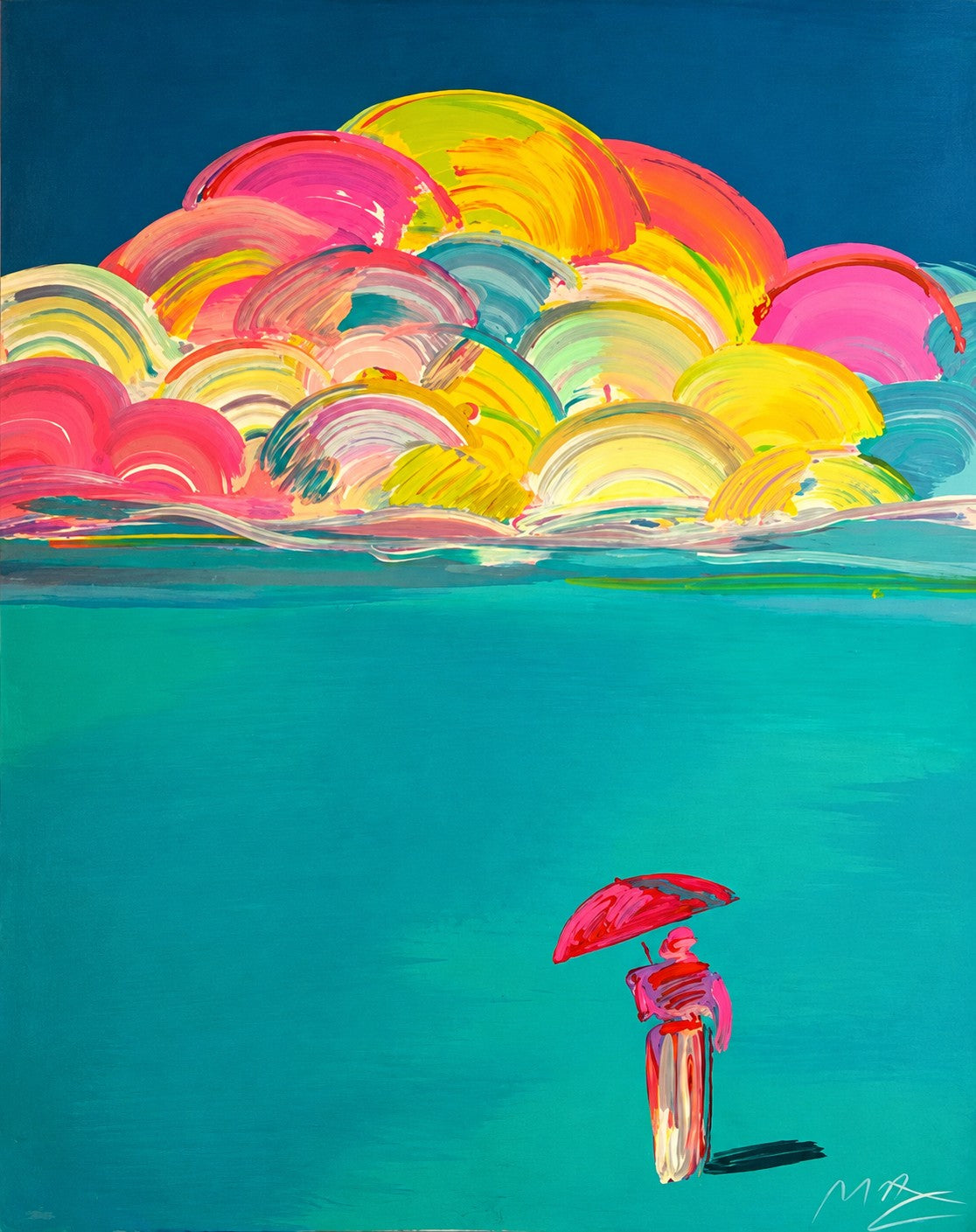
Now you can see something the closer pictures only hinted at. Nobody in this painting is getting wet! In none of the pictures on this walk is it raining. The umbrella has no weather to fend off, which leaves it a different job: a small, portable roof to stand under while you look. Shelter, here, becomes a way of paying attention.
That is why he can face the horizon without hurrying toward it. With a roof overhead and an open sky ahead, he has all the time in the world to watch what comes next.
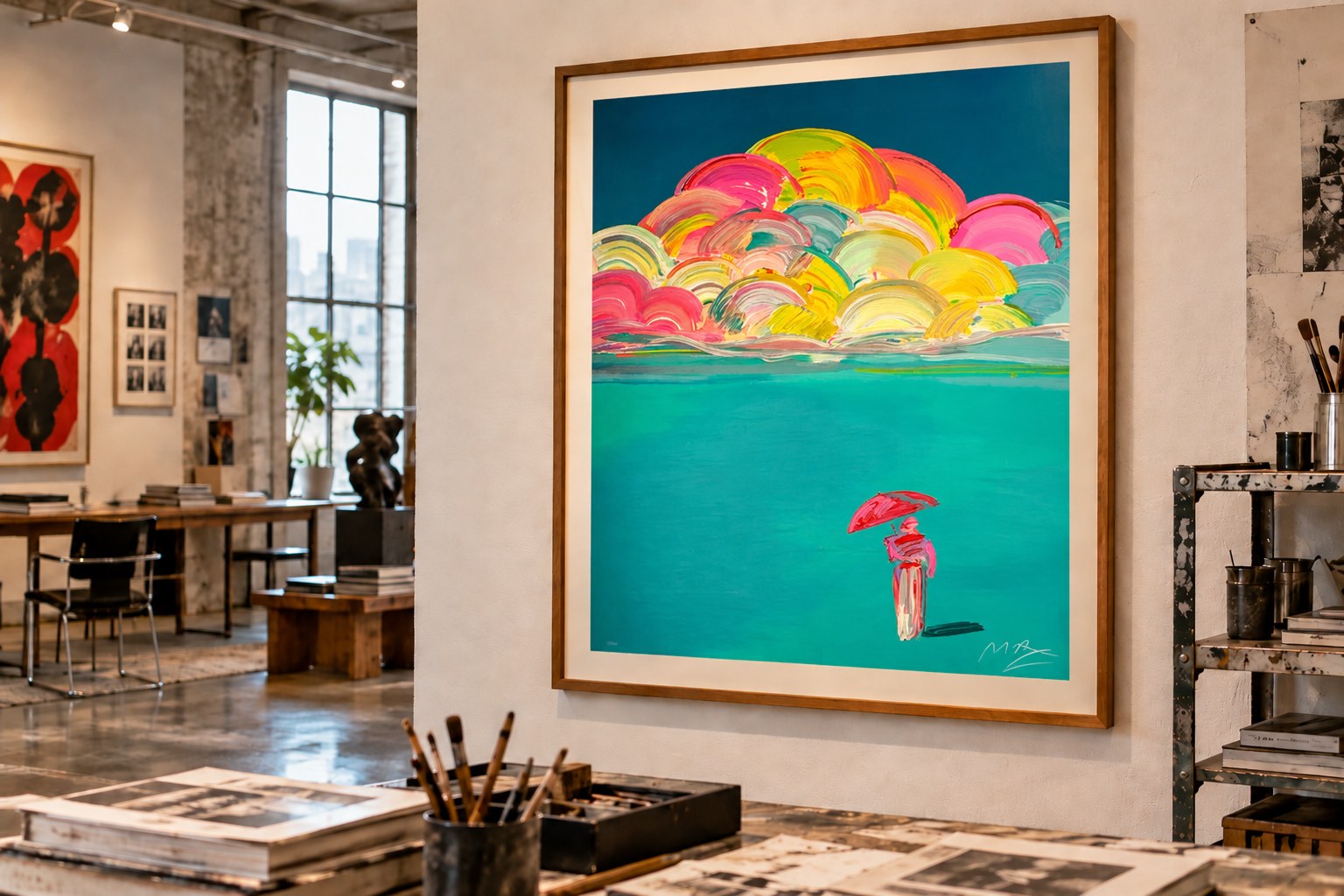
You now have three questions that work on any version of the Peter Max Umbrella Man: how large is the figure, what is the sky doing, and how much of the composition is horizon? Your answers tell you how the picture wants to be lived with, whether as a shoulder to stand beside, a night to sit in, or an expanse to cross.
There is one more thing to notice, and it only shows from this far away. Look at the small figure, a column of pink and red under a red umbrella, and ask who it is. Some viewers will see a man, because the title says so.
Others will see a woman, and the picture does not settle the question. Max once described figures like these as a projection of himself, and this one is open enough to take on anyone who stands behind it.
The One Who Looks Back
Every walk needs an exception, and this one ends with it. In Two With Umbrellas, a 1978 serigraph, a woman in an orange dress with pink ruffled cuffs stands in the foreground against a salmon-pink background and faces us. Far behind her, on a pale ledge, two small red figures stand close together, each holding an umbrella.
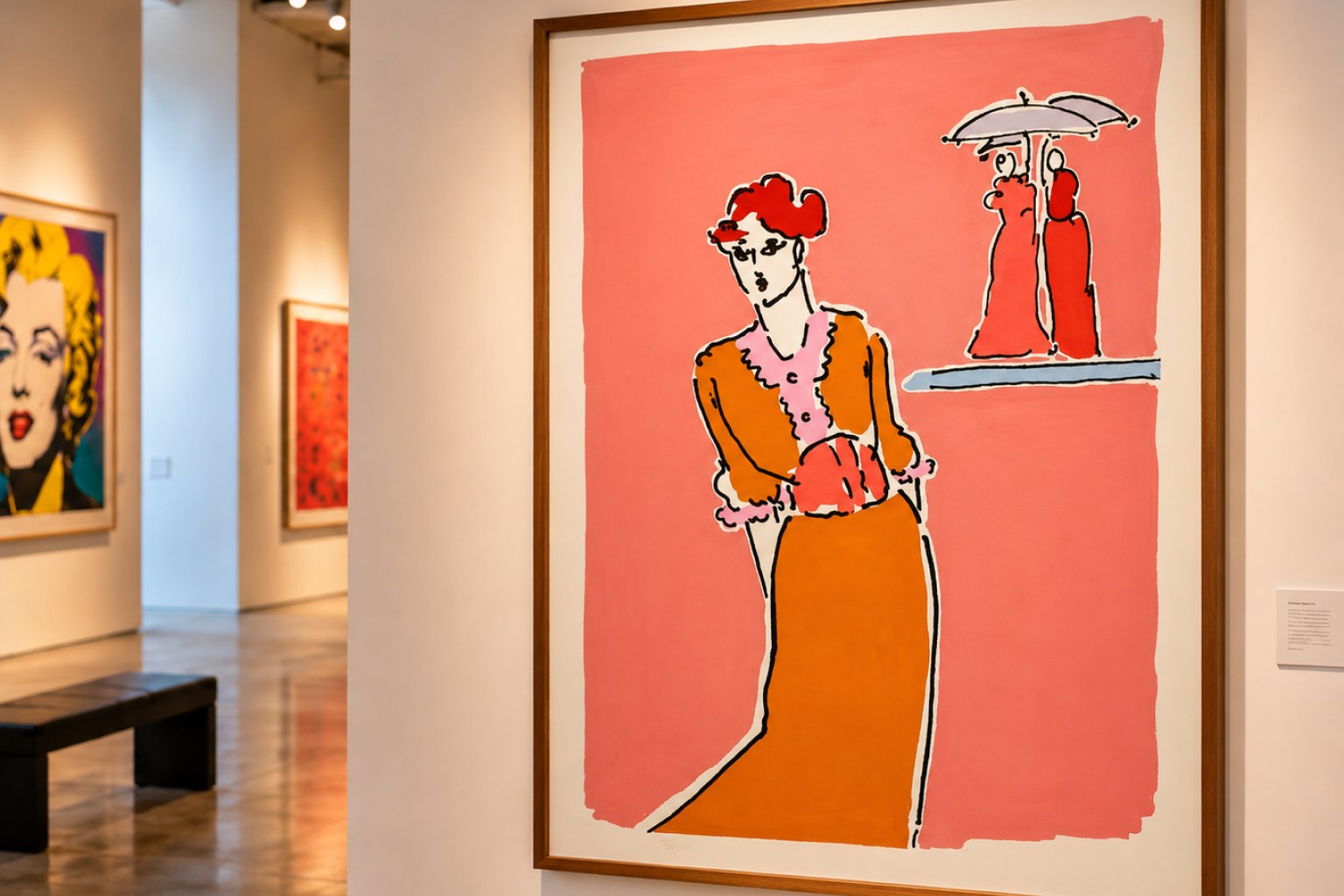
The studio places the Umbrella Man’s arrival in the 1980s, so this picture is older than he is. It shows that the umbrella was already on Max’s mind years before the man appeared, and that it could already bring two people close together.
Her outline is a thin black line around flat fields of color, the draftsman’s side of Max, and it makes a lively contrast with the loose, brushy skies and saturated palette of the other pictures.
Two With Umbrellas, 1978
See it in our collection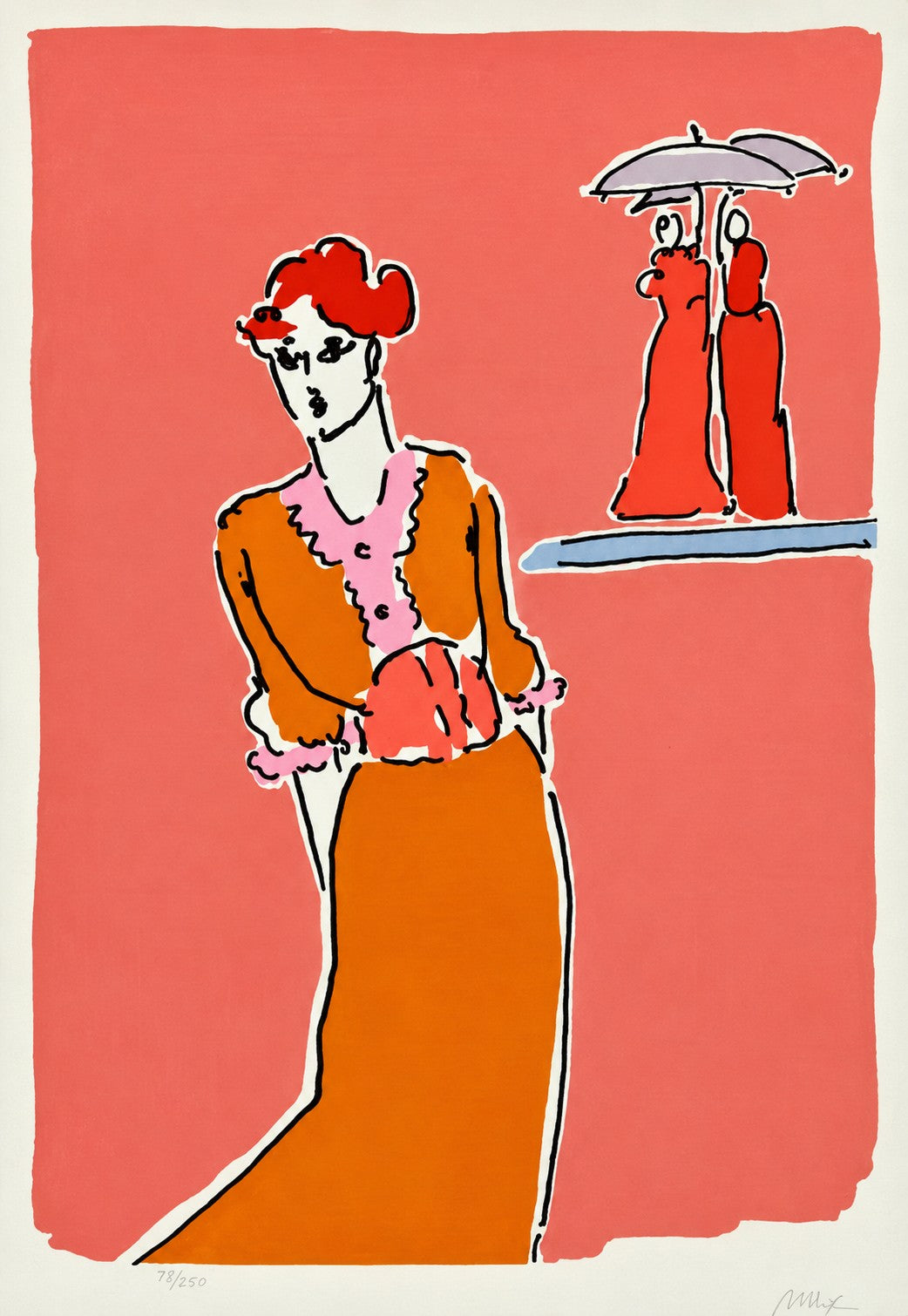
Everything else on this walk asks you to stand behind someone and look past them. This picture reverses the arrangement. The woman is the nearest thing in the frame, she turns toward us, and the figures with umbrellas shrink into the distance, which is where the horizon usually sits. For once the picture looks back.
Whatever Max meant by it, the effect is plain: after a long walk behind a man who never turns around, you feel noticed. It is a good picture to end on, because it reminds you that Max painted company as well as solitude, and that someone is always standing on the other side of a look.
Four Questions for Any Peter Max Umbrella Man
Whichever horizon you choose, the same four questions will keep you steady. Bring them to any Umbrella Man you meet:
- How was it made? An original is painted once, while a serigraph is printed through stencils in a run, and each has its own presence on a wall.
- How many exist? A unique work exists once, and a numbered edition shows a fraction such as 15/150, your copy’s place in the run.
- Who signed it, and how? Look for the artist’s hand signature and, on editions, the number beside it, and request a photograph of both.
- What comes with it? Request a gallery certificate of authenticity and, on originals, the Peter Max Studio registration number.
At Premier Pop Art, we list the medium, size, edition, signature, and documentation for each work, and we welcome questions about anything a listing leaves out. Our collector’s guide to Peter Max looks at paintings, prints, and originals across his whole career, and the habits behind limited edition prints apply to every numbered Umbrella Man.
Let’s Find Your Horizon Together
By now you may know which distance suits you: right behind his shoulder, a few steps back, or far enough to take in the whole sky. The harder question is which picture belongs in your home, and that one is easier to answer out loud.
Tell us what you have in mind: a Peter Max, another artist whose pictures stay with you, or only a color you keep coming back to. If you already know how you would like to look at it, close or far, in daylight or after dark, tell us that, too.
Our collection holds many more Umbrella Man pictures than we could walk through here, plenty of other Max works, and artists such as Warhol, Haring, Basquiat, and Britto. Whatever you want to know about any of them, we are glad to answer.
The figure is still there, back to us, looking at the horizon. Write to us about Peter Max, or about any art you would like to live with, and we will help you choose where you want to look.
Ask us about Peter Max or any artwork you love
FAQs: Peter Max’s Umbrella Man
Where did Peter Max’s Umbrella Man come from?
According to the Peter Max Studio, the figure emerged during Max’s Neo-Fauve period in the 1980s, inspired by a famous photograph of the cellist Pablo Casals playing his cello on a beach. Max, born Peter Max Finkelstein in Berlin and raised in Shanghai and Israel, painted him from behind, in a coat, hat, and umbrella, looking toward the horizon.
Why is the Umbrella Man usually shown from behind?
Max wrote that his meditating figures stand to observe the changing phenomena of nature, and he called such a figure a projection of himself. Painted from behind, the Umbrella Man lets you look where he looks, which turns the picture into a place you can stand and watch the horizon together.
What does Neo-Fauve mean?
The Peter Max Studio uses Neo-Fauve for Max’s painting period of the 1980s, when saturated color and kinetic brushwork took center stage. The name echoes the Fauves, the early twentieth-century painters known for bold, non-naturalistic color, a group that included Matisse. It describes a way of using color within his wider practice.
Which formats has the Umbrella Man appeared in?
Max made the figure into a long series of original acrylic paintings on paper and canvas, mixed-media works, serigraphs, etchings, lithographs, and posters. Originals are unique, while prints belong to numbered editions. The studio archives even include a vintage silk necktie that carries him, so the figure has traveled well beyond the wall.
What should you check before buying a Peter Max Umbrella Man?
Check how it was made, how many exist, how it is signed, and which documents come with it. For originals, look for the Peter Max Studio registration number. For editions, read the fraction and the signature. Request clear photographs of the front, the signature, and the framing, and take the time to compare a few versions before you decide.