


Artist Spotlights
The Sacrament of the Last Supper and Dalí's Sacred Universe
A guide to Dalí's Last Supper painting: what it shows, what it means, and the sacred imagery that runs through the rest of his work.
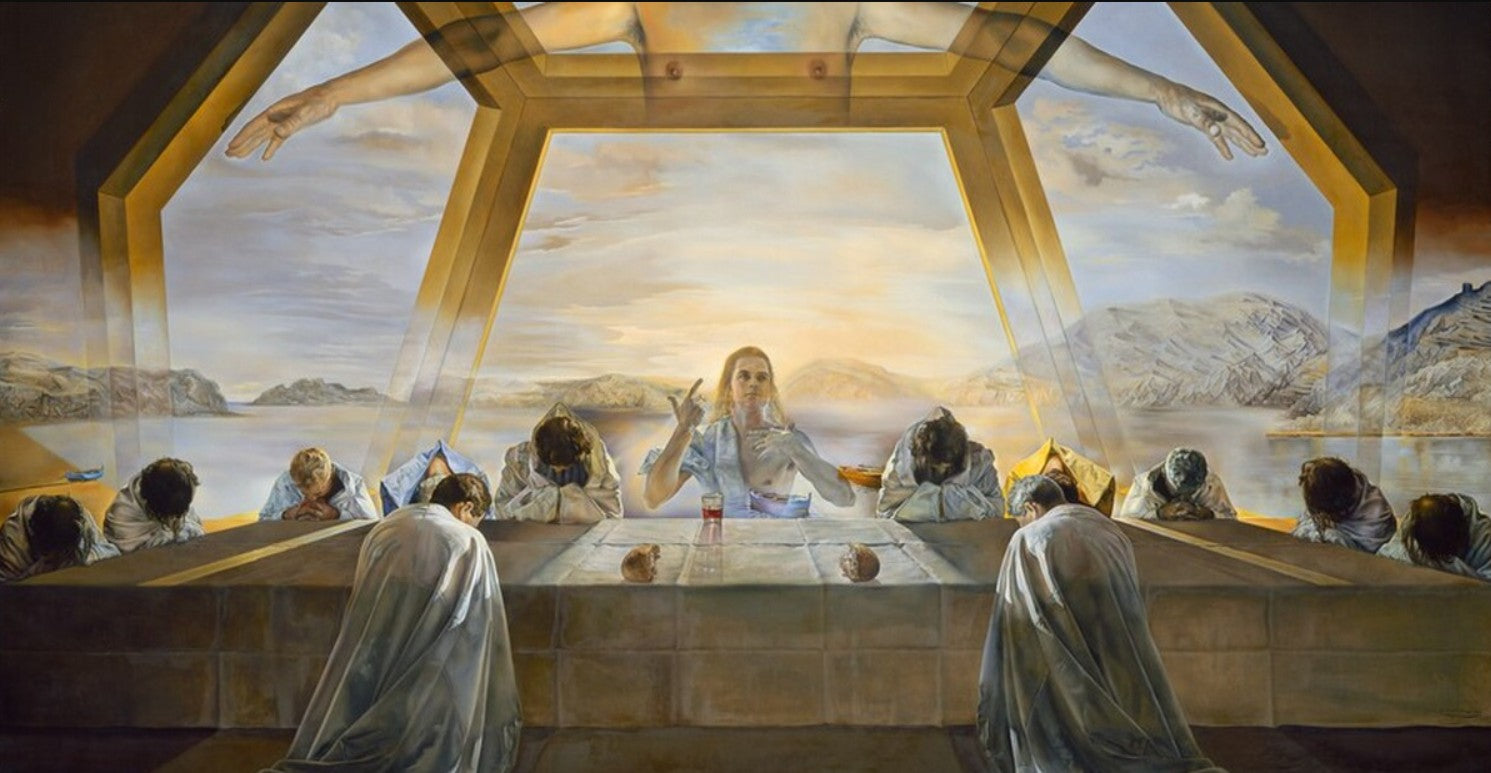
Walk into the National Gallery of Art in Washington expecting the Last Supper you grew up picturing, and Dalí will stop you in your tracks. His canvas is nearly nine feet wide. At its center a half-transparent Christ presides over a long table, little boats showing through his body, while a vast, glassy dodecahedron encloses the whole scene.
The Sacrament of the Last Supper, 1955
Stand in front of it long enough and a question forms: how did the painter of melting clocks end up painting communion? The answer runs through all of Dalí's later work, a sacred universe built from geometry, atomic physics, and an uneasy return to the Roman Catholic Church.
Dalí finished the canvas in 1955 and titled it the Sacrament of the Last Supper, a name that points straight at the Eucharist. That title is a first key: follow it through the painting's images, its geometry, its light, and its landscape, and it opens onto the rest of his religious and mystical vision. By the end, you will know what to look for in Dalí's sacred work, including in the Dalí collection at Premier Pop Art.
Reading the Sacrament of the Last Supper, Image by Image
A Table Inside a Dodecahedron
Begin at the table, where thirteen figures have gathered. Twelve are men with hidden faces, arranged as mirror images, six to a side. Since none of them is allowed a personality, your eye keeps drifting toward the center.
There it finds Christ, clean-shaven and half transparent, set exactly on the horizon line with the sun glowing behind him at the point where every line of perspective meets. In front of him Dalí placed the humblest things in the picture, a beaker of wine and a loaf of bread broken in two. He painted them with the hyper-real precision that made his name, and they are the elements of Holy Communion, bread and wine.
The Figure Above the Table
Look up from the bread and you meet the strangest thing in the painting. Christ points one hand at himself and the other toward a faceless torso with outstretched arms, wide enough to span the entire canvas.
Theologian Michael Anthony Novak hears an echo of the Gospel of John, where Philip asks Jesus to show them the Father and Jesus answers that whoever has seen him has seen the Father. Read that way, one gesture says me and the other says Father.
A Coast You Might Recognize
Through the dodecahedron's pentagonal windowpanes lies a stretch of Catalonia, the same kind of landscape Dalí set behind The Persistence of Memory in 1931. Christ seems to rise out of that water, with mountains ringing the water.
The Persistence of Memory, 1931
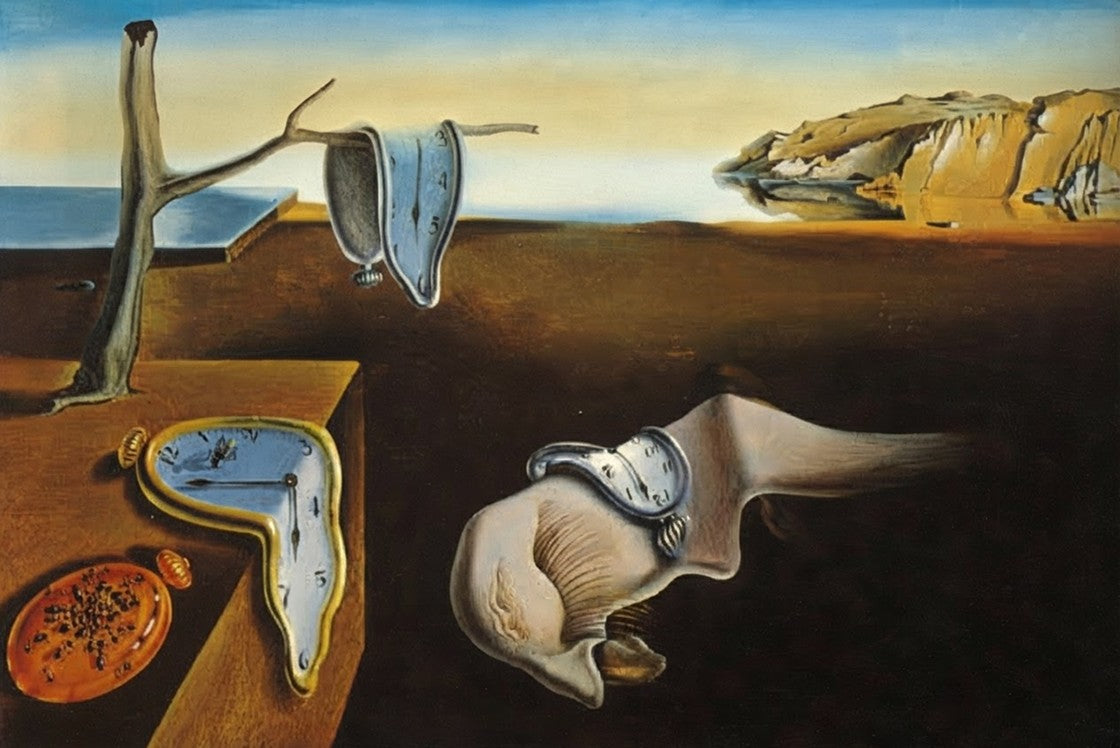
Look at the water once more and you see the trick the whole painting plays. Heaven arrives on a coast of Dalí's native Catalonia, and divinity stands in a landscape that could belong to any seaside afternoon. That meeting of exact observation and impossible vision is the signature of his best-known work.
It traveled well beyond the canvas. Dalí carried the same pairing into lithographs, etchings, and bronzes, and signed Dalí editions show that translation up close.
Salvador Dalí Last Supper: Crowd Favorite, Critic's Target
The picture exists because a collector pushed. Chester Dale, a banker, had bought Dalí's Crucifixion (Corpus Hypercubus) and given it to the Metropolitan Museum of Art, then told the painter to make one more religious picture. Dale never commissioned the Sacrament of the Last Supper, but he reserved first look, bought it on sight, and had dared Dalí to stand beside Tintoretto.
Dalí took the dare seriously, working on it for most of a year. A note he left in the museum's file calls the first Holy Communion on earth a rite of the greatest happiness for humanity, and says he wanted to join Zurbarán's mystical realism to the experiments of modern painting and make the result classic.
This Christian canvas sits a long way from the dream imagery that had made him famous from the late 1920s to the mid-1940s, and the National Gallery notes how little shock value it keeps.
Critics split hard. Theologians denounced it and art critics dismissed it, and in 1956 the Protestant theologian Paul Tillich called it junk, apparently taking it for a conventional Last Supper. But visitors saw something else. The painting became one of the National Gallery's most popular works, at one point ahead of Renoir's Girl with a Watering Can.
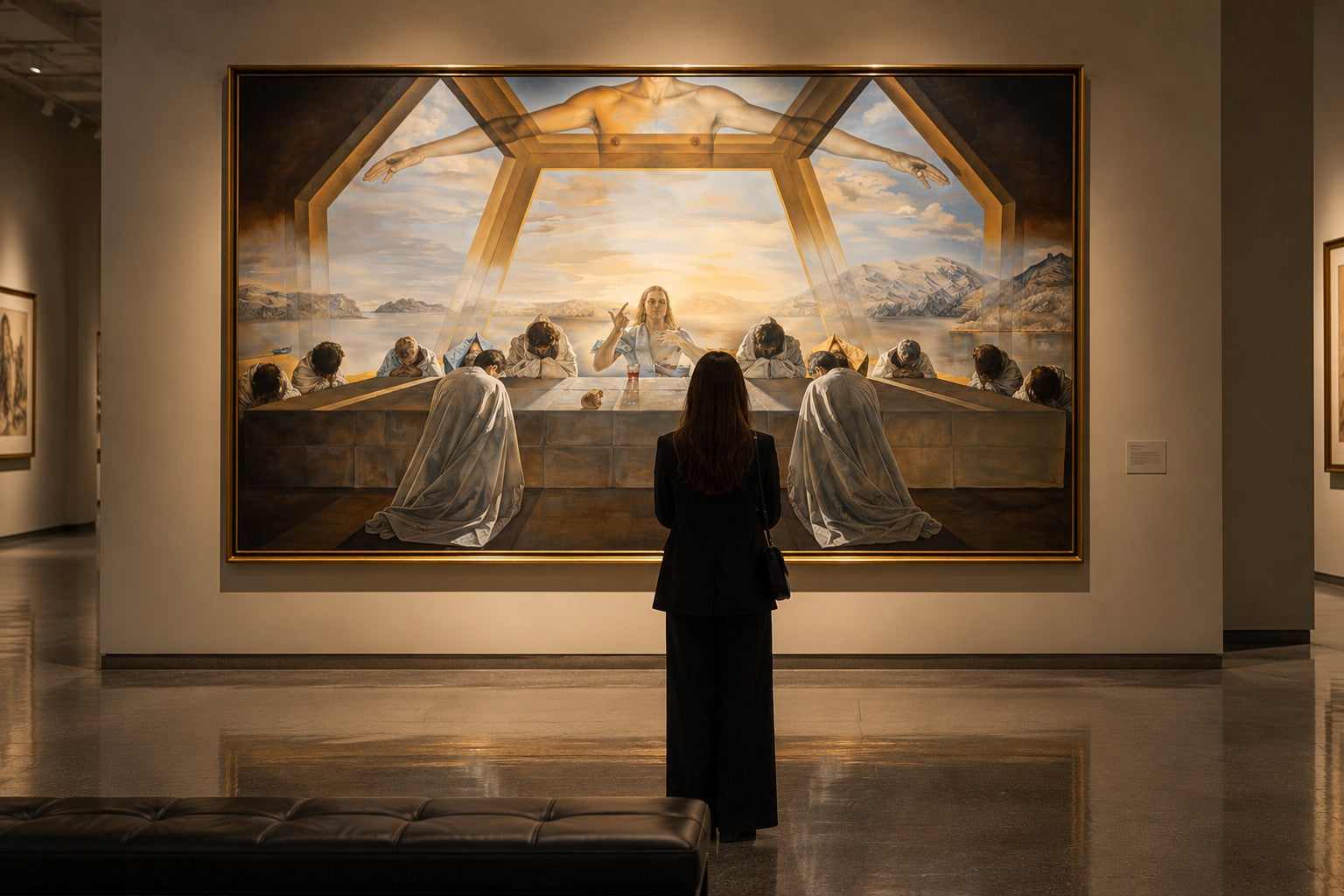
Decades later, the Catholic theologian Novak offered an interpretation that explains the gap. Dalí never meant to paint the Passover meal at all, he argued. His subject is the Eucharist, the moment when bread and wine become the body and blood of Christ and worship on earth makes present the worship of heaven.
Dalí's Last Supper, Recast in Gold
The painting was not Dalí's last word on the subject. Before he touched the canvas, he drew a study for it, which art historian Jean-Pierre Isbouts describes as an almost exact copy of Leonardo da Vinci's mural at Santa Maria delle Grazie. The finished picture breaks Leonardo's frieze apart and turns two apostles around, their backs to us, which draws the viewer toward the table's edge.
Then the subject kept traveling. In the late 1960s it surfaced in the Biblia Sacra, a Bible that Rizzoli published between 1967 and 1969 with 105 color lithographs after Dalí's watercolors. One of them is a Last Supper, and another, titled for the words "And after the morsel, Satan entered into him," catches the instant Jesus singles out Judas.
In 1975 the scene took its most unexpected shape yet: metal. Dalí's Last Supper relief exists in gold, platinum, and silver, the same subject in three different lights, so it is worth asking which metal and which edition you are looking at.
The Last Supper (Gold) is a gold patina relief, signed and numbered, from an edition of 65. It hangs on a wall like a small altarpiece, and it is the one Last Supper by Dalí that Premier Pop Art has in stock.
The Last Supper (Gold), 1975
See it in our collection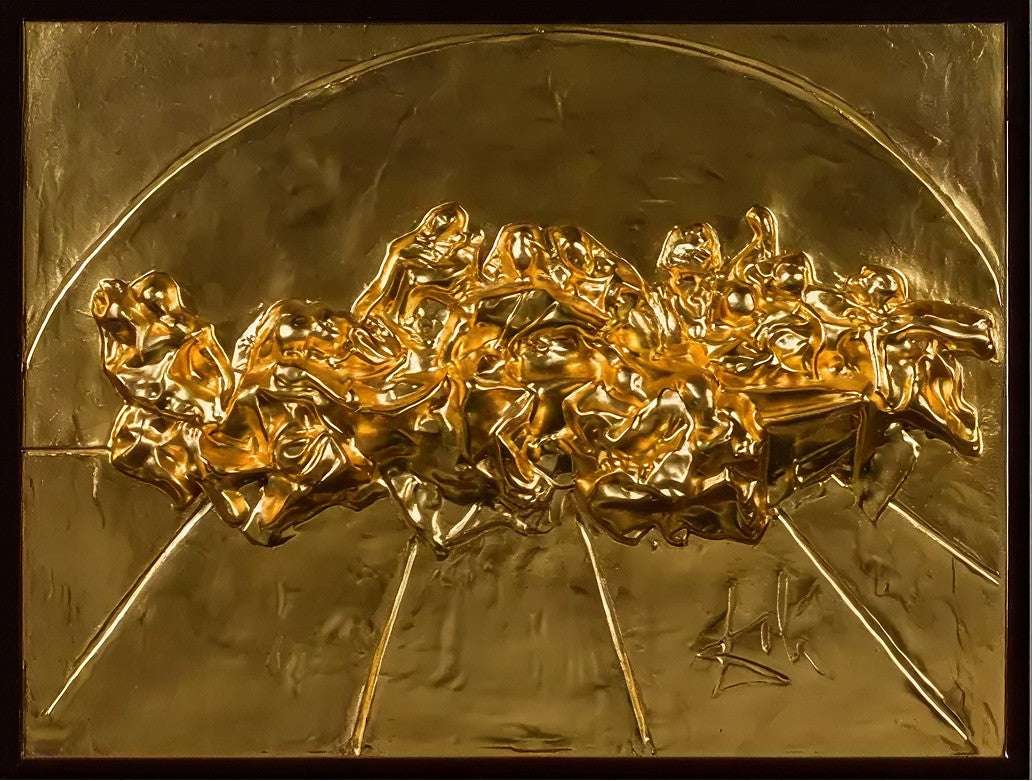
Heaven Has a Shape
Look again at the dodecahedron, the glassy shape that encloses the table. It has twelve faces, the same number as the men below, and Plato saw in this shape a picture of the universe.
Dalí built the canvas close to a golden rectangle, and the edges of the solid, seen in perspective, fall in the golden ratio to one another. He took the idea from the writings of Matila Ghyka, and he insisted that the Communion must be symmetrical, which is why the apostles mirror each other on either side of Christ.
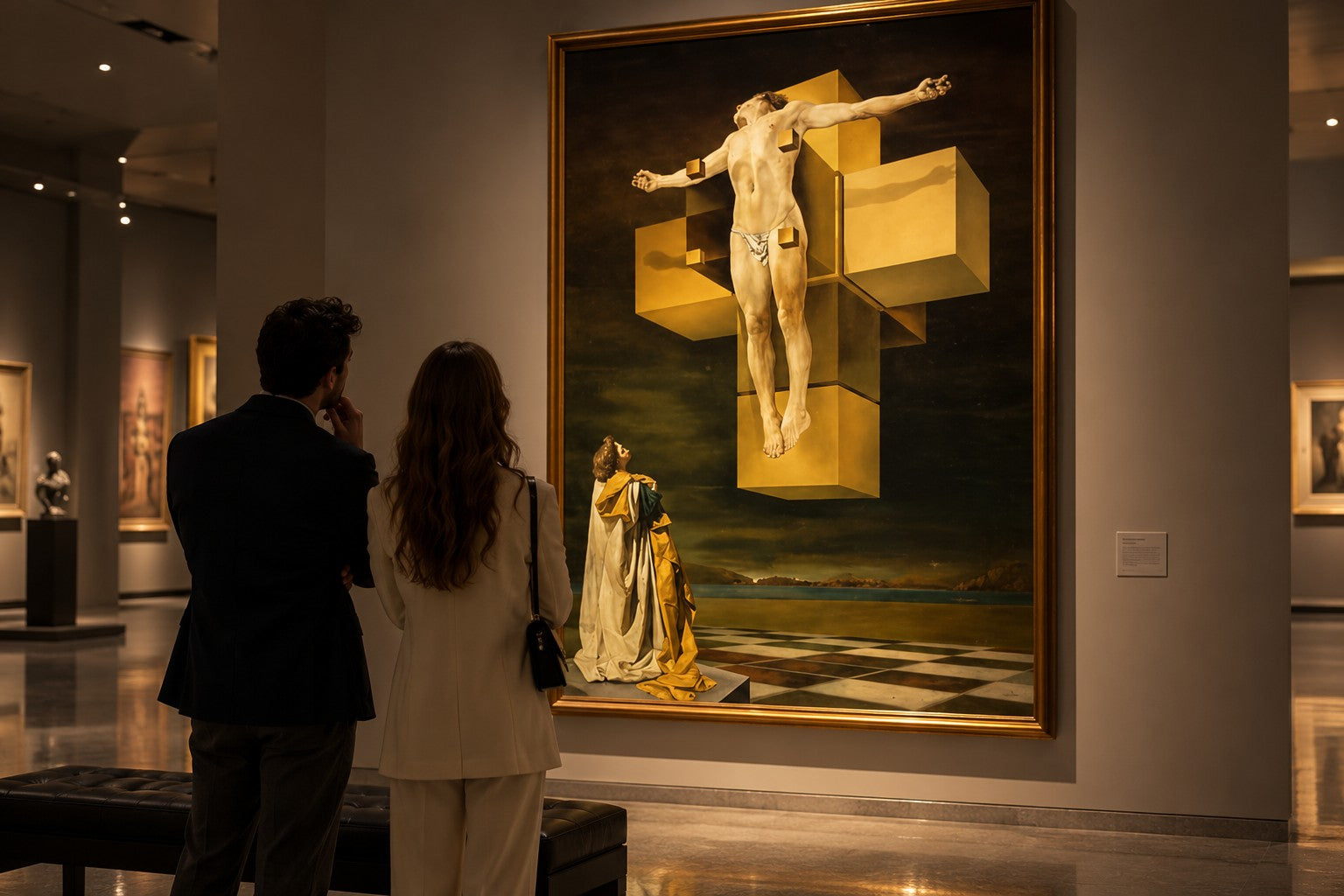
For Dalí, geometry was a way to talk about faith. In the 1950s he gave his blend of Catholicism and atomic physics a name, "nuclear mysticism," and claimed that physics was, for the first time, offering proof that God exists. The Metropolitan Museum's Crucifixion (Corpus Hypercubus), painted in 1954, shows the idea at work.
Christ levitates in front of a hypercube, a multidimensional form, with a healthy, athletic body and no nails or crown of thorns. Gala, Dalí's wife, stands by as a devotional figure who witnesses his triumph over physical harm.
The cross has a place in a home, too. Crucifixion (Dark Grey) is a solid Italian marble from 1980, one of an edition of 750, set with brass appliqués, a burst of metal rays, and four red beads. It can hang on a wall or rest on a table.
Crucifixion (Dark Grey), 1980
See it in our collection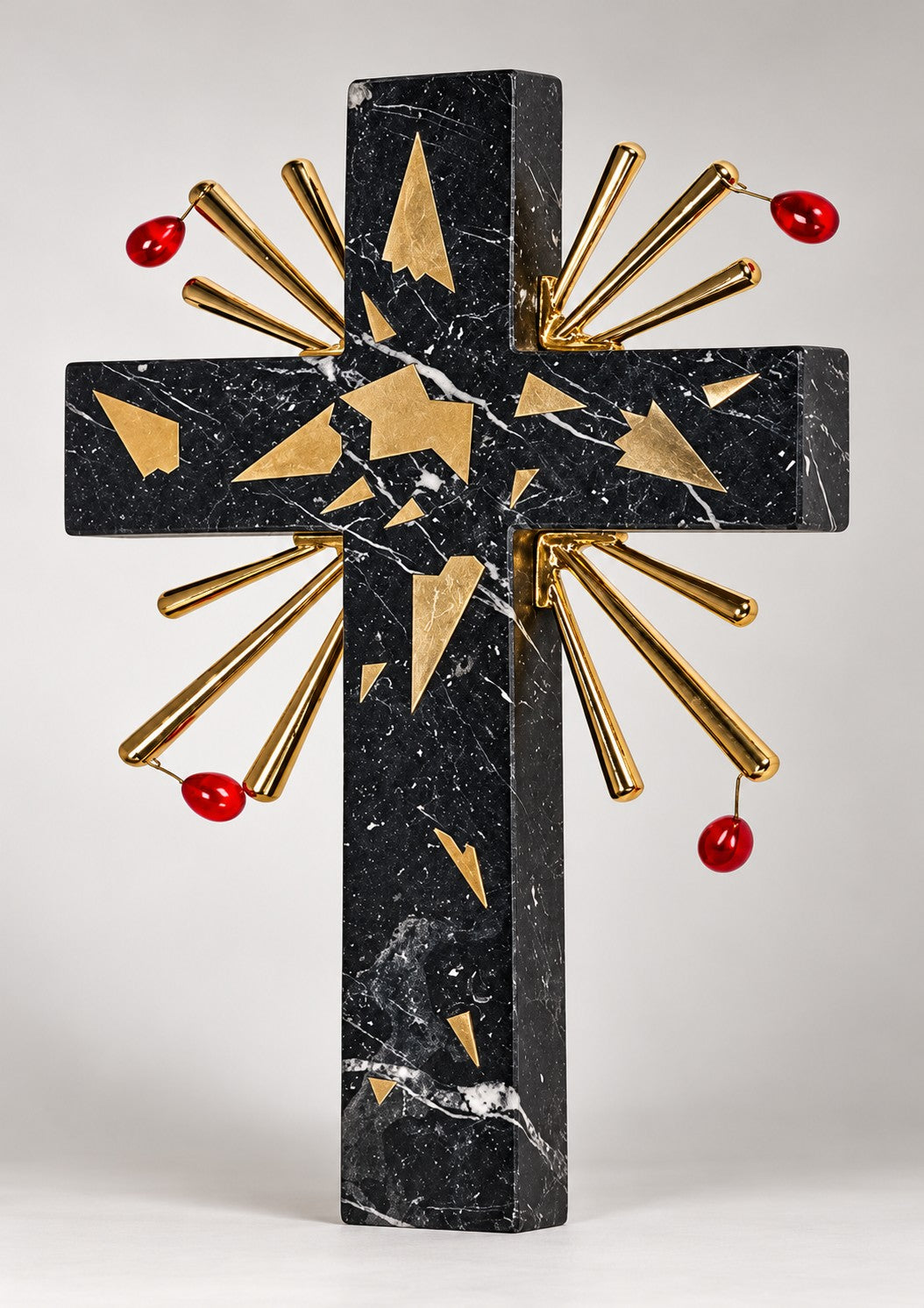
Gala and the Bay: A Holy Land Close to Home
Two things keep returning in Dalí's sacred paintings: Gala, and the bay at Port Lligat, the Catalan village where he made his home. In 1949 he carried the first version of the Madonna of Port Lligat to Rome, where Pope Pius XII blessed it. Gala is the Virgin Mary, floating above the bay.
A year later Dalí painted a second, far larger version, its air full of drifting fragments that reflect his fascination with nuclear physics after Hiroshima and Nagasaki.
Gala and the bay both appear in the name of the Madonna of Port Lligat: the Madonna is the Virgin Mary in whom Dalí pictured Gala, and Port Lligat names the bay. It is a natural place to begin living with this part of his sacred world.
Madonna of Port Lligat
See it in our collection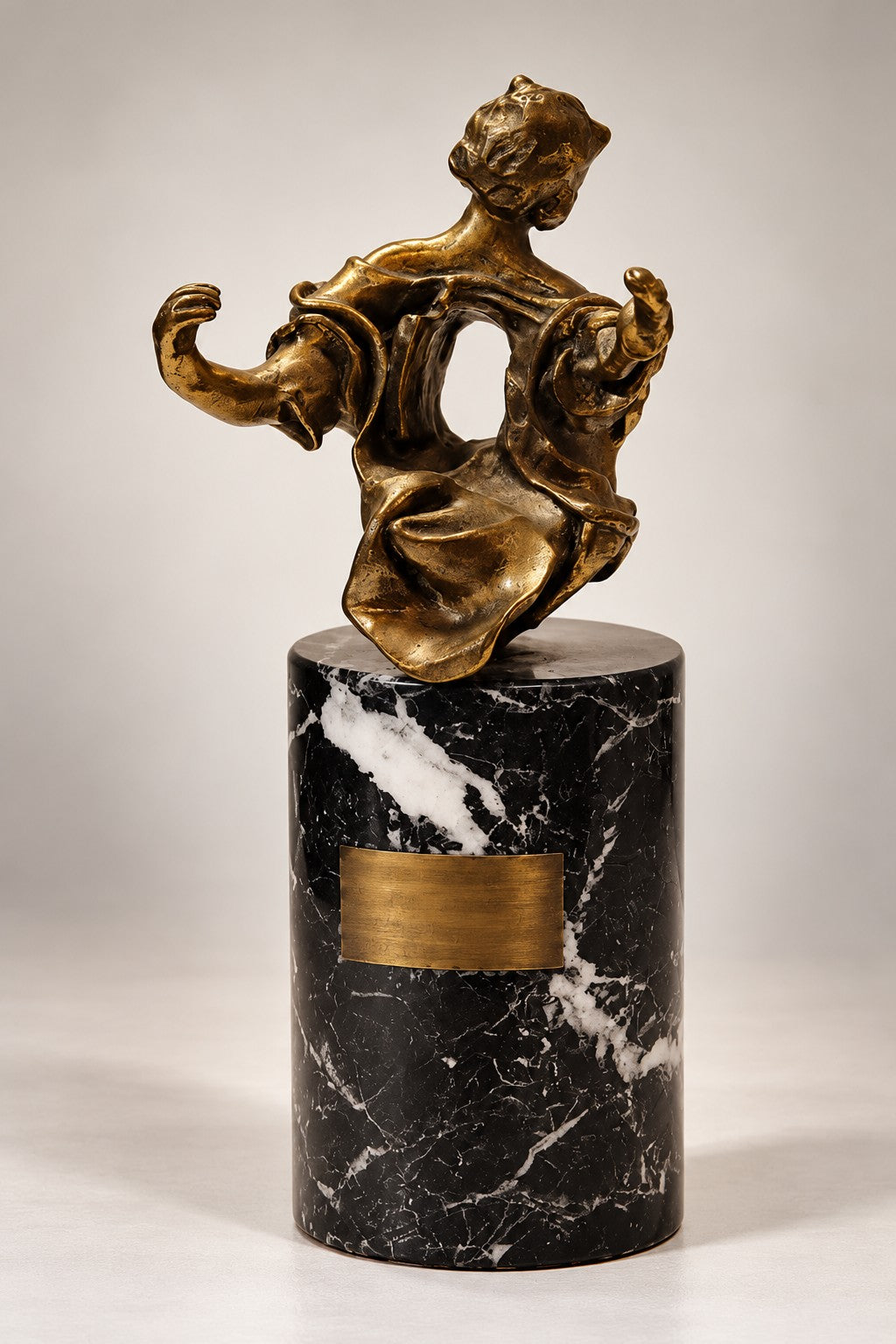
Visions of Paradise
Dalí said the idea for Christ of Saint John of the Cross arrived in a dream. He had been struck by a drawing of the crucifixion by the sixteenth-century friar Saint John of the Cross, and in the dream he saw Christ in the same position, seen from above, over the landscape of Port Lligat. A voice told him to paint it, and he began the next day.
What he painted is quiet. Christ hovers over the bay, serene, without the agony painters usually insist on. Glasgow bought the canvas in 1952, and in 2005 a poll named it Scotland's favorite painting.
Dalí also took on Dante. In the early 1950s the Italian government commissioned him to illustrate the Divine Comedy for the poet's 700th anniversary, then ended the commission after protests over a Spaniard illustrating Italy's national poet. He kept going, painting a hundred watercolors that became prints in the early 1960s.
Our Divine Comedy: The Constellation of Blessed Spirit is a 1964 lithograph from that Dantean world, hand signed and numbered, with a certificate of authenticity.
Divine Comedy: The Constellation of Blessed Spirit, 1964
See it in our collection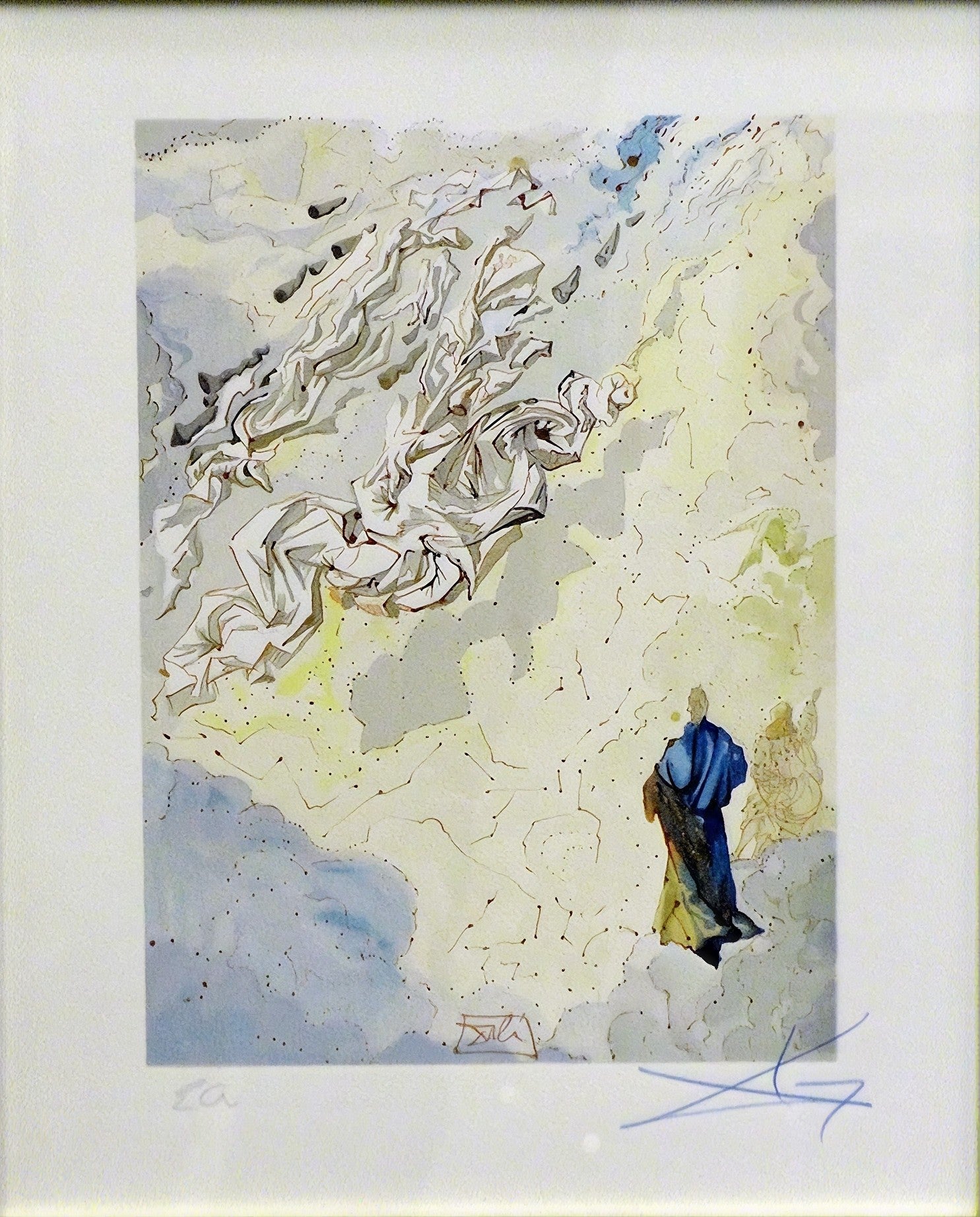
Bringing Dalí's Universe to Life
One Dalí can open a whole way of seeing. His work falls into worlds, and each one has its own door:
- The sacred. Geometry, Gala, Christ above the water, and visions of Paradise.
- Time. Melting watches, as in the lithograph Soft Watches Half Asleep.
- Elephants. Bronze elephants such as Triumphant Elephant and Space Elephant.
- Literature. Etchings and suites titled for Cervantes, Don Quijote, and Hamlet.
Once a world has pulled you in, the details decide the rest. A relief like The Last Supper (Gold) comes from an edition of 65, a marble like Crucifixion (Dark Grey) from an edition of 750, and what sets one example apart from another is the signature, the edition number, and the certificate of authenticity. Premier Pop Art vets and documents every work it offers, so you can ask to see all three.
The bronze Triumphant Elephant, from 1980, carries its publisher’s stamp, and its gold and green patina catches the light the way old gilding does. If a bronze or marble tempts you, start by reading up on collecting, maintaining, and displaying sculpture.
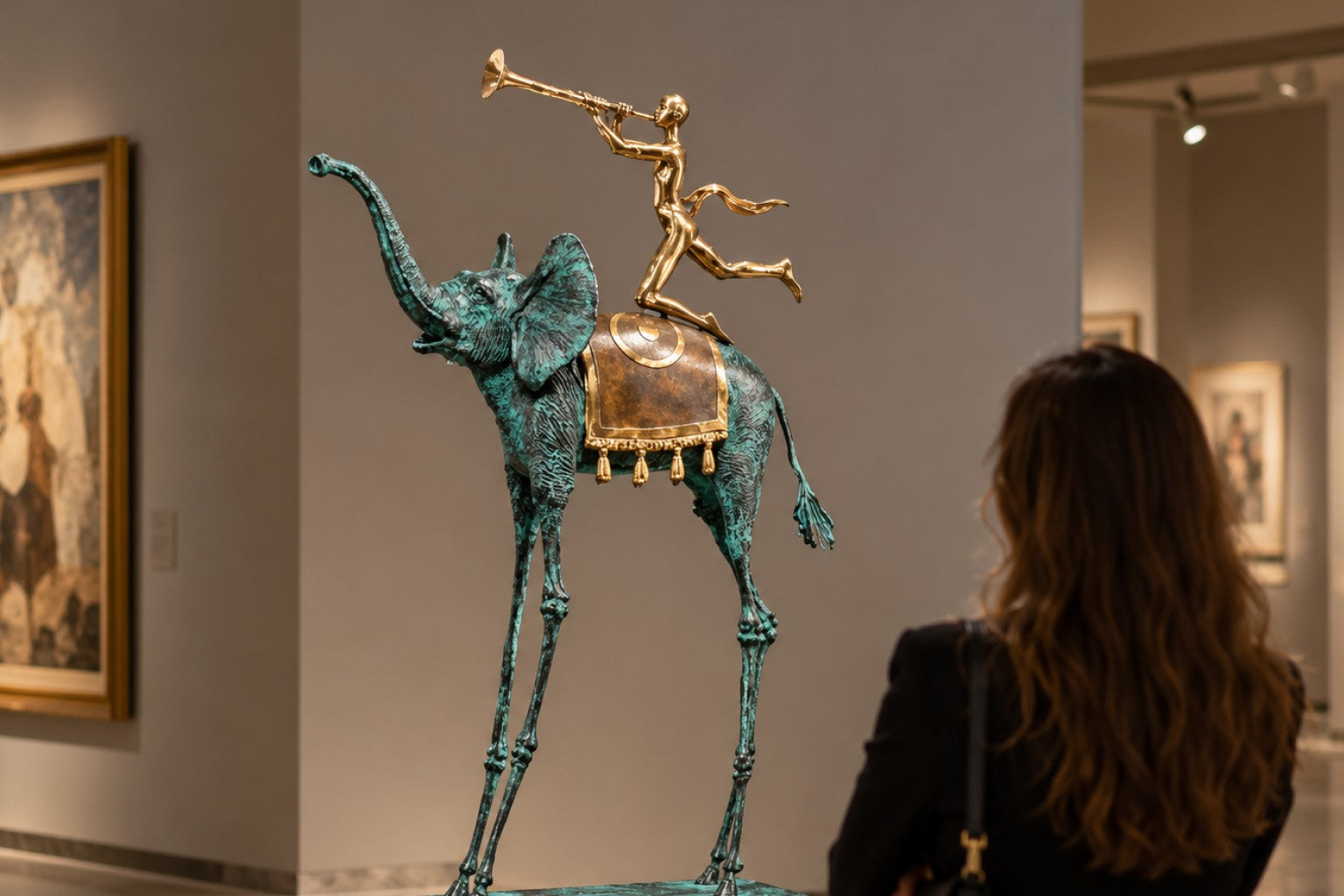
Spend time with the Sacrament of the Last Supper and the rest of Dalí starts to read the same way, through geometry, light, and the bay outside his door, so the works you choose can speak to one another.
Find the Dalí That Speaks to You
If one of these worlds has taken hold of you, that is the place to start your Dalí collection. Premier Pop Art can help you choose a first piece and imagine the ones that might follow, so they work together on your wall. You do not need to know Dalí's catalogue or the vocabulary of editions, because we translate as we go.
Tell us whether the sacred geometry, the melting watches, or the elephants pulled you in, and we will suggest works from our Dalí collection that fit your space and your taste, with every detail laid out in plain terms.
Start the conversation about your Dalí collection
FAQs: The Sacrament of the Last Supper
Where can you see Dalí's painting in person?
The National Gallery of Art in Washington, DC, holds the painting in the Chester Dale Collection, and admission is free. Dalí finished the oil on canvas in 1955, and at nearly nine feet wide it fills your field of vision in a way no reproduction can. Check the museum's website for what is on view before you travel.
What does the dodecahedron mean in Dalí's Last Supper?
The dodecahedron is a twelve-sided solid that encloses the table, and Plato described it as embodying the universe. Dalí built the canvas and the solid's perspective edges on the golden ratio. The painting does not spell out its meaning, but theologian Michael Anthony Novak reads the enclosed space as heaven itself.
Was Salvador Dalí actually religious?
Dalí declared himself Catholic in 1950, though he described himself as a Catholic without faith. He grew up between his mother's devout Catholic family and an atheist father, helped make early films that mocked priests, and turned back toward the Church from the 1940s. In 1949, Pope Pius XII blessed his Madonna of Port Lligat.
What is nuclear mysticism?
Nuclear mysticism is Dalí's name for his 1950s blend of Catholicism and atomic physics. He argued that physics was, for the first time, offering proof that God exists. The idea shaped works such as Crucifixion (Corpus Hypercubus), where Christ floats before a hypercube, tying faith, mathematics, and science into one visual language.
How do you start a Dalí collection?
Start with the world of Dalí that draws you, whether sacred imagery, melting watches, elephants, or literature. Then compare formats such as prints, reliefs, marble, and bronze, and read each piece's signature, edition number, and certificate of authenticity. Premier Pop Art documents every work it offers, and our team can walk you through the options.