


Artist Spotlights
Alexander Calder Lithographs:
A Painter Inside the Sculptor
He set out to be a painter, and the world remembers him for sculptures that move. On paper, the painter kept working.
In June 1922, a young engineer working as a fireman in the boiler room of a passenger ship fell asleep on deck. He woke on calm seas off the coast of Guatemala to a red sun rising on one side and a silver moon still hanging on the other. Alexander Calder never forgot it. Years later he wrote that the sight left him with “a lasting sensation of the solar system,” and soon afterward he decided to become a painter.
The world remembers him for something else, however. Calder gave us the mobile, those wire and metal sculptures that turn in the slightest breeze, and the stabile, its standing cousin, a structure sometimes tall enough to anchor a plaza. But the sun and the moon from that morning kept turning up on paper, too, in lithographs where red discs, spirals, and planets sit on the sheet as if waiting to be hung.
If you have seen one of those prints and wondered what you were looking at, this is for you. By the end you will know what an Alexander Calder lithograph is, where these prints came from, how the painter inside the sculptor shows up on them, and what to check on a real sheet before you bring one home.
A Painter in Disguise
Calder came to art sideways. His grandfather and father were sculptors and his mother a painter, so sculptures and artwork surrounded him from his birth in Lawnton, Pennsylvania. Even so, he trained as a mechanical engineer, graduating from the Stevens Institute of Technology in New Jersey in 1919.
Then came the boiler room, the sunrise off Guatemala, and a decision to paint. He enrolled at the Art Students League in New York, and by 1924 he was drawing sporting events and the circus for a weekly newspaper, the National Police Gazette. In 1926 he moved to Paris, where he began Cirque Calder, a miniature circus of wire and scraps that he performed by hand for friends and critics.
A visit to Piet Mondrian’s studio in 1930 pushed him toward abstraction. Marcel Duchamp named his moving pieces mobiles, and Jean Arp christened the standing ones stabiles. By 1952 he had won the grand prize for sculpture at the Venice Biennale.
But paper never left his life. Aimé Maeght gave him a first show at Galerie Maeght in 1950 and stayed his dealer in Paris until Calder’s death in 1976.
With Maeght and the printers around him, Calder made series of lithographs in the same primary colors and with the same economy of line as the mobiles. In them, the painter he first meant to be got to keep working. Our Alexander Calder collection at Premier Pop Art is devoted to these prints, magazine plates and signed editions alike.
Where the Prints Came From
Most Calder lithographs trace back to one address in Paris. Galerie Maeght published an art magazine, Derrière le Miroir, from 1946 until 1982, and each issue came with original lithographs by gallery artists bound into its pages. For Calder, the magazine served as an exhibition catalogue from 1950 onward, which is why so many of his sheets carry a fold down the middle and a page of French text on the back.
Printing happened in the workshops around the gallery. Mourlot, the Paris press that printed lithographs by influential artists such as Picasso, Chagall, and Joan Miró as well as Calder, handled some of the sheets, and later issues of the magazine came off the presses of Adrien Maeght’s Arte. That shared lineage is one reason a Calder sheet sits comfortably beside a Picasso collection.
Among printmaking techniques, lithography suited him. Each color is drawn on its own stone and printed in its own pass, so the fields stay flat and unblended, much like the painted sheet metal of a mobile.
Outside the magazine, Maeght also published signed, numbered editions and portfolios, and two of the prints we look at next belong to editions of 125 sheets. So an Alexander Calder original lithograph can mean three different things: a page from a magazine, a numbered edition, or a sheet from a portfolio. Knowing which one you are holding is the whole skill, and the next few sheets show what each looks like.
One Red Disc, Two Moods
Calder preferred not to analyze his work, so the best way in is simply to look. Spend a few minutes with several of his lithographs and a small cast of shapes starts to repeat: the disc, the spiral, the pyramid, the animal, and a black line that seems to remember being wire. The disc comes first, and it is Calder’s sun.
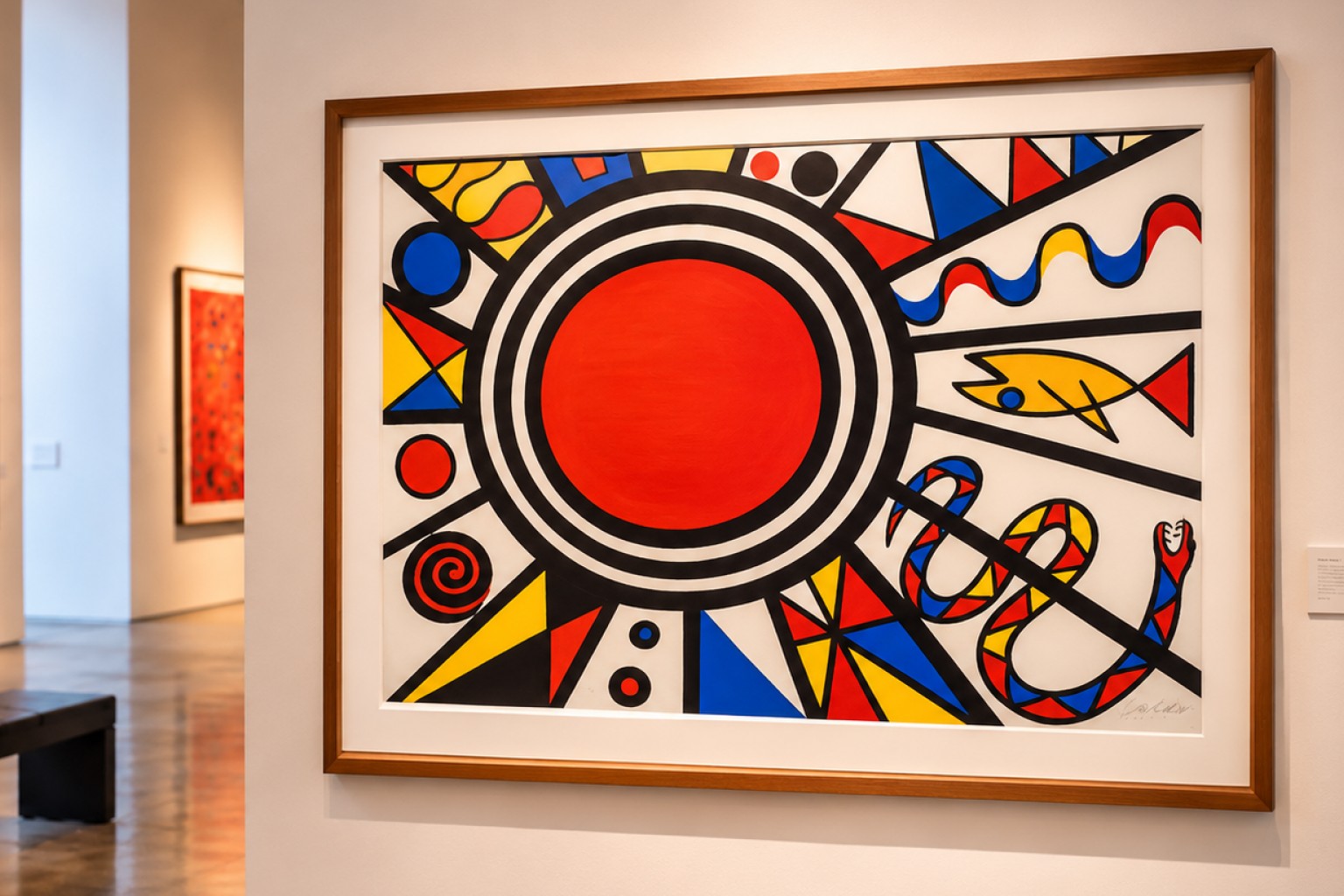
In Environment & Evolution, the sun is solemn. A red circle ringed in black and white fills the middle of the sheet, and black rays split everything around it into wedges of blue, yellow, and red. An orange fish and a snake patterned like a harlequin swim through the wedges, as if the sun had arrived with its own small ecosystem. Look lower left, and you will find a tiny red and black spiral, easy to miss.
Environment & Evolution, 1973
See it in our collection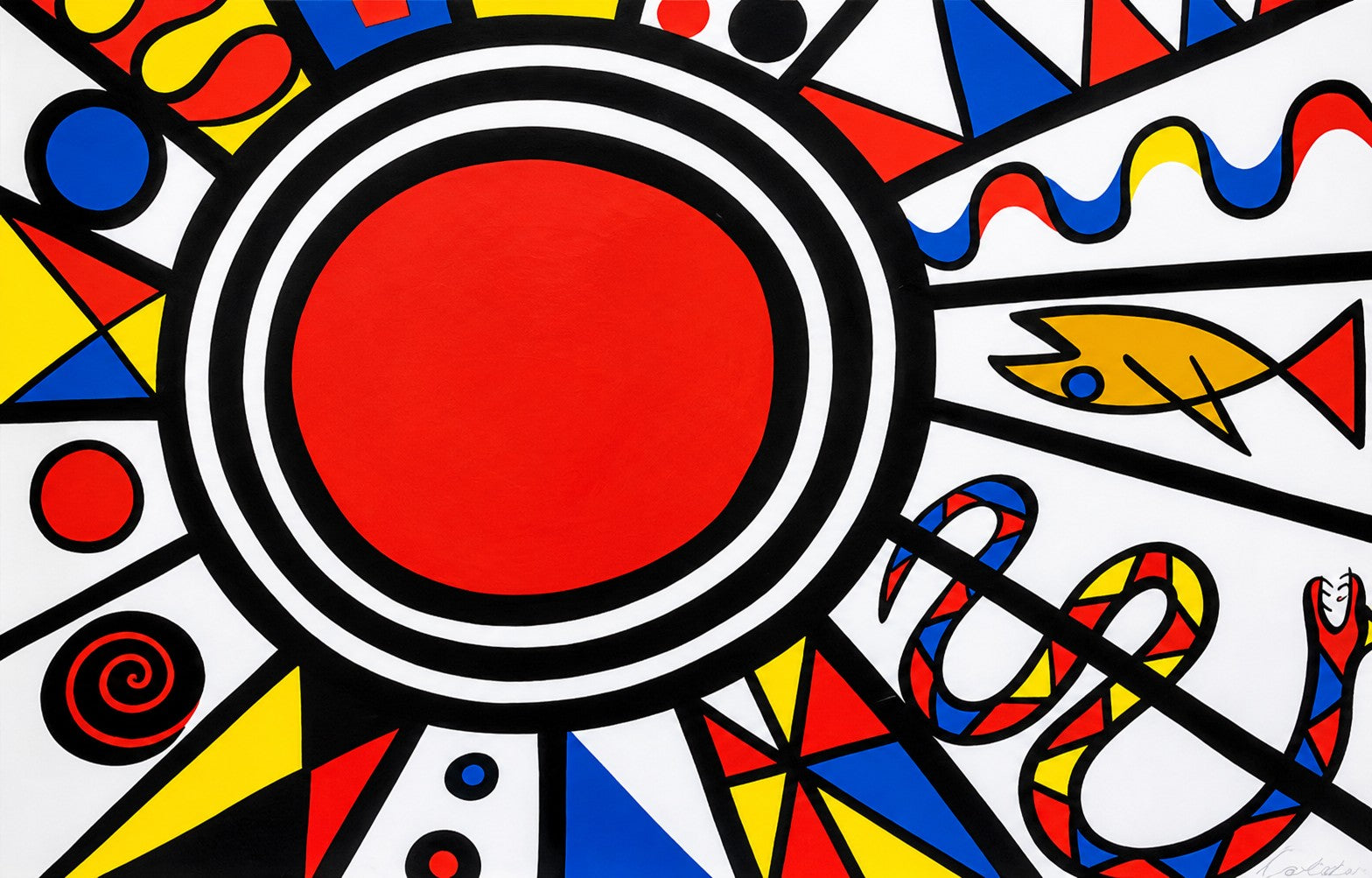
It reads like the sunrise off Guatemala turned into a diagram of the world beneath it.
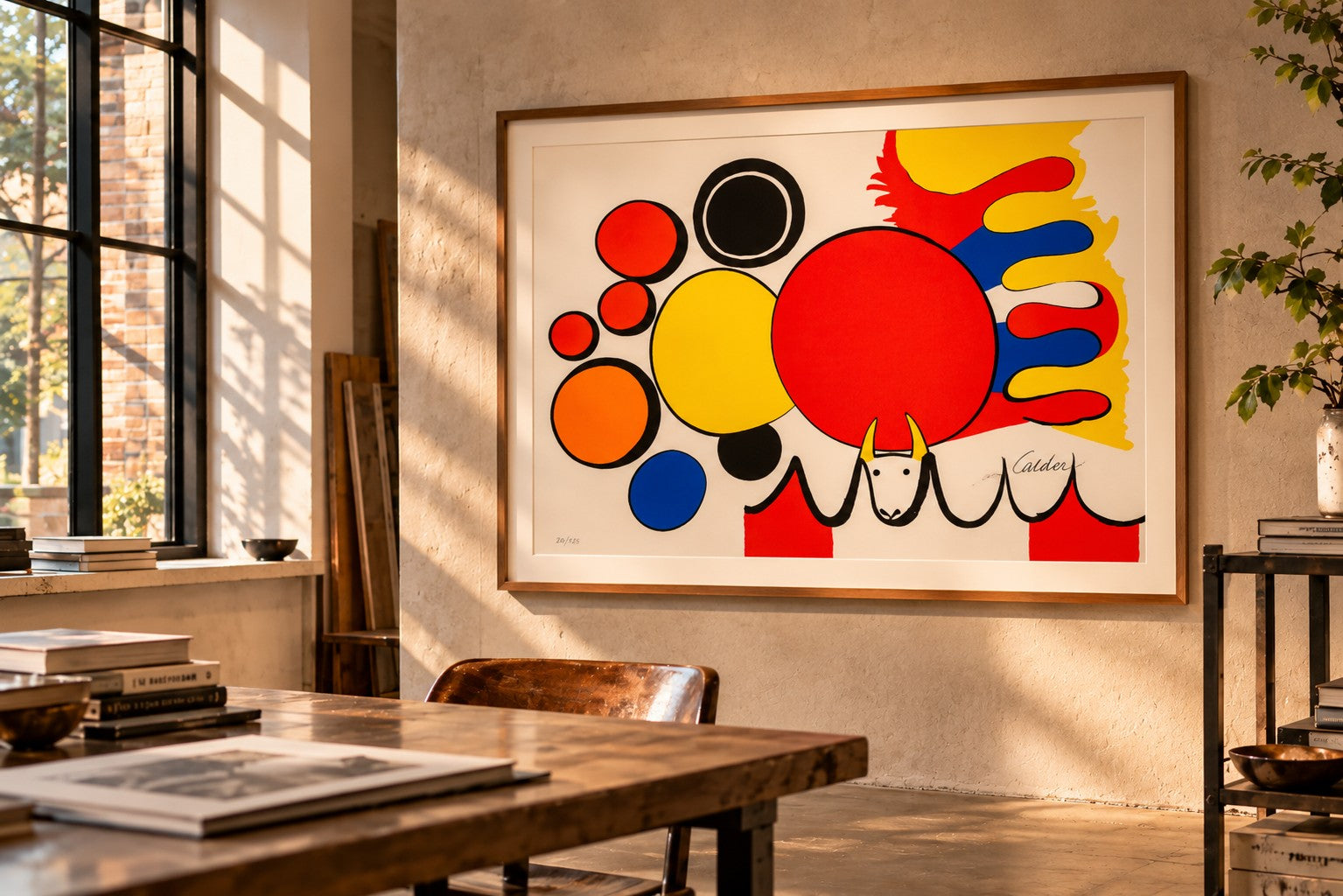
Taureau Avec Spirale Rouge carries the same red disc into lighter territory. A large red circle hangs above a small white bull’s head, its yellow horns just visible beneath it, with a looping black line running below like a row of arches. To the left, circles in red, yellow, orange, blue, and black cluster like planets. To the right, a fan of red, blue, and yellow bands spreads toward the edge of the sheet.
Taureau Avec Spirale Rouge, 1975
See it in our collection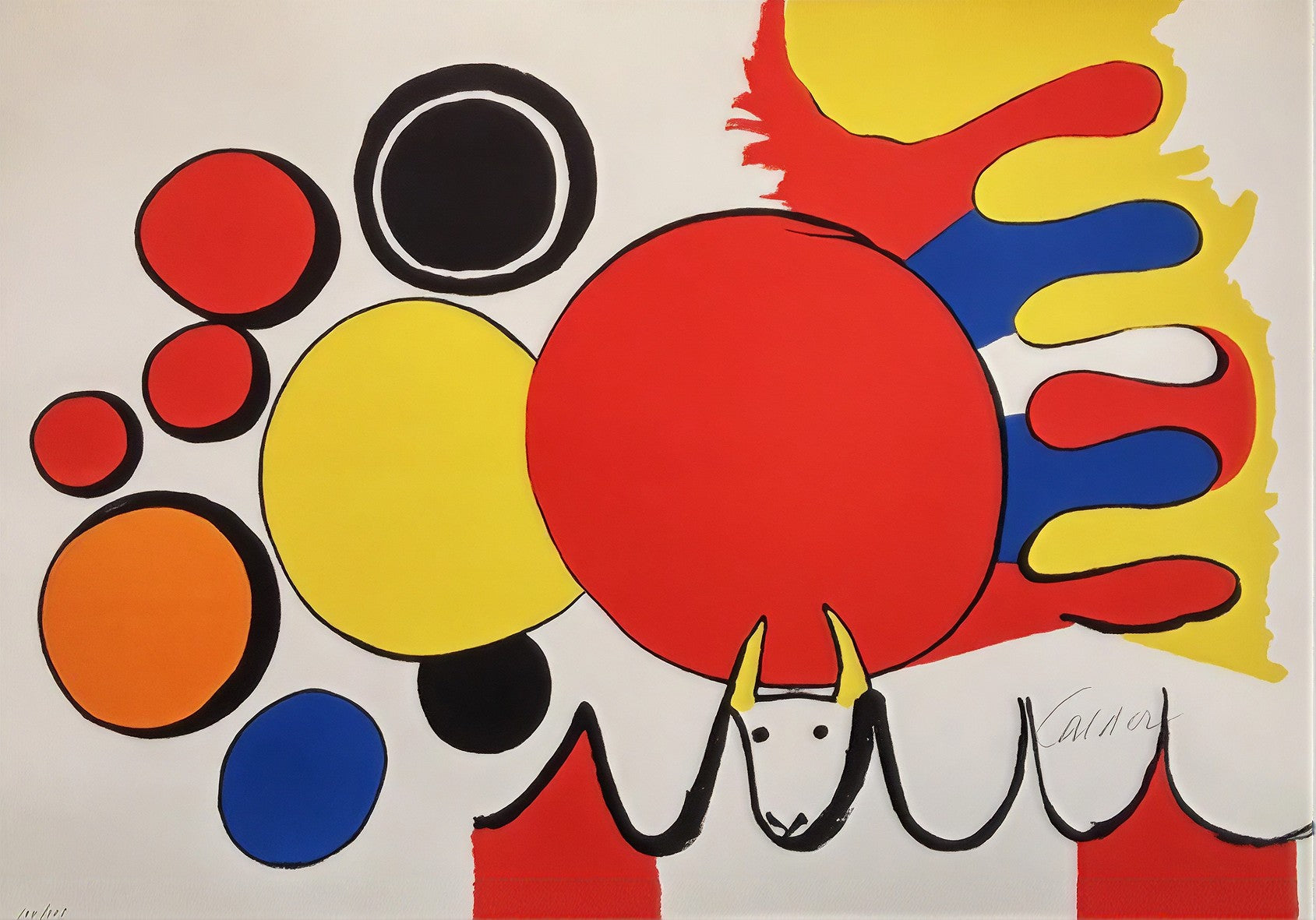
It is a looser, more playful arrangement of the same ingredients, and the little bull tucked beneath it all is hard not to smile at.
Nothing Moves, Everything Turns
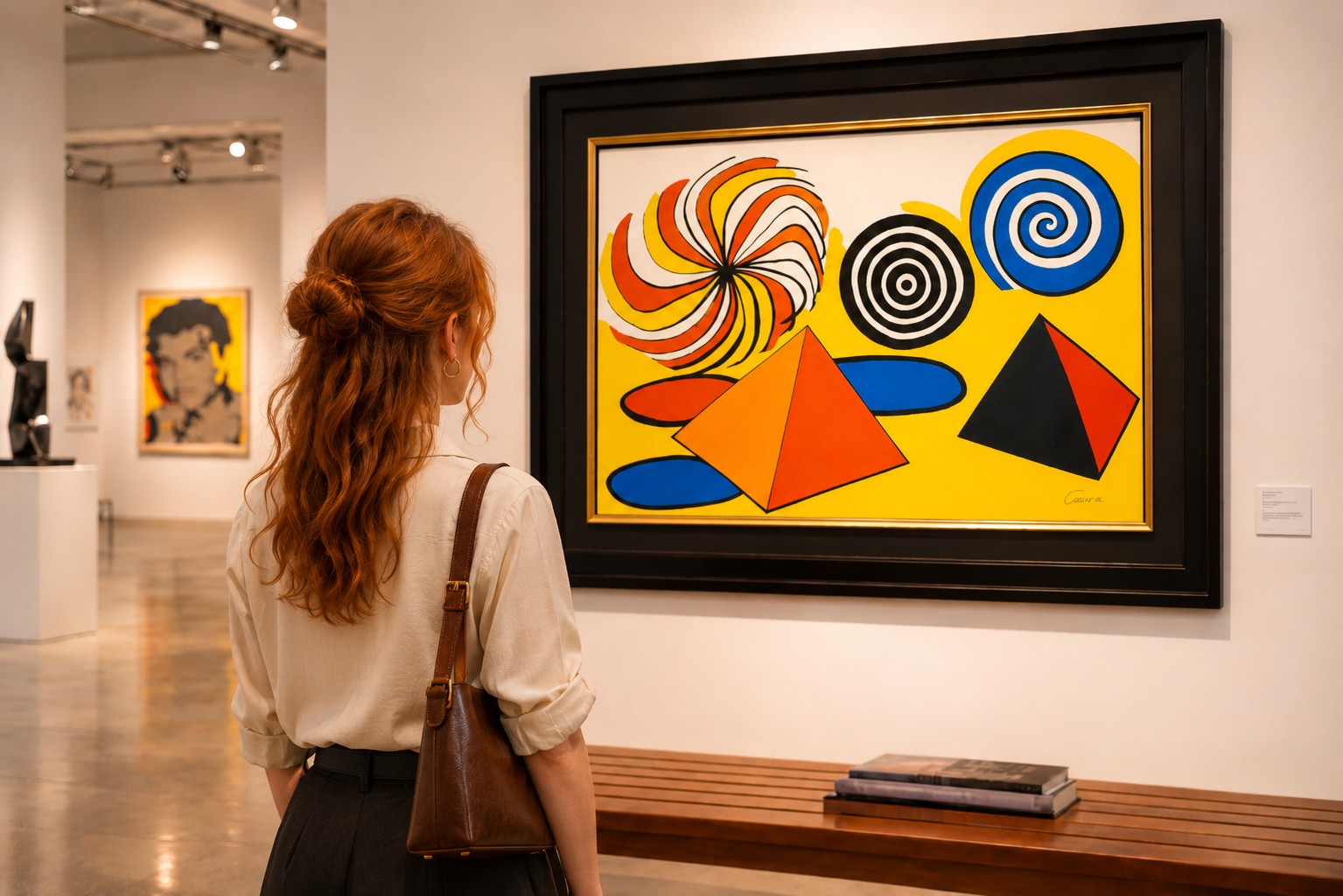
Spirals and pyramids bring in the motion. Pyramids And Spirales De Couleurs sets a red and white pinwheel, a black and white target, and a blue spiral on a flat yellow field. Nothing in it moves, and yet your eye keeps turning from one spiral to the next, the way you watch a mobile that has just been touched.
Pyramids And Spirales De Couleurs, 1974
See it in our collection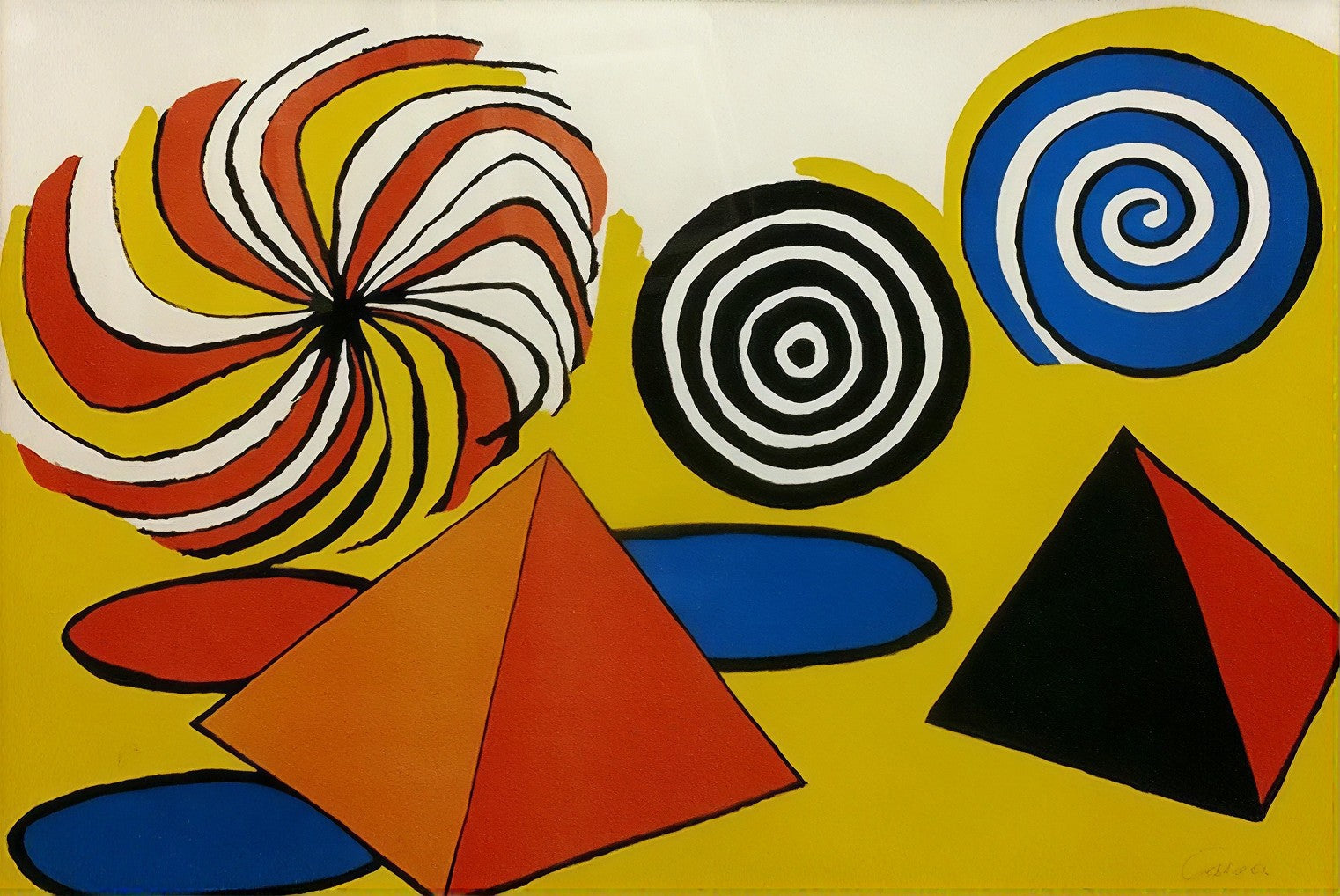
The two pyramids, one orange and one black and red, are the only solid forms on the sheet, and they make the spinning shapes spin harder by contrast. Notice, too, how flat everything is: fields of color with a firm black line between them. Those are the strong colors and geometric forms that built the mobiles and stabiles, now holding still on paper.
The Line That Remembers Wire
Then the line itself. Derriere Le Miroir Circus 4 is one of those magazine plates, and the only one of these four sheets with human figures in it. A row of characters is drawn in single black strokes: a small acrobat with raised arms, men in hats, a tall nude woman with her hair piled high, a bald man, and a horned animal rearing on its hind legs.
Derriere Le Miroir Circus 4, 1966
See it in our collection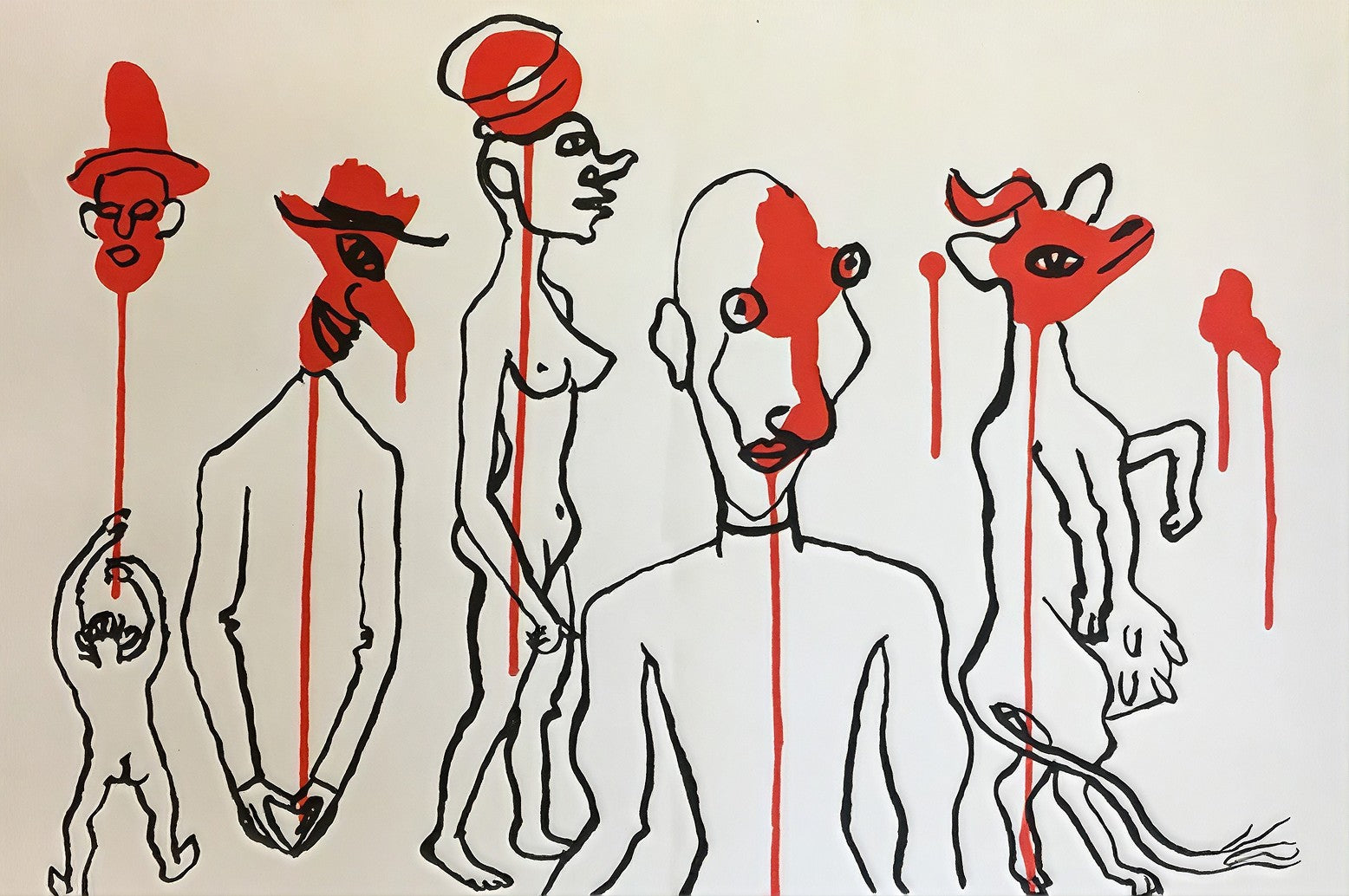
Nothing is shaded. Each figure is an outline, thin and unbroken, the way a figure bent from one length of wire would look if you pressed it flat.
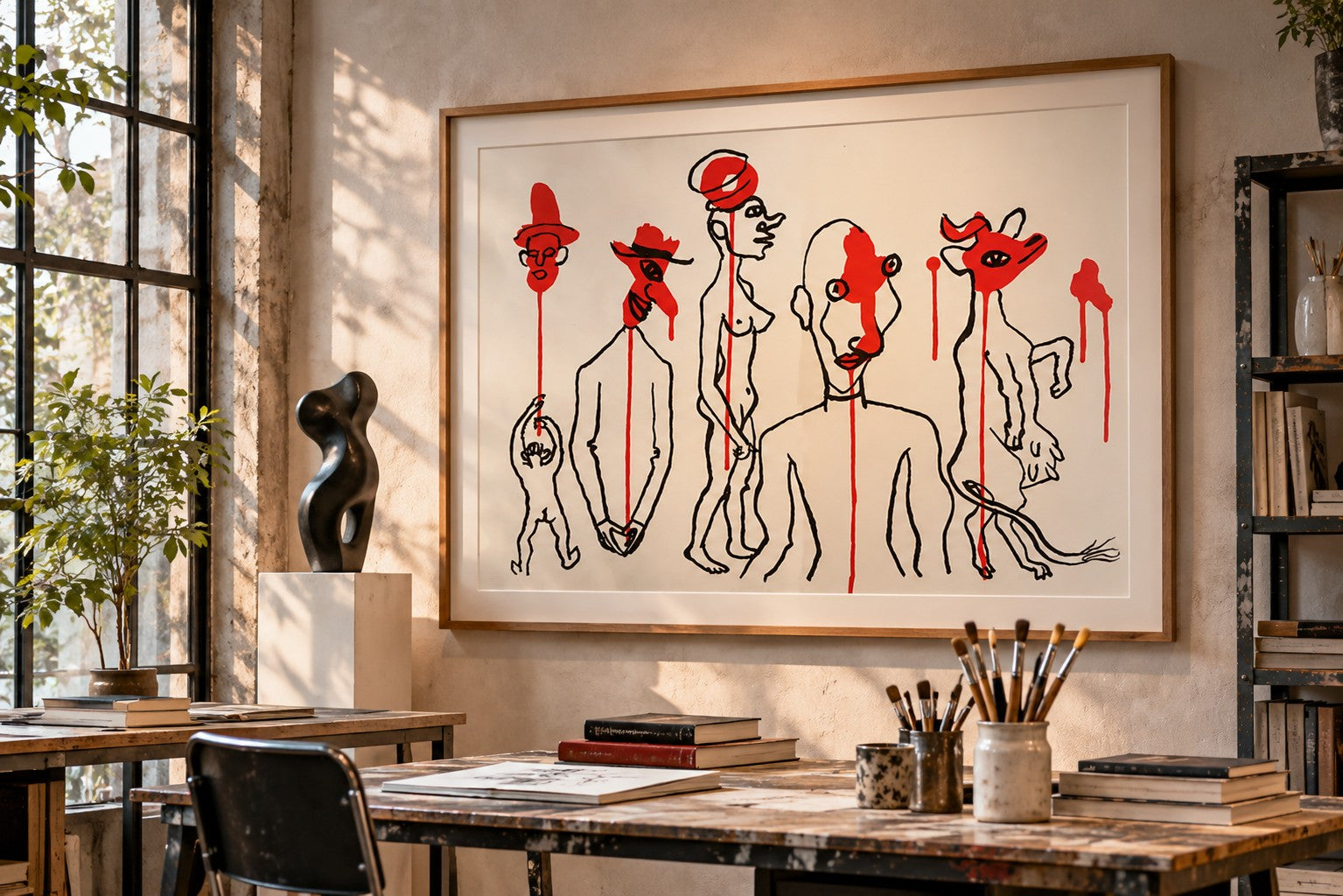
Red marks cap the heads, and from each one a thin red line falls to the bottom of the page, like cords waiting for a mobile to hang from them. The humor is pure Calder: a crowd that looks ready to start a show, held together by nothing but line and a little red. It is the wire of his Paris circus, laid flat on paper.
Disc, spiral, pyramid, and line: in each of these sheets, the sculptor’s vocabulary has been handed to the painter.
Reading an Alexander Calder Lithograph
You now know what Calder drew. Three habits will tell you what you are holding.
- Turn it over. If the verso carries a page of printed text, the sheet very likely came from Derrière le Miroir. A sheet like our Circus 4 shows an excerpt from Calder’s autobiography in French. Magazine plates were typically issued without a hand signature or edition number, so judge them by the fold, the paper, the edges, and the issue number, which you can request from the seller.
- Read the margin. On an editioned print, look for the signature and the numbers. A fraction such as 15/125 tells you which impression you have and how many exist. The letters EA, as on Pyramids And Spirales De Couleurs, stand for épreuve d’artiste, an artist’s proof printed outside the numbered edition.
- Follow the credits. Look for the publisher and printer, whether Maeght, Mourlot, or Arte. They tie a sheet to the workshops that printed Calder, and our Taureau Avec Spirale Rouge is listed as part of a portfolio printed by Maeght and Mourlot in Paris.
A signature alone settles nothing. The Calder Foundation publishes a list of works wrongly attributed to him, lithographs among them, and unauthorized editions and reproductions exist. Compare the size, colors, and credits with a documented impression, and request a certificate of authenticity along with clear photographs of the signature, the back, and the margins. Numbered editions work the same way across artists, and the basics of limited edition prints carry over to Calder.
Choosing Your First Sheet
Start with what you want to look at every day. A magazine plate like Circus 4 brings the line and humor of Calder’s circus at 14 by 22 inches. A large signed edition such as Environment & Evolution, at 26.5 by 38.5 inches, gives a room one big red sun to orbit.
When you choose your first Alexander Calder lithograph, weigh the wall, the light, and the condition of the paper as carefully as the image. Flat primary colors show fading and light stains quickly, so look for a nice impression: even color, clean paper, and no more than a few minor handling creases in the margins.
At Premier Pop Art, we list the size, edition, signature, and documentation we have for every Calder in our collection, and the pages for the prints in this article each include a certificate of authenticity.
Bring a Little Solar System Home
Calder spent his life persuading people that a red disc and a handful of lines could hold a whole sky. A sheet of paper can do the same on your wall, and the right one is easier to find with someone who has handled many.
Tell us what you already love, whether that is Calder, another artist, or only a color you cannot stop thinking about, and we will help you sort the options, read the paperwork, and see what fits the wall you have in mind. Write to us, and we will help you choose a sheet you will want to look at for years.
Write to us about Calder or any artist you love
FAQs: Alexander Calder Lithographs
Are Alexander Calder lithographs original prints?
Many are. Calder made original lithographs with Galerie Maeght and printers such as Mourlot, some in signed, numbered editions and others as plates bound into the magazine Derrière le Miroir. Posters and reproductions after his work also circulate, so compare the credits, size, and paper with a documented impression, and request a certificate of authenticity.
What is Derrière le Miroir?
Derrière le Miroir was the art magazine Galerie Maeght published in Paris from 1946 to 1982. Each issue carried original lithographs by gallery artists bound into its pages, and for Calder it served as an exhibition catalogue from 1950 onward. The sheets usually show a center fold and printed text on the back.
What does EA mean on a print?
EA stands for épreuve d’artiste, French for artist’s proof. These impressions are printed outside the numbered edition and traditionally set aside for the artist, yet they are signed and documented like the others. On a Calder lithograph, you will see EA in the margin in place of an edition fraction such as 15/125.
What do Calder’s lithographs show?
Most are built from the same few shapes as his mobiles: red and yellow discs, spirals, triangles, pyramids, and planets, often set against flat color. Others draw on his circus, with acrobats, animals, and figures in a single black line. The bold primary colors and economy of line make them easy to recognize, even from across a room.
What should come with a Calder lithograph?
Request a certificate of authenticity, the size and medium, the edition or proof marking, and clear photographs of the front, the signature, and the back. For magazine plates, also request the issue they came from. A signature alone does not settle authenticity, because the Calder Foundation lists works wrongly attributed to him, lithographs included.