


Artist Spotlights
Marc Chagall Prints:
Color, Story, and Collecting Details
Chagall’s prints distill color, memory, and movement into vivid scenes. As you consider one, its medium, edition, and history help clarify what you’re collecting.
Marc Chagall prints reward a closer look: their printmaking history is as individual as the image. For you as a collector, the key is knowing what kind of print you are looking at: Chagall made lithographs and etchings, illustrated books and portfolios, and exhibition posters, each with its own production history and collecting context.
The details on a listing matter as much as the image. Medium, edition, signature, condition, and provenance help you understand a specific work and compare it fairly with others. This piece walks through Chagall’s life and printmaking, explains how to read edition information, and shows which details can shape a print’s price. Browse Chagall works in our collection for examples, and check each listing for current details and availability.
What Makes Marc Chagall Prints Distinctive?
Chagall’s prints are distinctive for the way personal memory, storytelling, and color work together. Lovers may float above a village, a musician seems to move between earth and sky, or an animal appears beside a familiar figure. These images are dreamlike, yet their emotional sources are often concrete: home, family, faith, love, displacement, and the stories he carried with him.
Chagall was born in 1887 in Vitebsk, then part of the Russian Empire and now in Belarus, into a Jewish family. Memories of that childhood landscape shaped his paintings and prints throughout his career. He reached Paris in 1911 and became a French citizen in 1937. After leaving occupied France for the United States in 1941, he returned in 1948 and settled in Vence in 1950. Chagall remained an influential figure in modern art and kept working until his death in 1985. His work also extended to ceramics and stained glass, where color remained central.
Vitebsk remained present in his art long after he left. Chagall’s village scenes transform lived memory into something imaginative, where the proportions of a figure or a rooftop follow feeling more than physical perspective. Jewish life, biblical subjects, Russian folklore, and literature all fed his imagery. Love became another enduring thread, expressed through couples suspended in color-filled space.
Chagall’s Printmaking: From Etching to Color Lithography
Already an established painter, Chagall began printmaking in his thirties, working in etching and lithography. His book projects brought literature and scripture into his graphic work; later lithographic suites gave him room to explore color and narrative. Knowing the medium helps you understand a print’s history.
In Berlin in 1922, he began etching illustrations for My Life, his poetic autobiography. Paris art dealer Ambroise Vollard later commissioned him to illustrate Gogol’s Dead Souls, La Fontaine’s Fables, and the Bible. Chagall made 107 etchings for Dead Souls; the Bible project eventually reached 105 prints, mainly etchings.
Lithography let him build color differently. Four Tales from the Arabian Nights, his first major lithographic series, appeared in 1948. Among his 1960s suites was Daphnis et Chloé, published by Tériade in 1961 as a 42-print color sequence shaped partly by the Greek landscape and printed at Atelier Mourlot. Chagall worked closely with master printer Fernand Mourlot, using lithography to create atmosphere and expressive color.
Later projects included Le Cirque, L’Odyssée, and The Fourteen. A complete portfolio, a single print from a suite, and a standalone lithograph are distinct collecting options. Chagall’s suites and illustrated books let him develop stories across sequences of images, a narrative use of printmaking you can compare with Picasso’s prints.
Original Chagall Lithographs, Prints After Chagall, and Reproductions
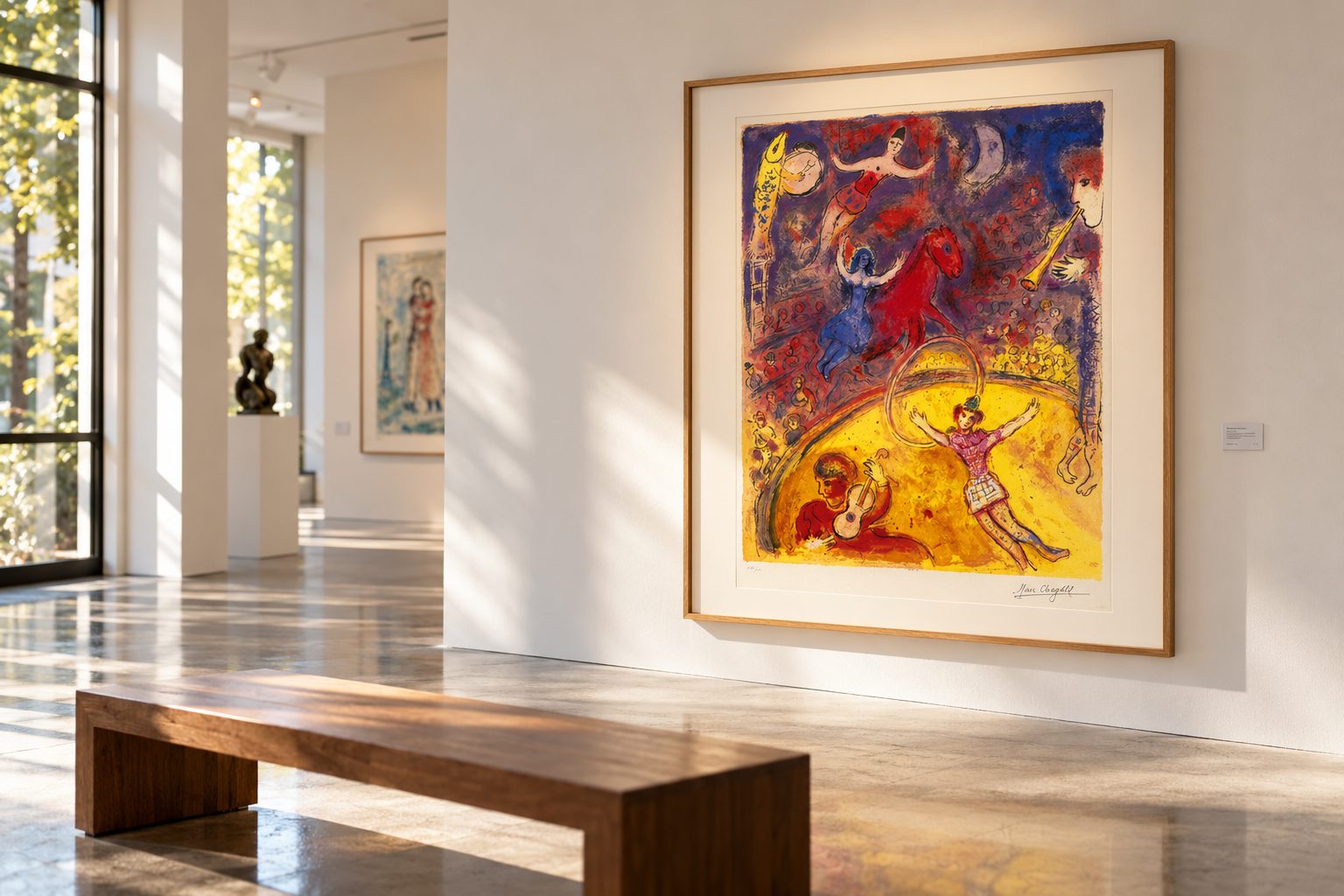
When a Marc Chagall print catches your eye, look past the signature and ask two things: who made the image, and how was it printed? An original print is pulled from a matrix, such as a lithographic stone or plate; a reproduction transfers an existing image through a different process. “After Chagall” usually means the composition is his, while another artist made the print.
You can see that distinction in some editions of Profile with red flowers: Chagall is credited “after,” while Charles Sorlier, the French master printer who often worked with Chagall, is named as the lithographer. Chagall supplied the composition; Sorlier made the color lithograph. That small difference in the credit line tells you more than the artist’s name alone.
Take The Angel of Judgement (Signed) as an example: Sorlier made this 1974 lithographic exhibition poster, and Chagall signed and dated it. Its stated edition is 5,000, and it appears as no. 138 in Sorlier’s Chagall’s Posters. That’s the key distinction: Chagall signed it, but Sorlier made the poster; the condition note and certificate describe this individual impression.
The Angel of Judgement (1974)
See it in our collection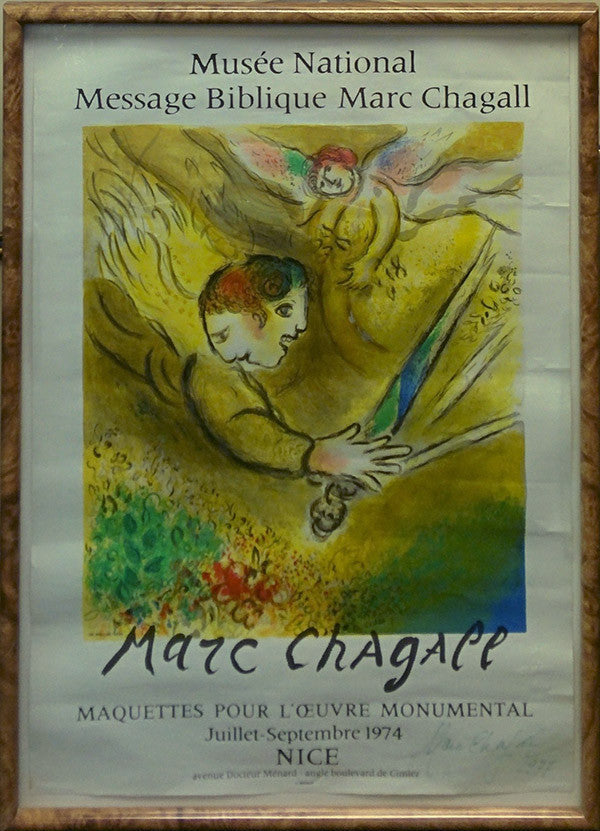
For a work you’re considering, bring those clues together: medium, maker, edition, signature, condition, and any catalogue reference. If the description leaves a gap, request close images of the margins, signature, and labels, and for the documents that support its attribution.
Reading Edition Numbers, Signatures, and Proofs
An edition fraction identifies one impression within a stated edition. In “58/300,” the first number is the impression number and the second is the total edition size. The number does not rank quality. For a Chagall print, read it alongside the medium, signature, date, publisher, printer, and any catalogue reference, since these details describe the specific work more fully.
On Marriage, 64/375 means impression 64 in an edition of 375. It is hand-signed and numbered in pencil; the dimensions, framing, condition, and certificate add context about this particular sheet. The fraction tells you where the impression sits in the edition, while the condition report and supporting documents address its state and history.
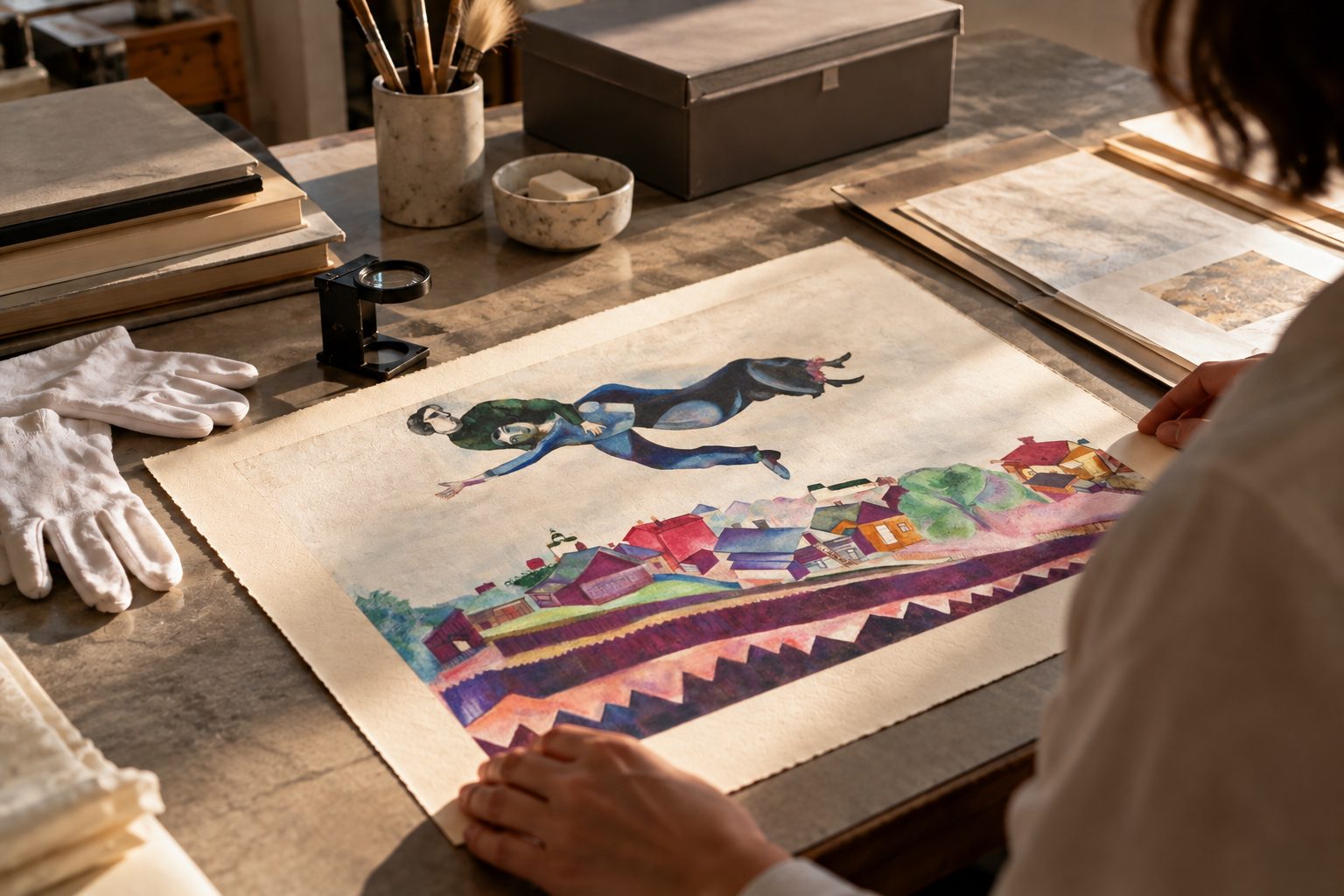
Proof marks need their own context. An artist’s proof is a proof impression, but the label alone doesn’t make it more important or valuable. With Daphnis et Chloé, the deluxe edition of 60 had a signature on every lithograph; a standard edition of 250 was also issued. Before drawing conclusions from a proof mark or signature, check how that particular image was issued.
Condition and Provenance: Details to Examine
Two Chagall sheets of the same image can feel quite different in person. One may have bright color and clean margins; another may show fading, foxing, repairs, or a trimmed edge. That’s why condition and provenance belong beside the image when you compare prints. A useful description covers the title, medium, date, sheet dimensions, edition, signature, printer, publisher, catalogue reference, and ownership history, and separates confirmed facts from anything still unknown.
Color is especially worth seeing clearly. Sunlight can fade some lithographic pigments or shift their tone, so a print may look different from an online photo. Foxing, creases, tears, discoloration, restoration, and old repairs matter too. Full-sheet photographs, close views of the margins, and clear images of signatures, inscriptions, and labels make those details easier to evaluate.
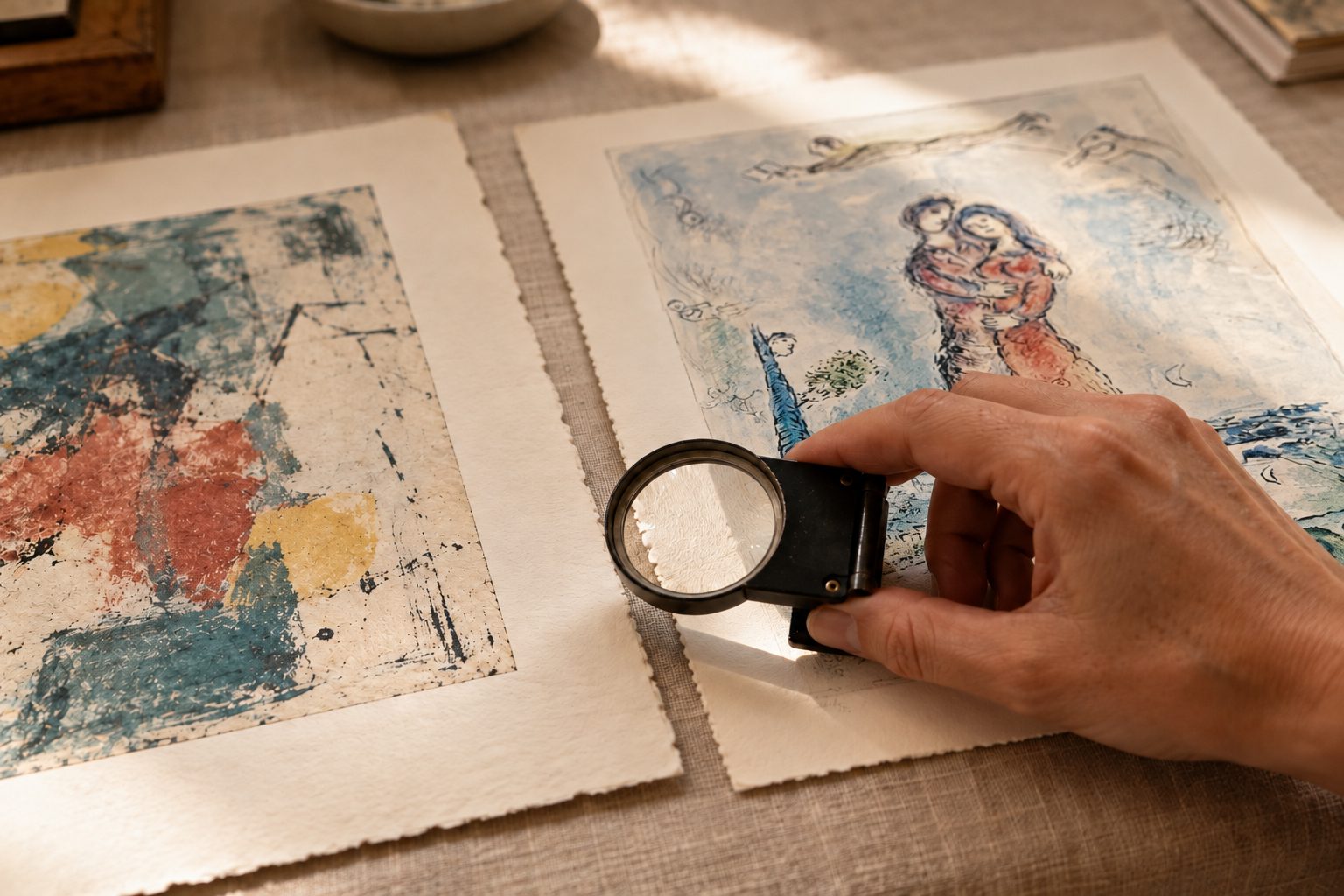
Documentation can fill in a work’s history, but it isn’t a magic stamp. A certificate of authenticity is useful only if you know who issued it and which specific impression it covers. For deeper research, the official Chagall catalogue raisonné was compiled with the Comité Marc Chagall and the Marc and Ida Chagall Archive; its entries draw on archival material, including correspondence, administrative documents, and photographs. A catalogue reference can help identify a work, while provenance traces its ownership. Neither should be assumed from a signature alone.
Framing can hide the clues you most need: sheet edges, inscriptions, and labels. Before deciding, get full views of the print and its margins, along with any documents tied to that impression. Keep those written details with your purchase records. The same careful reading applies to limited-edition prints: the edition number, signature, condition, and provenance each tell a different part of the story.
What Affects the Price of Marc Chagall Prints?
Part of the challenge in pricing Chagall prints is that “print” covers a surprisingly wide field: original lithographs, prints made after his designs, book illustrations, exhibition posters, individual sheets, and complete suites. These works aren’t interchangeable, and a Chagall signature alone doesn’t settle who made the print or how it was produced.
Price reflects both the image and the particular impression. Medium, edition and publisher, maker, signature, condition, provenance, and collector demand all play a part. Our Bella listing shows the kind of details that help you understand a specific work: edition, hand signature, condition, and certificate. None of them, on its own, sets the price.
Bella
See it in our collection
Published prices need context, too. A dealer’s asking price is an offer; an auction result records one completed sale at a particular moment. The most useful comparisons are works with a similar image, medium, edition, condition, and provenance. When those details don’t line up, treat prices as reference points, not a valuation.
Choosing a Chagall Print for Your Collection
Choose an image you want to spend time with, then check the facts that help you understand that work. You might be drawn to a romantic scene, a biblical subject, or the color and movement of a lithograph. Once an image catches your attention, look at its medium, edition, condition, provenance, and documentation before deciding whether it fits your collection.
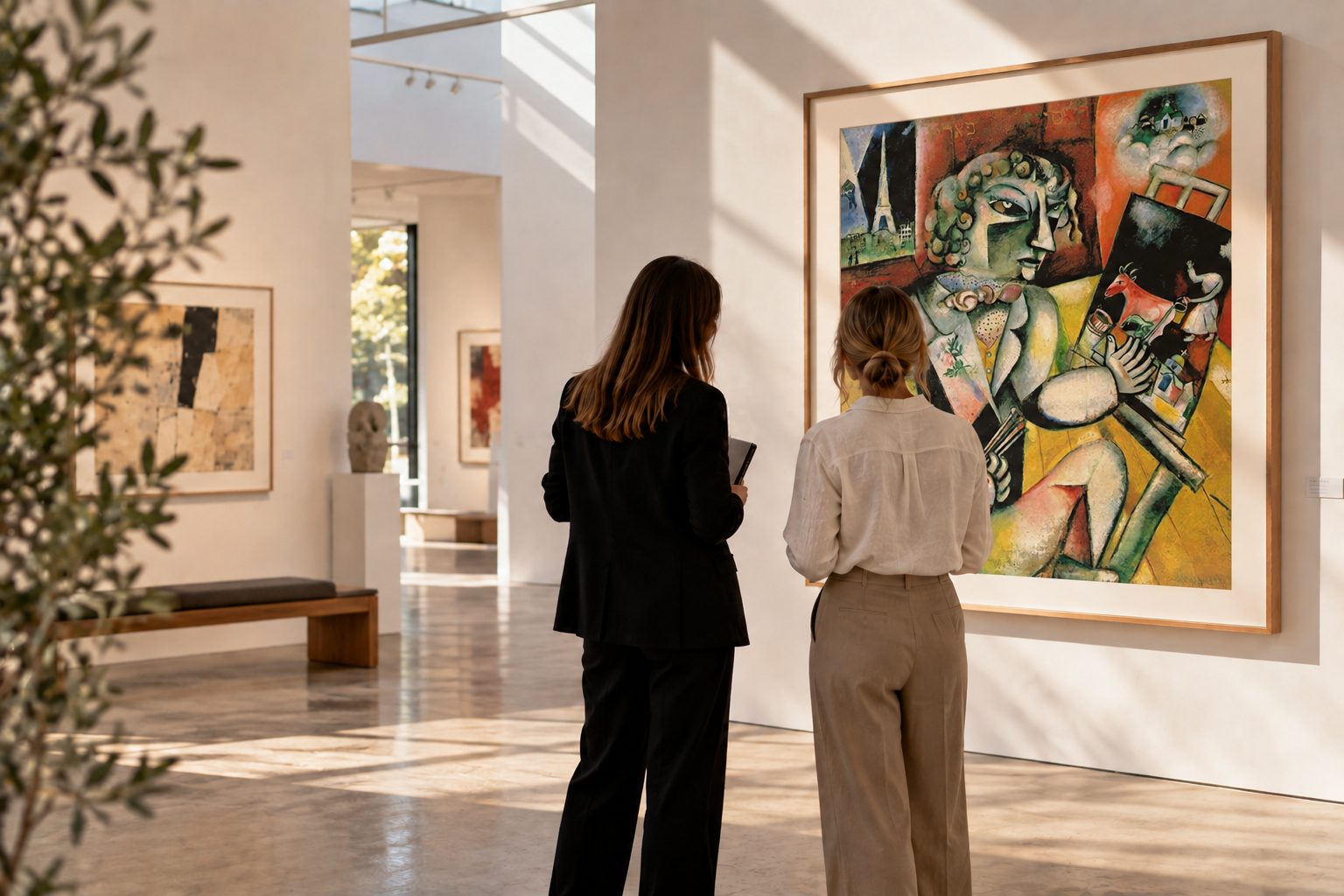
Set a budget for the complete purchase, including framing, shipping, and any conservation needs. Compare a few works in the same category, and ask questions where the listing leaves something unclear. If you are considering a portfolio, check whether the set is complete and whether its publication details match the description. For a single print, confirm the sheet size as well as the image size so you know what will fit your wall.
You do not need to become a printmaking specialist before you begin. A careful look at the image, a clear record of the edition, and answers to your questions will give you a sound basis for choosing a Chagall print you will be glad to live with.
Talk with Us About a Chagall Print
You don’t need to have the terminology sorted out before reaching out. Maybe one particular image has stayed with you; maybe you’re still working out whether a Chagall print is the right place to begin. We can help you look beyond the signature to the details that matter in that individual work, so you can feel confident about what you’re considering.
If you’re starting a collection, we can help you find a first print that speaks to you and suits your space and budget. If you already collect Chagall, we can help you think through what might complement the works you love. Browse the Chagall collection, then tell us what caught your eye or where you’re unsure. We’ll take it from there.
FAQs: Marc Chagall Prints
Are all Marc Chagall prints lithographs?
No. Chagall made prints using several techniques, including lithography and etching. His early illustrated books, such as My Life and Dead Souls, used etching, while Daphnis et Chloé is a major color lithography suite. Check the medium listed for the specific work you are considering, since an artist’s name alone does not identify the process.
Are Chagall lithographs published in suites?
Many were issued as part of suites, including Daphnis et Chloé, the 42-print color lithograph suite published in 1961. You may encounter a complete portfolio or a single print from a suite. Check the listing’s description and publication details to confirm what is included and whether the set is complete.
How do I read edition information on a Chagall print?
An edition fraction gives the number of the individual impression and the total number in that edition. The first number identifies the impression; the second gives the edition size. It does not rank quality. Read the notation alongside the medium, signature, date, printer, publisher, and catalog reference, since details vary by work.
Does a hand-signed Chagall print come with guaranteed authenticity?
A hand signature is one detail to investigate, not a guarantee on its own. Compare it with the work’s edition history and catalog references, review the paper and printing details, and ask what provenance or certificate supports the description. For important or uncertain works, consult a qualified specialist familiar with Chagall prints and their cataloging.
Can Chagall prints fade over time?
Yes. Some Chagall lithographs have shown pigment fading or color changes after exposure to sunlight, so inspect the condition closely. Compare the color across the sheet and ask about its display history or any restoration. Also check for foxing, discoloration, creases, tears, trimmed margins, and repairs.